Prompt Version Control with Git: How to Test, Ship, and Roll Back Prompts
Editorial cover with the headline Prompt Version Control with Git on an off-white background

Prompt version control means storing every prompt as a file in Git, together with the model and settings it runs with, testing each change against a fixed set of examples, and keeping a history you can roll back to. If you have ever dug through a “Prompts_Final_v3_OLD.docx” trying to work out why the AI behaved … Read more


The ‘Step-Back Prompting’ Abstraction Technique: Mastering Complex Problem Solving with AI

The 'Step-Back Prompting' Abstraction Technique Mastering Complex Problem Solving with AI - Image avicenafilyakako.com

Have you ever found yourself staring at a complex prompt, watching your AI model hallucinate or provide a surface-level answer that misses the mark? It’s a common frustration. To get better results, sometimes we need to stop pushing forward and instead take a collective breath. This is where Step-Back Prompting comes into play. Developed by … Read more

Stop Getting Vague AI Answers: Build a Self-Querying Prompt System Today

Stop Getting Vague AI Answers Build a Self-Querying Prompt System Today - Image avicenafilyakako.com

Have you ever asked an AI a question, only to receive a response so vague it felt like reading a generic horoscope? Usually, the culprit isn’t the AI’s lack of intelligence—it’s a lack of context. As a Senior SEO Content Writer, I’ve seen how precision in prompting separates professional-grade outputs from digital noise. To fix … Read more

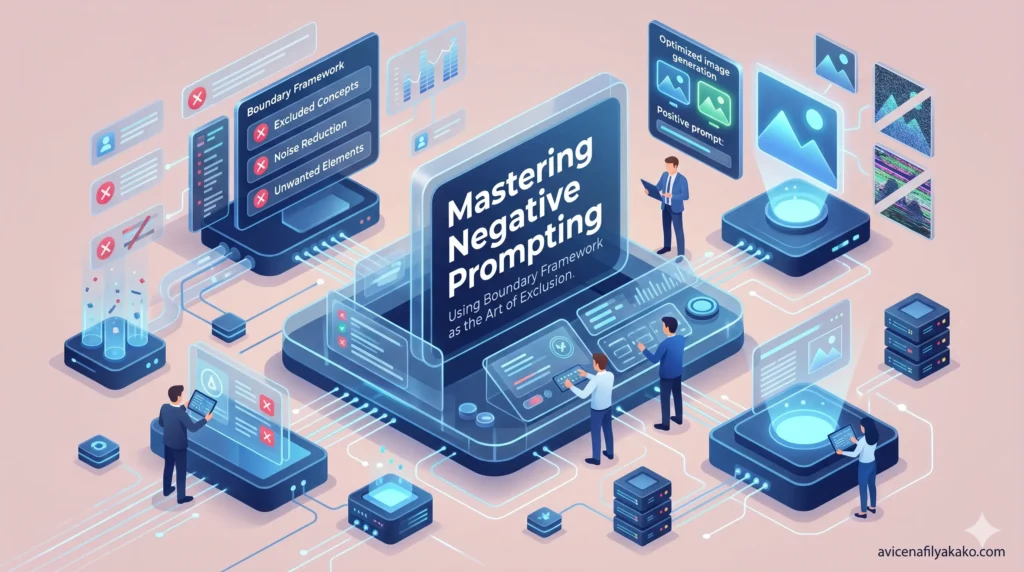
Mastering Negative Prompting: Using Boundary Framework as the Art of Exclusion

Mastering Negative Prompting Using Boundary Framework as the Art of Exclusion - Image avicenafilyakako.com

When you prompt an AI, you usually focus on what you want to see. You ask for “a sunset,” “a professional tone,” or “a Python script.” But as AI models become more sophisticated in 2026, the secret to precision isn’t just in the request—it’s in the exclusion. I like to think of prompting like sculpting. … Read more

Persona-Driven Logic in Prompting: Redefining LLM Intelligence

A 3D isometric visualization of an LLM core being shaped by various professional persona-driven profiles to enhance specialized intelligence.

If you have ever asked an AI to “act as a world-class lawyer” or “write like a weary detective,” you have dabbled in the basics of persona engineering. But beneath the surface of these simple requests lies a sophisticated mechanism called persona-driven logic. By assigning a specific identity to a Large Language Model (LLM), you … Read more

Recursive Prompting for Code Optimization

A glowing blue data crystal being processed by multiple AI workstations, symbolizing the high-level optimization achieved through Recursive Prompting.

Efficient coding is rarely about the first draft; it is about the relentless pursuit of refinement. If you have ever asked an AI to “fix my code” and received a mediocre result, you likely hit a wall in prompt engineering. To bridge the gap between “working code” and “high-performance code,” you need to leverage Recursive … Read more

Scaling Content: Using Few-Shot Learning for Accurate Technical Synopses

An infographic showing multiple data nodes connecting to a central processor, illustrating how Few-Shot Learning scales technical synopses.

Generating a technical synopsis can often feel like trying to condense a thousand-page manual into a single, punchy paragraph without losing the vital “why” and “how.” If you’ve ever asked an AI to summarize a complex white paper only to receive a generic, fluffy response, you know the struggle. This is where Few-Shot Learning becomes … Read more

Chain of Verification Prompting (CoVe): How to Make AI Fact-Check Itself

Editorial cover reading Chain of Verification Prompting, dark green background with a thin gold line

Chain of verification prompting (CoVe) is a four-step technique that makes a large language model fact-check its own draft: it writes an answer, plans verification questions about each factual claim, answers those questions independently, and then rewrites the answer using only what held up. The method comes from a 2023 Meta AI research paper, where … Read more

Prompt Engineering Taxonomy: A Practical Map of Context, Reasoning, Constraints, and Meta-Prompting

Editorial cover with the headline Prompt Engineering Taxonomy on a dark green background

A prompt engineering taxonomy sorts prompting techniques by the job they do: setting context, shaping reasoning, constraining the output, and improving the prompt itself. I use the label Deliberate Prompting for working this way: every line in a prompt has a purpose, and you can say which layer it belongs to. Researchers have catalogued 58 … Read more