
If you have ever asked an AI to “act as a world-class lawyer” or “write like a weary detective,” you have used persona prompting: giving a large language model (LLM) a role before giving it a task. Persona prompting reliably changes how a model writes, including its tone, vocabulary, focus, and format. Controlled studies show it does not make answers more factually accurate.
That distinction matters. A persona is a framing tool, not a knowledge upgrade. Used well, it saves you from re-explaining audience, register, and priorities in every prompt. Used as a shortcut to expertise, it adds confidence to the tone without adding correctness to the content. This guide covers both sides, and how to write a persona that earns its place.
Why Persona Prompting Changes the Output
A role works as compressed context. When you write “You are a senior employment lawyer explaining this to a startup founder,” you imply an audience, a vocabulary, a level of caution, and what to put first. The model picks up those cues and shapes its answer around them, which is why persona prompts often read as more specialised even when the facts are identical.
Think of it like casting an actor. A good actor changes how a character speaks and reacts, but playing a surgeon does not teach them surgery. In this guide, I use the term cognitive profiling for structured role design: defining who the model is writing as, for whom, and under which constraints. It is a working label, not an established technical term.
What the research says: In a study of 162 personas across four model families and 2,410 factual questions, adding a persona to the system prompt did not improve accuracy compared with no persona, and the effect of any single persona was largely random (Zheng et al.). A December 2025 Wharton Generative AI Labs report tested expert personas on two graduate-level benchmarks across six models and found no reliable accuracy gain, while low-knowledge personas such as “toddler” sometimes made answers worse.
The Mechanics of Persona Engineering
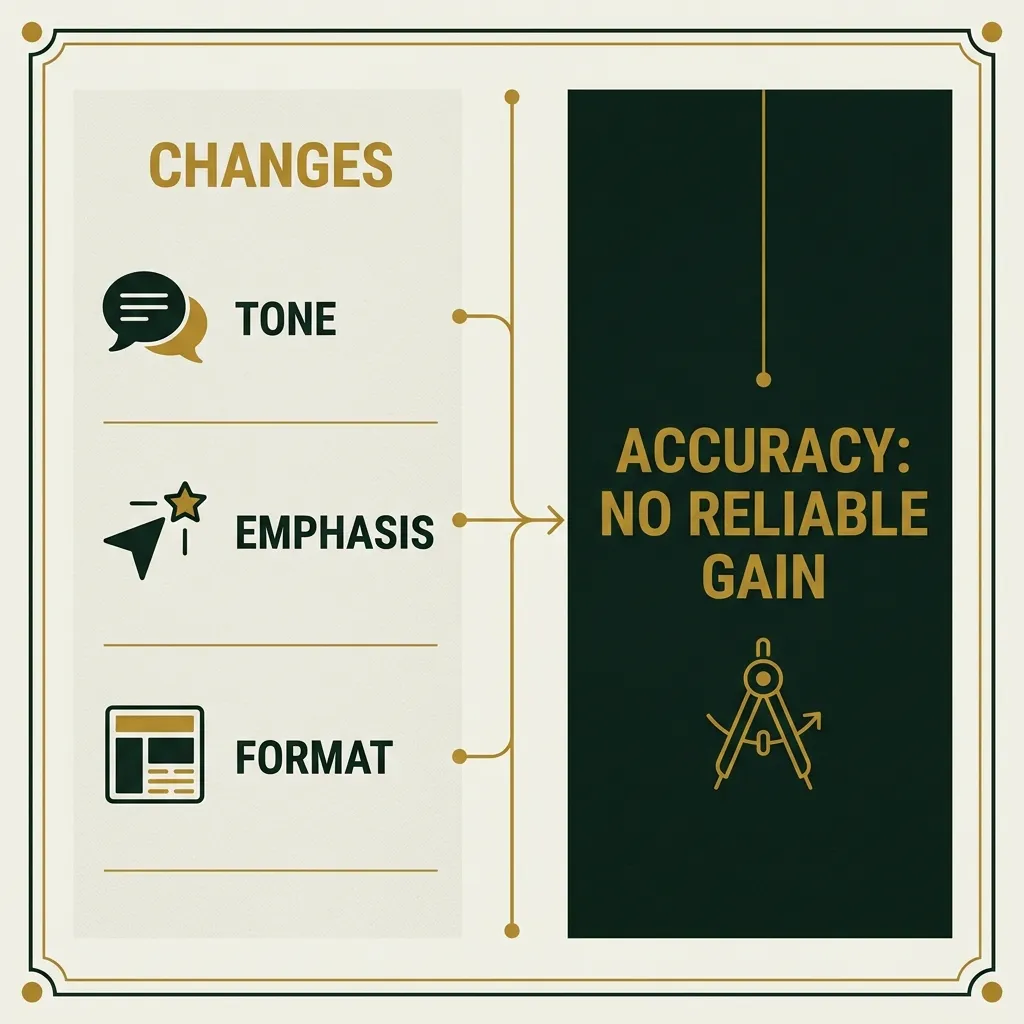
A persona has three levers, and each one changes something different. Saying “be a teacher” pulls only the first. Specifying who the teacher is speaking to and what they must achieve pulls all three.
To achieve this level of precision, many practitioners combine persona roles with a structured taxonomy for deliberate prompting to categorize and refine complex instructions.
1. Tone Modulation
This determines the “vibe” of the response. A persona-driven prompt for a startup founder will sound urgent and visionary, while a prompt for a lab scientist will be precise and clinical. Modulating the tone ensures the AI speaks the language of your industry.
2. Constraints and Reasoning Paths
Every professional operates under constraints. A judge follows the law; a marketer follows consumer psychology. Writing those constraints into the persona, such as “cite the statute for every claim” or “flag anything you are unsure of,” steers the structure of the answer and keeps it on topic. It does not stop hallucination: a persona told to cite sources can still invent them, so verify claims separately.
3. Domain Focus
A role shifts which parts of a topic the model brings forward. A “cybersecurity expert” persona will lead with encryption and threat models rather than general IT tips. That is a change in emphasis, not access to knowledge the model did not already have, which is why the studies above show no accuracy gain.
Generic vs. Persona Prompts: What Actually Differs
| Feature | Generic prompt | Persona prompt |
|---|---|---|
| What it changes | Nothing beyond the task itself | Tone, vocabulary, emphasis, format |
| Factual accuracy | Baseline | No reliable gain in controlled studies |
| Best for | Quick lookups and simple tasks | Audience-specific writing and a consistent voice |
Steps to Implement Cognitive Profiling in Your Prompts
A useful persona prompt takes more than a job title. Follow these five steps:
- Define the Identity: State the role and niche, and name the audience it is speaking to. “Years of experience” adds little on its own.
- Set the Objective: What is the specific problem this persona is trying to solve?
- Establish Tone and Style: Use adjectives like “candid,” “analytical,” or “empathetic” to guide tone modulation.
- Provide the Methodology: Tell the AI how to think (e.g., “Use first-principles thinking” or “Apply the Pareto Principle”).
- Test It Against a Baseline: Run the same task with and without the persona on a few real examples. Keep the persona only if it improves the output you actually care about.
To further sharpen the persona’s output, consider integrating few-shot learning examples to provide the model with specific patterns of the desired reasoning style.
Moving Beyond Simple Roleplay
A persona becomes more useful when you pair it with a process. Chain-of-thought prompting, introduced by Wei et al. in 2022, asks the model to work through intermediate steps before answering. For instance, you might ask a “financial analyst” persona to list the risks of an investment before giving a view. Many current models already reason internally, so explicit step-by-step instructions matter most where that reasoning is not built in.
Laying out the reasoning makes the answer easier to check, and that is the real benefit: you can spot a weak step instead of trusting a confident conclusion. To push that further, have the model check its own claims with chain-of-verification prompting.
The Ethics of Persona-Driven AI
As we refine persona-driven interactions, we must remain aware of biases. A persona is a reflection of the data it was trained on. If you ask for a “traditional CEO,” the AI might lean into outdated stereotypes. Always audit your persona-driven results for fairness and accuracy.
One effective way to mitigate these biases and hallucinations is to apply a negative prompting framework that explicitly defines the boundaries of what the AI should avoid saying or assuming.
Using Cognitive Profiling is a tool for precision, not a replacement for human oversight. You are the director; the AI is the performer. The quality of the performance always comes back to the quality of your script.
When a Persona Won’t Help
- Factual and exam-style questions. An expert role does not add knowledge, so accuracy stays where the model’s training put it.
- Mismatched roles. In the Wharton tests, some models refused far more often when given an expert persona from an unrelated field.
- Low-knowledge personas. Asking a model to answer “as a child” to simplify a topic can lower accuracy. Ask for plain language instead.
- As a substitute for sources. A “lawyer” or “doctor” persona sounds authoritative, so check its claims against primary sources before you rely on them.
Where personas do pay off is voice: keeping AI-assisted content consistent across writers, channels, and months. If you are building that kind of content workflow, here is how I work with clients. For more practical prompting guides, browse AI Insight.
Frequently asked questions
Does persona prompting improve AI accuracy?
Not reliably. A study of 162 personas across four model families found no accuracy gain on 2,410 factual questions, and a 2025 Wharton report found the same for expert personas on graduate-level benchmarks. Personas change tone, focus, and format. For accuracy, clear task instructions, good examples, and verification work better.
What is persona prompting best used for?
Persona prompting is best for shaping how an answer is written: matching an audience, keeping a consistent brand or character voice, setting the level of caution, and choosing what to emphasise first. It is a quick way to pack context into one line, as long as you treat it as framing rather than expertise.
What is the difference between a structured persona and simple roleplay?
Roleplay usually changes only the voice, as in “talk like a pirate.” A structured persona also defines the audience, the goal, the constraints, and the method the model should follow. That makes output more consistent and easier to evaluate, though it still does not add knowledge the model lacks.
Can I use persona prompting for creative writing?
Yes, and it is one of the strongest uses. A detailed persona helps a model keep a character’s voice, vocabulary, and perspective consistent across a long piece. Restate the key traits when a conversation runs long, because voices tend to drift as newer text pushes the original instructions further back.
Disclaimer: The information provided in this article is for educational and general informational purposes only and should not be construed as professional advice (such as legal, medical, or financial). While the author strives to provide accurate and up-to-date information, no representations or warranties are made regarding its completeness or reliability. Any action you take based on this information is strictly at your own risk.
Comments are closed.