

A prompt engineering taxonomy sorts prompting techniques by the job they do: setting context, shaping reasoning, constraining the output, and improving the prompt itself. I use the label Deliberate Prompting for working this way: every line in a prompt has a purpose, and you can say which layer it belongs to. Researchers have catalogued 58 LLM prompting techniques in The Prompt Report; this guide condenses that landscape into a working map you can use on everyday business and content tasks.
Think of Deliberate Prompting as the difference between throwing ingredients into a pot and following a Michelin-star recipe. It makes outputs more predictable and easier to check, though it does not eliminate hallucinations, so verification stays part of the workflow. Below, I break the taxonomy into layers so you can see which part of a prompt to fix when an answer misses.
What is Deliberate Prompting?
At its core, Deliberate Prompting is the practice of intentionality. It is a framework where every word in your instruction serves a specific function—whether that is setting a persona, defining the scope, or applying heuristics to guide the model’s reasoning.
Instead of asking, “Write a blog post about dogs,” a deliberate prompter might say: “Act as a veterinarian. Write a 500-word educational guide for new golden retriever owners, focusing on joint health and using a reassuring tone.” The latter provides a roadmap; the former is just a vague suggestion.
“The limits of my language mean the limits of my world.” — Ludwig Wittgenstein, Tractatus Logico-Philosophicus (5.6)
The Core Layers of a Prompt Engineering Taxonomy
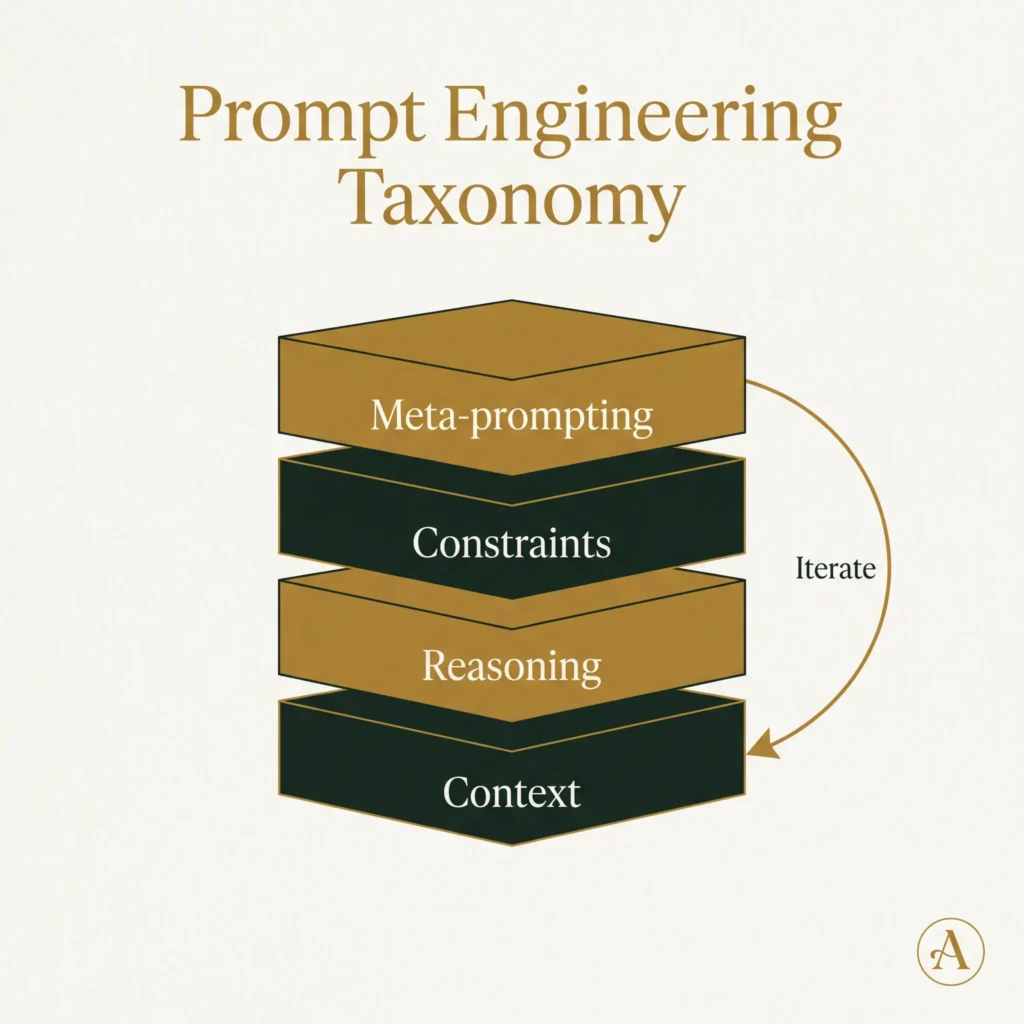
Most prompting techniques fit into three core layers. A fourth layer, meta-prompting, sits on top and improves the other three. When an output fails, the useful question is not “how do I reword this?” but “which layer is missing?”
1. The Foundation: Context and Role-Play
Context comes first: who the output is for, what it will be used for, and what a good result looks like. A role such as “Senior SEO Strategist” is useful shorthand for tone, vocabulary, and priorities, but it is not a performance switch. A study that tested 162 personas across four model families found that adding a persona to the system prompt did not improve accuracy on factual questions (Zheng et al., 2024). Use roles to shape style and focus; use context and examples to shape quality.
Examples usually do more than titles. Few-shot learning techniques show the model the format and tone you want, so it can mirror them instead of guessing. For a closer look at roles, see my notes on persona-driven LLM logic.
2. The Mechanics: Heuristics and Logic
This is where Deliberate Prompting separates the amateurs from the experts. Heuristics are mental shortcuts or rules of thumb that guide the AI’s “thinking” process.
Chain-of-thought (CoT) prompting asks the model to write out intermediate reasoning steps before the final answer. Google researchers showed that a few worked examples of this kind improved arithmetic, commonsense, and symbolic reasoning, with the gains appearing mainly in very large models (Wei et al., 2022). The shorter instruction “Let’s think step by step” comes from a separate paper on zero-shot reasoning (Kojima et al., 2022). One caveat for current models: reasoning models already work through problems before answering, and OpenAI’s reasoning best practices say telling them to “think step by step” is unnecessary. Use explicit CoT on standard chat models; on reasoning models, spend those words on the goal and the success criteria instead.
To tackle highly abstract problems, you might also employ the step-back prompting method, which encourages the AI to retrieve high-level principles before diving into specific details. While Chain of Thought helps with reasoning, you can further reduce factual errors by using a chain-of-verification prompting framework to check the factual claims in a draft before it delivers the final response.
3. The Guardrails: Output Constraints
Without boundaries, AI tends to wander. Output constraints are the physical walls of your content. These include:
- Word counts or character limits.
- Formatting requirements (Markdown, JSON, or Tables).
- Negative constraints (e.g., “Do not use the word ‘innovative'”).
Implementing a strict negative prompting framework for AI text boundaries ensures the model avoids forbidden phrases or repetitive ‘AI-isms’ that often plague generic outputs.
OpenAI’s prompt engineering best practices recommend putting instructions first and separating them from the context with delimiters such as ### or triple quotes. Clear separation helps the model tell your rules apart from your material, which makes it easier to keep the output inside the limits you define.
Comparative Analysis: Casual vs. Deliberate Prompting
To visualize why Deliberate Prompting matters, let’s look at how specific techniques change the quality of the interaction.
| Feature | Casual Prompting | Deliberate Prompting |
| Intent | Vague or exploratory | Goal-oriented and specific |
| Logic Tool | Trial and error | Heuristics (e.g., Chain of Thought) |
| Boundaries | None | Explicit output constraints |
| Structure | Single-sentence | Modular/Multi-part |
| Success Rate | Inconsistent, many retries | Higher, with fewer retries |
Advanced Strategies: Meta-prompting and Beyond
Once you master basic structures, you can move into the “Director’s Chair” of AI interaction. This involves Meta-prompting, which is essentially prompting the AI to create a prompt for itself or another model.
A more autonomous way to refine output is via self-querying prompt engineering, where the AI critiques its own draft against your original goals before you ever see the first version.
How Meta-prompting Works
Meta-prompting treats the AI as an architect. You might describe a complex problem and ask the AI to “Design the optimal 10-step prompt structure to solve this task.” Models are often good at spotting missing context, vague goals, and unstated constraints in a draft instruction. Treat what comes back as a draft to test against real outputs, not as a better prompt by default.
This architectural approach is particularly powerful for complex coding tasks; for instance, applying recursive prompting for code refactoring can systematically clean up legacy scripts by breaking the logic into iterative loops.
Implementing Feedback Loops
A key aspect of Deliberate Prompting is the iterative loop. Instead of accepting the first draft, you provide feedback based on specific gaps.
- Analyze: Where did the output fail?
- Adjust: Was it a lack of context or a failure in heuristics?
- Refine: Add a specific constraint to fix that exact issue.
As your library of deliberate prompts grows, consider treating them like software by using Git-based prompt version control to track performance improvements over time.
Best Practices for Search Intent Optimization
When you use AI for SEO or content creation, your prompts should push toward what Google asks creators to aim for: helpful, reliable, people-first content. To make sure a draft covers the sub-topics readers expect, use semantic discovery prompts to map the entities and questions a complete guide should answer. Then build E-E-A-T (experience, expertise, authoritativeness, and trustworthiness) into the brief itself, because a model cannot supply your first-hand experience. Google’s quality raters use these concepts to evaluate search results, though their ratings do not directly change rankings; Google’s guide to creating helpful, people-first content is the clearest summary for creators.
To achieve this, I recommend including a “Source Requirement” in your prompts. Tell the AI to “cite specific examples” or “refer to established industry frameworks” like the Pareto Principle or the S.W.O.T. analysis.
Then check every source the model returns. Language models can produce citations that look real but do not exist, so a source requirement only helps if a human verifies it.
For a real example of AI-assisted SEO on a brand-new domain, see my Rawatin case study. If you want these methods applied to your own site, see how I work with clients.
Putting the taxonomy to work. Mastering Deliberate Prompting isn’t about memorizing “magic words.” It is about understanding the hierarchy of information.
- Set the context: Who is it for, and what does a good result look like?
- Apply Heuristics: How should they think?
- Set Output Constraints: What are the rules?
- Use Meta-prompting: Can the AI improve this process?
- Iterate: Which layer failed, and what single change fixes it?
By following this taxonomy, you stop guessing at wording and start fixing the layer that actually failed. For more applied guides on prompting and LLM workflows, browse the AI Insight section.
Frequently asked questions
What is a prompt engineering taxonomy?
A prompt engineering taxonomy is a way of grouping prompting techniques by the job they do. In this guide, techniques fall into four layers: context (roles, examples), reasoning (chain-of-thought, step-back, verification), output constraints (length, format, banned phrases), and meta-prompting with iteration. Knowing the layer tells you what to fix when an output fails.
What is Deliberate Prompting?
Deliberate Prompting is the label this guide uses for writing prompts where every line has a defined purpose and belongs to one layer of the taxonomy. It is not a formal research term. Instead of rewording a request until it works, you identify which layer is missing or weak and change only that.
Do I still need chain-of-thought prompts with reasoning models?
Usually not. Reasoning models work through problems internally before answering, and OpenAI’s guidance says asking them to think step by step is unnecessary. Chain-of-thought prompts remain useful on standard chat models. For reasoning models, spend your words on the goal, the context, and clear success criteria.
Do personas make AI answers more accurate?
Not reliably. A study of 162 personas across four model families found that adding a persona to the system prompt did not improve accuracy on factual questions. Roles are still useful for setting tone, vocabulary, and focus, but context, examples, and clear constraints do more for the quality of the answer.
Can output constraints be too restrictive?
Yes. Constraints become too restrictive when they stop the model from giving a complete answer, such as a word limit too short for the task. Start with a few essential rules, review the first output, and tighten only where it went wrong. Balance what to avoid with what to prioritize.
Disclaimer: The information provided in this article is for educational and general informational purposes only and should not be construed as professional advice (such as legal, medical, or financial). While the author strives to provide accurate and up-to-date information, no representations or warranties are made regarding its completeness or reliability. Any action you take based on this information is strictly at your own risk.