

In the early days of search engines, matching words was enough. If you searched for “baking,” the engine looked for the word “baking.” Today, AI and LLMs have shifted the landscape toward Semantic Discovery. We no longer just look for words; we look for the “ghosts” of meaning hidden between the lines.
If you are a prompt engineer or a data scientist, mastering Semantic Discovery is like gaining X-ray vision for your datasets. I will show you how to move beyond surface-level keywords and prompt for the deep, underlying themes that define high-quality content.
What is Latent Semantic Discovery?
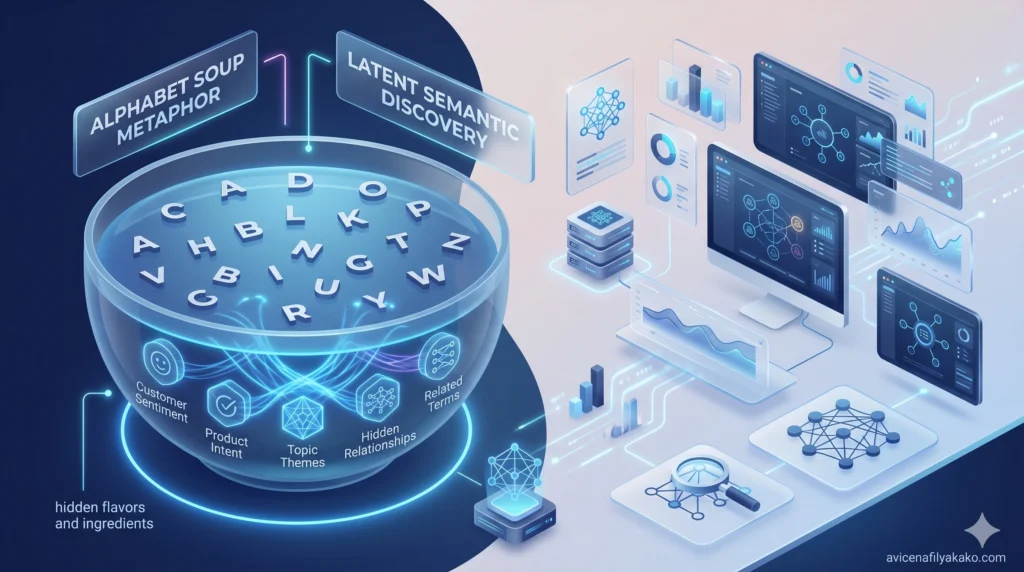
Think of your data like a giant bowl of alphabet soup. On the surface, you see individual letters. However, beneath the surface, there are flavors and ingredients you can’t see but can definitely taste. Semantic Discovery is the process of identifying those hidden flavors.
Technically, this often involves Latent Dirichlet Allocation (LDA). This is a generative statistical model that allows sets of observations to be explained by unobserved groups. In simpler terms, it’s a way for a computer to say, “Even though you didn’t mention the word ‘vacation,’ I know this text is about travel because you mentioned ‘suitcases’ and ‘boarding passes’.”
“The meaning of a word is its use in the language.” — Ludwig Wittgenstein
By leveraging prompts that focus on Data synthesis, we can force an AI to act as a bridge between raw text and these high-level concepts.
The Role of Hidden Entities in Topical Authority

To build topical authority, you can’t just repeat your primary keyword. You need to map out Hidden entities. These are the related people, places, and things that Google expects to see in a comprehensive guide.
For example, if you are writing about “Coffee,” Semantic Discovery would lead you to entities like “Arabica beans,” “Roast profiles,” and “Barista techniques.” If these are missing, your content feels hollow to both users and search algorithms.
To effectively organize these hidden entities into a cohesive content map, you should apply a taxonomy deliberate prompting strategy to categorize your knowledge graph effectively.
Comparing Semantic Approaches
| Approach | Focus | Primary Goal |
|---|---|---|
| Keyword Matching | Exact word strings | Relevancy to a specific query |
| Semantic Discovery | Context and intent | Building topical authority |
| Data synthesis | Pattern recognition | Uncovering Hidden entities |
How to Prompt for Deep Semantic Insights
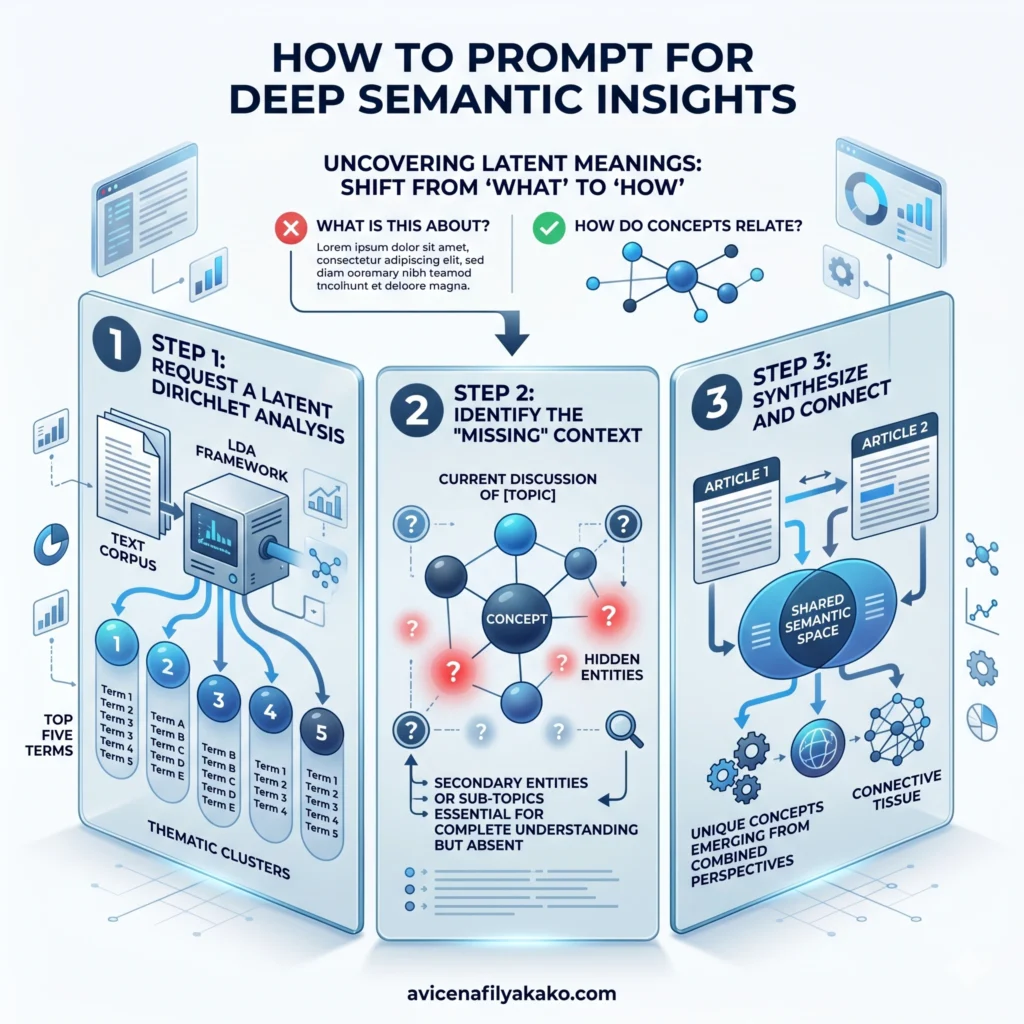
I have found that the best way to uncover latent meanings is to stop asking the AI “what” a text is about and start asking “how” the concepts relate.
When dealing with complex semantic data, it is crucial to use chain of verification prompting to reduce hallucinations and ensure the accuracy of the thematic clusters the AI identifies. Here are three steps to refine your prompts:
1. Request a Latent Dirichlet Analysis
Instead of asking for a summary, ask the AI to categorize the text into thematic clusters. Use a prompt like: “Analyze this corpus and identify five underlying themes using a Latent Dirichlet framework. List the top five terms that define each cluster.”
2. Identify the “Missing” Context
To find Hidden entities, ask the AI what is not there but should be. “Based on the current discussion of [Topic], what secondary entities or sub-topics are essential for a complete understanding but are currently absent?”
3. Synthesize and Connect
Use Data synthesis prompts to find the “connective tissue” between different datasets. “Compare these two articles and identify the shared semantic space. What unique concepts emerge when these two perspectives are combined?”
Leveraging Research for Better Prompts

When I build these strategies, I rely on foundational research. For instance, understanding the mathematical structures of latent analysis helps us craft prompts that mirror how machines actually process language.
Furthermore, recent advancements in large-scale semantic modeling suggest that the more we treat AI as a collaborator in Data synthesis, the more accurate our Semantic Discovery becomes.
If the AI struggles with high-level data synthesis, you can implement the step back prompting method to help the model abstract broader principles before diving into specific semantic details. You can explore more on the evolution of topic models to see how far we’ve come from basic word counting.
Practical Applications for SEO and Content Strategy

Why does this matter for your bottom line? Because search engines are now “Semantic Engines.” They evaluate your site’s expertise based on the breadth of your knowledge graph.
- Content Gap Analysis: Use Semantic Discovery to find out what your competitors are talking about—and what they are ignoring.
- Internal Linking: By identifying Hidden entities, you can create a more logical site structure, linking pages that share the same latent themes.
- User Intent Alignment: Ensure your content answers the “why” behind a search, not just the “what.”
FAQs on Semantic Discovery
What is the main benefit of Semantic Discovery?
The primary benefit is the ability to understand the intent and context of a user’s query beyond literal word matching. By uncovering Hidden entities, creators can build content that resonates more deeply with both human readers and search algorithms.
How does Latent Dirichlet Allocation (LDA) work in simple terms?
LDA works by assuming that every document is a mix of various topics and that every topic is a mix of various words. It treats a piece of text like a recipe, trying to figure out which “topics” were used as ingredients to create the final result.
Can I use AI for Data synthesis without technical knowledge?
Yes, you can use specialized prompts to ask LLMs to perform Data synthesis tasks. By instructing the model to look for patterns and relationships between different pieces of information, you can extract high-level insights without writing a single line of code.
Disclaimer: The information provided in this article is for educational and general informational purposes only and should not be construed as professional advice (such as legal, medical, or financial). While the author strives to provide accurate and up-to-date information, no representations or warranties are made regarding its completeness or reliability. Any action you take based on this information is strictly at your own risk.
This article was authored by Avicena Fily A Kako, a Digital Entrepreneur & SEO Specialist using AI to scale business and finance projects.