Local LLM Quantization: The 70B Trade-off Between Size, Speed, and Quality

Featured cover reading Fitting 70B Models Locally on a dark green background with a thin gold line

Local LLM quantization stores a model’s weights at lower precision so a 70B model fits on hardware you own. At FP16, a 70B model needs about 140GB just for its weights. The widely recommended Q4_K_M GGUF of Llama 3 70B is about 42.5GB, which a consumer GPU plus system RAM can hold through llama.cpp offloading. … Read more

Mixture of Experts Explained: Why MoE Models Need So Much VRAM

Mixture of Experts cover showing total vs active parameters and the VRAM trade-off of MoE models

A Mixture of Experts (MoE) model splits its feed-forward layers into many smaller “expert” networks and uses a router to run only a few of them for each token. That is why DeepSeek-V3 can carry 671 billion parameters yet use only about 37 billion per token. The catch, and the focus of this guide, is … Read more

Personal AI Data Sovereignty: How to Keep Your Prompts, Files, and Client Data Under Your Control

Editorial cover reading Personal AI Data Sovereignty on an off-white background with a thin gold line

Personal AI data sovereignty means you decide where your prompts, files, and outputs are stored, who can access them, and whether they are used to train someone else’s model. Every time you paste proprietary code, an unreleased strategy, or raw financial statements into a consumer AI chat, you hand part of that decision to a … Read more

The AI Time Blocking Trap: How to Optimize Your Calendar Without Burning Out

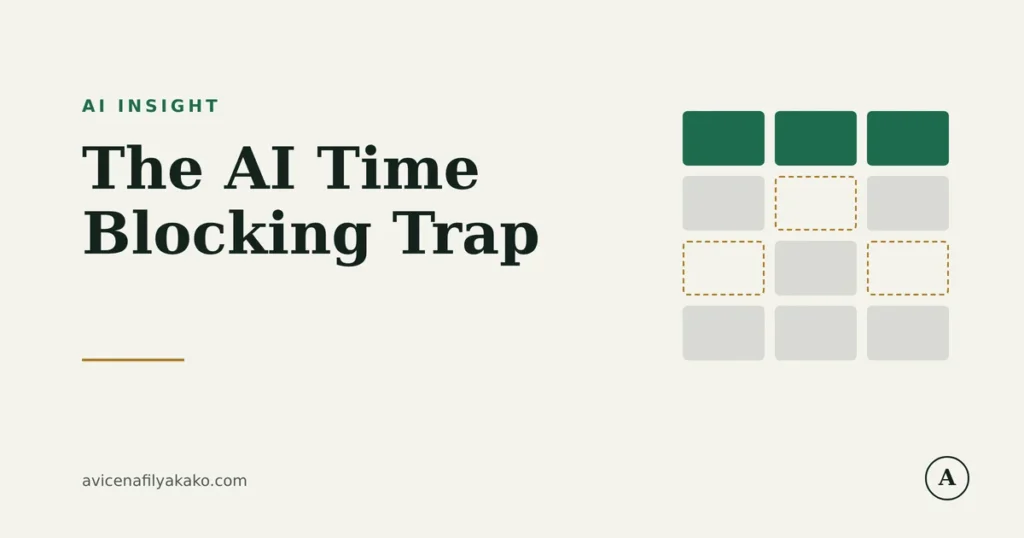
The AI Time Blocking Trap cover: calendar grid with locked deep-work blocks and dashed buffer slots

AI time blocking works when you give the scheduler rules about your energy, not just your free slots. Lock your peak hours for deep work, force short buffers after meetings, and set priorities so that when work overflows, low-value tasks move first instead of your breaks. Most productivity advice tells you that time blocking is … Read more

Fine-Tune a Local LLM on Your Emails: A LoRA Guide

Minimal cover with the headline Fine-Tune an LLM on Emails in serif type on dark green

You can fine-tune a local LLM on your emails, but not by dumping your sent folder into a training script. Feed a model raw, unedited email data and you get a broken assistant that generates corporate disclosure footers, broken HTML tags, and repetitive “Best regards” sign-offs. What works is a narrow goal (your style, not … Read more

Tired of Unread PDFs? Build a PDF Summarization Pipeline for Your Reading List

Editorial cover reading Automate Your PDF Reading List on an off-white background with a thin gold line

An automated PDF summarization pipeline turns a backlog of unread papers into structured, searchable notes. It pulls new PDFs from sources like the arXiv API, converts them to clean Markdown with a layout-aware parser, summarizes each one with a fixed-schema prompt, and syncs the result to Notion or Obsidian. The hard part is rarely the … Read more

Python vs No-Code AI Agents: Where Visual Builders Break and Code Pays Off

Editorial cover reading Python vs No-Code AI Agents on a dark green background with a thin gold line

The Python vs no-code AI agent decision comes down to three things: how complex the logic is, how long the system must live, and how much volume it will handle. The short answer: use a visual builder like Make, Zapier, or n8n for linear automations you need running this week, and use Python when your … Read more