
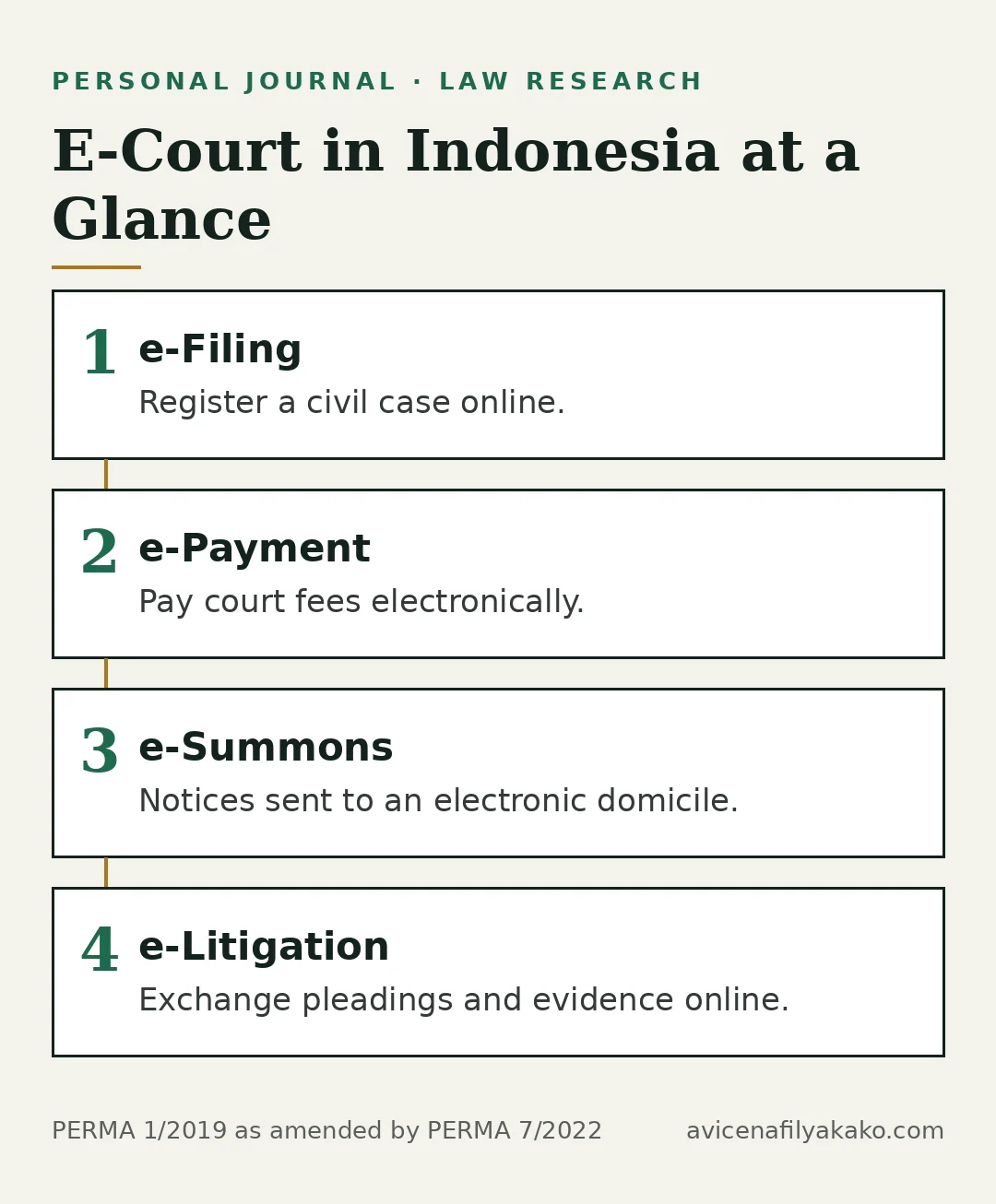
E-Court in Indonesia is the Supreme Court’s system for filing civil cases, paying court fees, receiving summons, and exchanging documents online. Today it rests on a Supreme Court regulation, not a statute. The Civil Procedure Bill now before the House of Representatives (DPR) could change that, while also replacing Dutch colonial-era procedure. This post summarizes the research paper I co-wrote on the topic.
It is a summary of academic research, not legal advice.
Why Indonesia needs a new civil procedure law
Indonesian civil procedure still relies on two colonial-era codes. The HIR applies in Java and Madura, and the RBg applies outside them. Procedure scholars have long called for a single national code to end this dualism.
The process is moving. In January 2026, the government and the DPR’s Commission III agreed that the Civil Procedure Bill would continue as a DPR-initiated bill to speed up deliberation. In May 2026, the DPR kept it on its 2026 priority legislation list with that status.
The current legal basis for e-Court in Indonesia
The first regulation was Supreme Court Regulation (PERMA) No. 3 of 2018 on electronic case administration. It was replaced by PERMA No. 1 of 2019, which added electronic trials. PERMA No. 7 of 2022 then amended PERMA No. 1 of 2019, taking effect on 11 October 2022.
| Instrument | What it covers | Status |
|---|---|---|
| PERMA No. 3 of 2018 | Electronic case administration | Revoked by PERMA 1/2019 |
| PERMA No. 1 of 2019 | E-filing, e-payment, e-summons, e-litigation | In force, as amended |
| PERMA No. 7 of 2022 | Amends PERMA 1/2019 | In force since October 2022 |
| Civil Procedure Bill | A national civil procedure code | Under deliberation in the DPR |
A PERMA is binding, but it sits below statutes in Indonesia’s hierarchy of laws. Our paper argues that putting electronic procedure into the Civil Procedure Bill would give it firmer legal certainty.
Efficiency gains from e-Court
Our study compared e-Court with manual procedure under the HIR and RBg. It found clear savings in time and cost:
- Filing and payment online. Parties no longer need to travel to court to register a case.
- Electronic summons. Notices reach registered parties faster than physical service by bailiffs.
- Document exchange. Replies, rejoinders, and conclusions can be filed online between hearings.
- One standard. A national code could make these steps the same in every court.
The access-to-justice problem
Efficiency is only half the picture. Our paper found that the digital divide remains a serious concern. Internet access and digital skills are uneven, especially in rural areas.
Practitioners have raised the same point. One district court chief noted that many people own smartphones but are still unfamiliar with court technology. A digital court must not leave those litigants behind, so manual and assisted options still matter.
The gap on electronic evidence
Indonesia’s Electronic Information and Transactions Law (ITE Law), as amended most recently by Law No. 1 of 2024, recognizes electronic information and documents as valid legal evidence. Article 5 treats them as an extension of the evidence allowed under procedural law.
Classic civil procedure rules, however, still list the traditional forms of evidence. These include Article 164 HIR and Article 1866 of the Civil Code. Criminal procedure has moved further: Indonesia’s new Criminal Procedure Code, Law No. 20 of 2025, lists electronic evidence as its own category.
In the draft we reviewed, electronic evidence was not set out as a distinct category in the same way. Our paper recommends clear standards for the integrity and authenticity of digital evidence in the new code.
About the research
This post summarizes our peer-reviewed paper, published in September 2026. It uses a normative legal method with a statutory approach. The paper also discusses access-to-justice theory (Cappelletti), procedural justice (Thibaut and Walker), Radbruch’s three values of law, and Soerjono Soekanto’s theory of legal effectiveness.
For how I apply research and data in practice, see my GEO portfolio and the rawatin.com case study.
Frequently Asked Questions
What is e-Court in Indonesia?
It is the Supreme Court’s online system for civil case administration and trials. It covers e-filing, e-payment, electronic summons, and e-litigation, the online exchange of documents and hearings.
What is the legal basis for e-Court?
Supreme Court Regulation (PERMA) No. 1 of 2019, as amended by PERMA No. 7 of 2022. It replaced the earlier PERMA No. 3 of 2018.
Is electronic evidence valid in Indonesian civil cases?
Yes. The ITE Law, most recently amended by Law No. 1 of 2024, recognizes electronic information and documents as valid evidence. Our paper argues the new civil procedure code should also set clear standards for it.
Has the Civil Procedure Bill been passed?
Not according to the latest reports I found. In 2026, it moved forward as a DPR-initiated bill on the priority legislation list. Check the DPR’s official updates for its current status.
References
- Kako, A. F. A., & Handayani, H. R. (2026). Transformasi Digital dalam RUU Hukum Acara Perdata: Analisis Efisiensi dan Akses Keadilan melalui Sistem E-Court. Jurnal Hukum Lex Generalis, 7(4). DOI: 10.56370/jhlg.v7i4.3697.
- Peraturan Mahkamah Agung No. 1 Tahun 2019 tentang Administrasi Perkara dan Persidangan di Pengadilan secara Elektronik. JDIH BPK.
- Peraturan Mahkamah Agung No. 7 Tahun 2022 tentang Perubahan atas PERMA No. 1 Tahun 2019. JDIH BPK.
- Undang-Undang No. 1 Tahun 2024 tentang Perubahan Kedua atas UU No. 11 Tahun 2008 tentang Informasi dan Transaksi Elektronik. JDIH BPK.
- DPR RI. (2026, January 22). RUU Hukum Acara Perdata disepakati jadi usul inisiatif DPR.
- Hukumonline. (2022). RUU Hukum Acara Perdata harus mengakomodir sistem peradilan elektronik.
- Hukumonline. Dasar hukum alat bukti elektronik dalam KUHAP.
Disclaimer: The information provided in this article is for educational and general informational purposes only and should not be construed as professional advice (such as legal, medical, or financial). While the author strives to provide accurate and up-to-date information, no representations or warranties are made regarding its completeness or reliability. Any action you take based on this information is strictly at your own risk.