
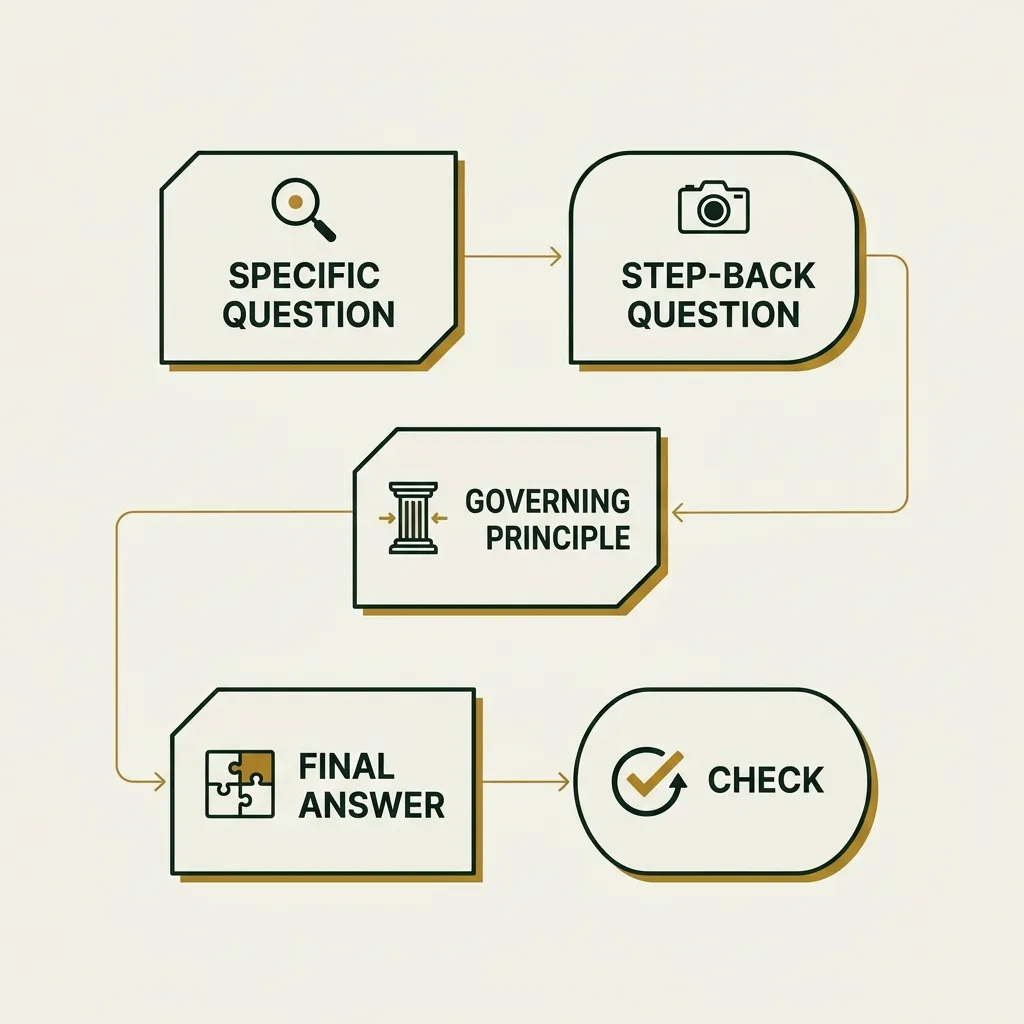
Step-back prompting is a two-stage technique: before answering a specific question, you ask the model a broader “step-back” question about the principle behind it, then have it answer the original question using that principle. Below is a step-back prompting example you can copy, what the original research actually found, and the cases where the extra step adds nothing.
The method comes from Google DeepMind researchers (Zheng et al.), first posted on arXiv in October 2023 and published at ICLR 2024. It asks the model to set aside the specific details of a question long enough to identify the concept or principle that governs it.
Think of it like a chess grandmaster. They don’t just look at the piece you moved; they “step back” to recognize the overall opening strategy you are employing. By abstracting the problem, the AI can find a more accurate, high-level solution.
What is Step-Back Prompting?
At its core, Step-Back Prompting is a strategy that involves two distinct stages: abstraction and reasoning. Instead of answering a query directly, the model is first asked a broader, related question. This “step-back” question helps the model retrieve a fundamental concept or principle that governs the specific problem.
In the original experiments, the biggest gains came on physics and chemistry questions, time-sensitive knowledge questions, and multi-hop reasoning. On grade-school math (GSM8K) it performed about the same as chain-of-thought, and coding was not tested.
This structured approach is part of a broader framework of mastering the taxonomy of deliberate prompting, where every instruction is categorized to maximize the model’s reasoning capabilities.
“The art of being wise is the art of knowing what to overlook.” — William James
The Two-Step Mechanism
- Abstraction: The model identifies the core concept behind the user’s prompt.
- Reasoning: Using the high-level principle derived from the abstraction, the model circles back to solve the original query.
Why Abstraction Matters in Problem Solving
Standard prompting often forces an AI to jump straight into a task. However, complex problems are often layered. If the AI doesn’t understand the “Why” or the “How” behind a rule, it relies on probabilistic guessing rather than logical deduction.
This tends to improve accuracy on detail-heavy questions, but the principles come from the model’s own knowledge, so they are only as reliable as what the model already knows. Treat them as a draft to check, not as verified facts.
Comparison: Standard vs. Step-Back Methods
| Feature | Standard Prompting | Step-Back Prompting |
|---|---|---|
| Initial Focus | Immediate answer | Underlying principle |
| Error Rate | Higher in complex logic | Lower on the benchmarks tested |
| Logic Path | Linear / Direct | Hierarchical / Principles-first |
How to Implement Step-Back Prompting in Your Workflow
For a code-level version, Mirascope’s step-back prompting recipe shows the two calls chained in Python (it sits in their legacy v1 docs, but the pattern still applies).
For tasks requiring extreme factual precision, you can combine this with a Chain of Verification prompting workflow to double-check the principles the AI identifies before it generates a final response.
1. Identify the Specific Query
Start with your complex question. For example: “If I increase the temperature of a gas in a sealed container, what happens to the pressure?”
2. Create the Abstraction Prompt
Ask the AI to step back. You might say: “Before answering, what are the physical laws governing the relationship between temperature and pressure in gases?”
3. Synthesize the Final Answer
You do not need many examples to teach the step-back move: in the original paper, a single demonstration of a question paired with its principle worked as well as several. PromptHub’s walkthrough of step-back prompting shows the same two-prompt pattern on a fact-recall question.
A step-back prompting example you can copy
The same two prompts work outside physics. Here is a hypothetical SEO question, split into a step-back prompt and a reasoning prompt:
Prompt 1 (step back): Before answering, step back. What general principles decide how Google ranks a page for an informational query? List them briefly and do not answer my question yet.
My question: Why did my guide drop from position 4 to position 11 after I rewrote the introduction?
Prompt 2 (reason): Using only the principles you listed, give the three most likely causes for the drop, starting with the most likely. If a principle does not apply here, say so.
Swap in your own question and keep the two prompts separate. Answering the step-back question first stops the model from jumping straight to a guess.
The Power of Principle-Based AI
When I use Step-Back Prompting for SEO analysis or technical writing, I notice a massive shift in quality. Instead of the AI giving me generic advice, it begins to reference the core tenets of search intent and user experience.
Integrating these techniques allows for advanced semantic discovery prompts that help map out complex topical authorities more effectively than standard keyword research. If you want principle-first analysis like this applied to your own site’s content and search visibility, see how I work with clients.
In the original paper, step-back prompting raised PaLM-2L’s accuracy by about 7 percentage points on MMLU Physics, 11 on Chemistry, 27 on TimeQA when combined with retrieval, and 7 on MuSiQue, compared with asking the model directly.
- Improved Accuracy: Can reduce reasoning errors on detail-heavy questions.
- Better Context: Ensures the AI understands the “bigger picture.”
- Scalability: Tested on science, fact-recall, and multi-hop questions; worth testing in other fields, such as law, on your own tasks.
When step-back prompting doesn’t help
The DeepMind authors are clear that abstraction is not always useful. Three limits are worth knowing before you add the extra step to every prompt.
- Simple or direct questions: if the answer is a single fact, such as who held an office in a given year, there is no higher principle to retrieve, and the step-back question only adds length.
- Reasoning is still the weak point: in the paper’s error analysis on physics questions, more than 90% of the remaining mistakes happened after the model had found the right principle, while it was applying it.
- Results come from 2023 models: the experiments used PaLM-2L, GPT-4, and Llama2-70B. Current reasoning models already work through problems before answering, so the extra gain may be smaller. Test it on your own tasks.
If a wrong principle would be costly, add a verification pass before you trust the final answer.
Frequently asked questions
What is a simple step-back prompting example?
Ask: “What happens to a gas’s pressure if I heat it in a sealed container?” Instead of answering directly, the model first answers a step-back question: “Which laws relate temperature and pressure in a gas?” It names the ideal gas law, then applies it: at constant volume, pressure rises in proportion to absolute temperature.
Is step-back prompting the same as chain-of-thought?
No. Chain-of-thought breaks one problem into sequential steps. Step-back prompting first moves up a level, asking for the concept or principle that governs the problem, then reasons from it. The two combine well: retrieve the principle with a step-back question, then work through the application step by step.
Does step-back prompting still help with reasoning models?
Sometimes. The 2023 experiments used PaLM-2L, GPT-4, and Llama2-70B, before today’s reasoning models, which already plan internally. A step-back question can still help on detail-heavy or fact-recall tasks, but gains are not guaranteed. Run the same prompts with and without the step-back step and compare the answers.
Does step-back prompting work with Claude, Gemini, or ChatGPT?
Yes, because it is a prompting pattern, not a model feature, so any chat model can follow it. The original paper only tested PaLM-2L, GPT-4, and Llama2-70B, so its results say nothing direct about Claude, Gemini, or newer ChatGPT models. Check outputs on your own tasks before relying on them.
Final Thoughts on Advanced Prompting
Step-back prompting is a cheap habit worth testing: one extra question that asks the model for the governing principle before it answers. It helps most on detail-heavy questions and least on simple ones, and the principle it returns still needs checking. For more applied prompting guides, browse the AI Insight section.
The next time you face a wall with a complex task, don’t just rephrase your question. Ask the AI to take a step back. You’ll be surprised at how much clearer the path forward becomes.
Disclaimer: The information provided in this article is for educational and general informational purposes only and should not be construed as professional advice (such as legal, medical, or financial). While the author strives to provide accurate and up-to-date information, no representations or warranties are made regarding its completeness or reliability. Any action you take based on this information is strictly at your own risk.