
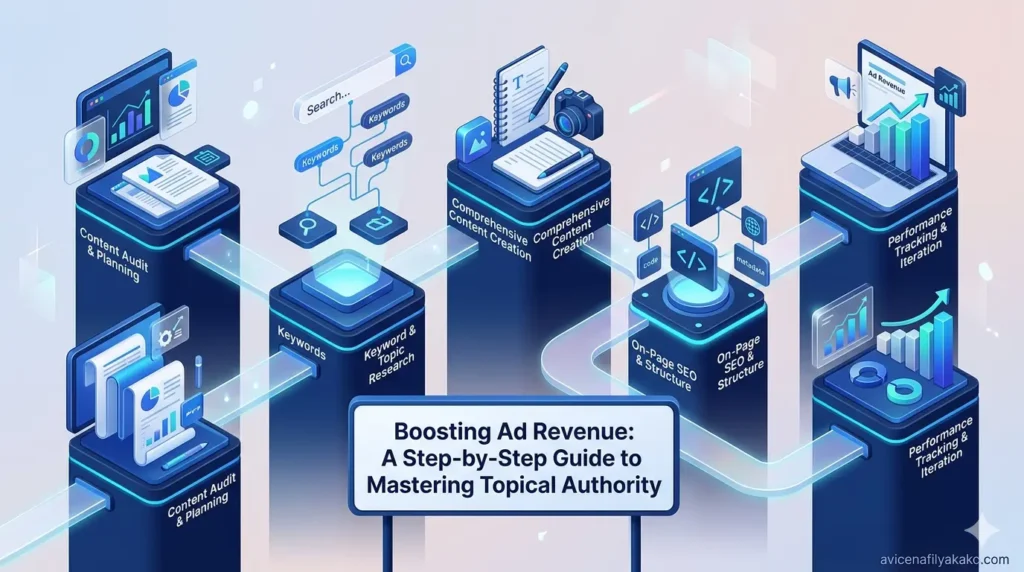
You’ve likely heard that “content is king,” but in the competitive world of digital publishing, being a “jack of all trades” is a recipe for low earnings. To truly maximize your Ad Revenue, you need to move beyond chasing viral trends and start building a fortress of expertise.
The secret lies in topical authority. When search engines recognize your site as the definitive source on a specific subject, your rankings stabilize, and more importantly, your RPM (Revenue Per Mille) begins to climb. By the end of this guide, you will understand how to shift from a broad content strategy to a specialized authority model that attracts premium advertisers.
Why Topical Authority is the Engine of Ad Revenue

Think of topical authority like a specialized medical clinic versus a general practitioner. A specialist can charge significantly more because they possess deep, concentrated knowledge. Similarly, Google rewards sites that demonstrate “depth” rather than just “breadth.”
When you cover a topic from every possible angle, you create a “content cluster.” This structure signals to search engines that you are a trusted expert. For publishers, this trust translates into higher visibility in search results, which naturally leads to a consistent increase in Ad Revenue without needing to constantly gamble on new, unproven keywords.
The Connection Between Authority and RPM
Your RPM isn’t just a random number; it’s a reflection of how much advertisers value your audience. By establishing authority, you attract high-intent users. Advertisers are willing to pay a premium to place their display ads in front of users who are deep in the research phase of a purchase, directly boosting your bottom line.
High CPM Niches: Aligning Clusters with US Market Demand

To see a significant jump in Ad Revenue, you must align your authority with High CPM niches. If you are targeting the US market, advertisers in finance, technology, and healthcare have massive budgets waiting for authoritative platforms.
For a deeper look at how to refine your pages for these high-value audiences, check out this guide on SEO content optimization for higher conversions.
“The most successful publishers don’t just sell space; they sell context. When an ad appears next to expert-level content, its value to the advertiser triples.” — Digital Marketing Axiom
| Niche Category | Targeted Entity | Revenue Impact |
|---|---|---|
| Personal Finance | Credit Card Debt | Highest CPC/RPM |
| Enterprise SaaS | Cloud Security | Premium B2B Tiers |
| Legal Services | Personal Injury | Maximum Lead Value |
How to Structure Clusters to Boost Ad Revenue
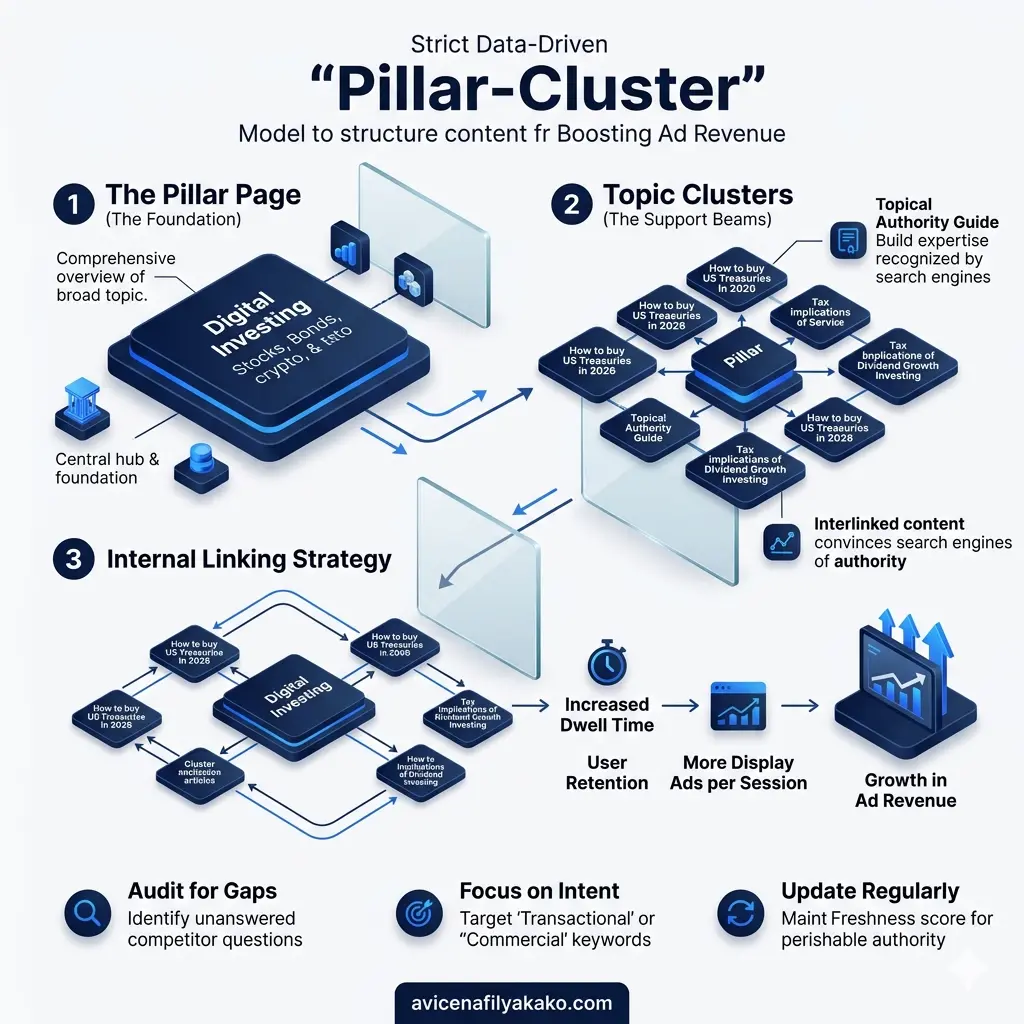
Building authority is like building a skyscraper; you need a solid foundation before you can add the penthouse. I recommend using the “Pillar-Cluster” model to organize your site’s architecture.
Before mapping out your architecture, it is essential to perform a thorough content inventory valuation to identify which assets currently hold the most earning potential.
1. The Pillar Page (The Foundation)
Your pillar page is a comprehensive overview of a broad topic. For example, if you want to dominate the “Digital Investing” space, your pillar page would cover everything from stocks to crypto. It serves as the central hub for all your related content.
2. Topic Clusters (The Support Beams)
Surrounding your pillar are smaller, highly specific articles. These “clusters” answer granular questions like “How to buy US Treasuries in 2026” or “Tax implications of Dividend Growth Investing.” According to the insights found in this Topical Authority Guide by Niko Alho, this interlinked web of content is what convinces search engines of your expertise.
3. Internal Linking Strategy
Every cluster article should link back to the pillar, and the pillar should link out to the clusters. This creates a loop that keeps users on your site longer. Increased “dwell time” allows you to serve more display ads per session, which is a mechanical way to grow your Ad Revenue safely.
- Audit for Gaps: Identify what questions your competitors aren’t answering and fill those gaps.
- Focus on Intent: Ensure your clusters target “Transactional” or “Commercial” intent keywords.
- Update Regularly: Authority is perishable. Refresh your data to maintain your “Freshness” score.
Maximizing Ad Revenue via Strategic Display Ads Placement

While content brings the crowd, the layout closes the deal. If you have built topical authority, your traffic is likely composed of “high-value” readers. However, if your display ads are intrusive or slow down the page, you will lose the trust of both the user and the search engine.
I suggest using a “content-first” ad layout. Place your highest-paying ads within the first 30% of the article where attention is highest. Use sticky sidebars for desktop users to keep your Ad Revenue consistent as they scroll through your long-form authority pieces.
Common Pitfalls to Avoid
- Thin Content: Avoid writing 300-word “fluff” pieces just to hit a keyword. Search engines will penalize your authority.
- Ignoring Core Web Vitals: A slow site will kill your rankings, regardless of how “authoritative” your writing is.
- Ad Overload: Too many ads break the semantic flow of the article, making it harder for AI crawlers to categorize your expertise.
Avoid writing 300-word “fluff” pieces just to hit a keyword. Search engines will penalize your authority if you lack original insights; instead, focus on leveraging information gain to create a competitive advantage by adding unique data and perspectives that AI-generated clones often miss.
FAQ: Scaling Authority and Earnings
What is the fastest way to increase Ad Revenue for a new site?
The fastest way to increase Ad Revenue is to identify a “micro-niche” within a high-CPM industry and write 20-30 deeply researched articles that cover every possible question in that niche. This builds topical authority much faster than trying to compete on broad, high-volume terms.
Does topical authority help with Google’s “People Also Ask” sections?
Yes, structuring your content to answer specific questions directly (the “Direct Answer” pattern) makes it highly likely that your site will be featured in PAA boxes. Being featured here increases your CTR, which leads to more traffic and higher Ad Revenue.
Can I build authority using AI-generated content?
You can use AI to scale your research and drafting, but human oversight is mandatory for E-E-A-T. To maintain your status as an authority, you must inject unique perspectives, personal experiences, and verified data that AI cannot synthesize on its own.
Disclaimer: The information provided in this article is for educational and general informational purposes only and should not be construed as professional advice (such as legal, medical, or financial). While the author strives to provide accurate and up-to-date information, no representations or warranties are made regarding its completeness or reliability. Any action you take based on this information is strictly at your own risk.
This article was authored by Avicena Fily A Kako, a Digital Entrepreneur & SEO Specialist using AI to scale business and finance projects.