
A ghostwriting system is a repeatable process that lets other people, or AI tools, turn a founder’s ideas into finished content. The founder supplies the thinking and approves the result, while writers handle the drafting. Done well, it multiplies output without generic-sounding content.
Done badly, it produces polished posts that say nothing the founder actually believes.
This guide covers the four parts of a ghostwriting system and how to use AI in it responsibly.
Why founders build a ghostwriting system
Founders are usually the best source of their company’s insight and the busiest person in it. That makes the founder the bottleneck for content.
The payoff for solving it can be real. In the 2024 Edelman-LinkedIn B2B Thought Leadership Impact Report, 73% of decision-makers said a company’s thought leadership is a more trustworthy basis for judging its capabilities than its marketing materials. Expert content builds trust that ads can’t.
Naval Ravikant put the leverage simply: code and media are “permissionless leverage.” Content can keep working long after it’s published. But it only works if it carries real expertise.
The four parts of a ghostwriting system
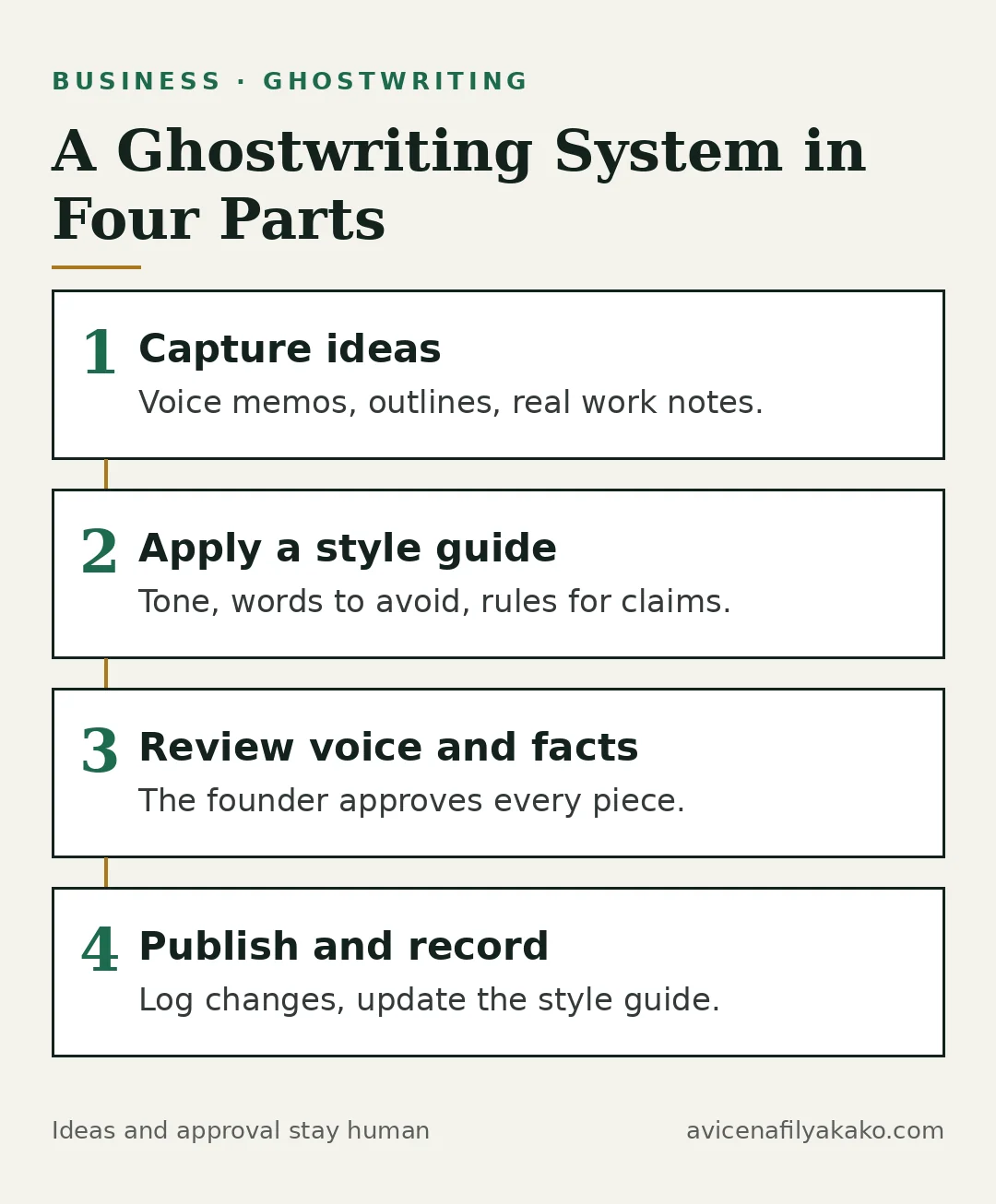
1. Capture the founder’s ideas
The founder shouldn’t write drafts, but they must supply the substance. Good raw material includes:
- A 10-minute voice memo on one topic.
- A rough outline or list of points.
- A recorded interview with the writer.
- Notes from real work: a client question, a mistake, a decision.
Give the writer a specific thesis, not just a topic. “Write about SEO” produces generic content. “Explain why we stopped chasing keyword density, using the example from last month’s audit” produces something only you could have said.
2. Write a style guide
A style guide lets any competent writer sound like the founder. Keep it short and concrete:
- Tone. Direct or warm, formal or casual, with one example paragraph.
- Words to avoid. Clichés and phrases the founder never uses.
- Formatting. Sentence length, paragraph length, how lists and headings are used.
- Reader. Who the content is for and what problem they have.
- Claims. Every number needs a source, and personal results need evidence.
3. Review for accuracy and voice
The founder, or someone they trust, reviews every piece before it’s published. Check two things: does it sound like the founder, and is every claim true? A ghostwritten post with a wrong fact damages the founder’s name, not the writer’s.
4. Publish and keep a record
Track what was published, who drafted it, and what changed in review. Over time, those notes show which feedback keeps coming up. Add those points to the style guide.
In-house writer or outside ghostwriter?
| Option | Strengths | Trade-offs |
|---|---|---|
| In-house writer | Close to the business, fast feedback | Salary and management time |
| Freelance ghostwriter | Flexible, pay per piece | Needs a strong brief and style guide |
| AI with human review | Fast first drafts | Needs careful fact-checking and editing |
If you manage content across several sites, the same choice applies to each one. See multi-site portfolio management for how to keep quality consistent across assets.
Using AI in your ghostwriting system
AI can draft fast, but it can’t supply your experience. Google’s guidance says it rewards high-quality content “however it is produced.” It also says using AI to generate content mainly to manipulate rankings violates its spam policies.
Google’s newer guidance on generative AI says it can help with research and structure. But generating many pages without adding value may count as scaled content abuse. So use AI for structure and first drafts, and keep the ideas, examples, and final approval human.
A real example: maintenance of this blog runs on a version of this system. An AI assistant drafts updates from a written style guide, checks claims against primary sources, and prepares the changes. Nothing goes live until I review and approve it, and every update is logged.
Is ghostwriting honest?
Ghostwriting is common in business, from executive speeches to company blogs. It stays honest when the ideas, opinions, and experiences belong to the named author, and the author approves the final text. It becomes a problem when the content claims experience the author doesn’t have, or in settings with explicit authorship rules, such as academic work.
When AI is involved, Google encourages disclosure where readers would reasonably expect it. A short note on how content is made builds trust rather than weakening it.
To turn this content into revenue, connect it to a clear content-to-product monetization path.
Frequently Asked Questions
What is a ghostwriting system?
It is a repeatable process for turning a founder’s ideas into published content written by someone else. It usually includes idea capture, a style guide, a review step, and a publishing record.
How do I keep my voice when someone else writes?
Supply the substance yourself, write a short style guide with examples, and review every piece before it goes out. Give writers a specific thesis rather than a broad topic.
Can I use AI as a ghostwriter?
You can use it for research, structure, and first drafts. Keep the ideas, examples, and final approval human, and check every factual claim. Google warns against mass-producing pages without adding value.
Is ghostwriting ethical for personal brands?
Generally yes, when the ideas and experiences are genuinely the author’s and they approve the final text. It isn’t honest to claim experience you don’t have.
Actionable Next Steps
- Record a 10-minute voice memo on one topic you know well.
- Write a one-page style guide with one example paragraph.
- Have a writer or AI draft from the memo, then review it for voice and facts.
References
- Edelman & LinkedIn. (2024). 2024 B2B Thought Leadership Impact Report.
- Ravikant, N. (2019). Product and media are new leverage.
- Google Search Central Blog. (2023, February 8). Google Search’s guidance about AI-generated content.
- Google Search Central. Google Search’s guidance on using generative AI content on your website.
Disclaimer: The information provided in this article is for educational and general informational purposes only and should not be construed as professional advice (such as legal, medical, or financial). While the author strives to provide accurate and up-to-date information, no representations or warranties are made regarding its completeness or reliability. Any action you take based on this information is strictly at your own risk.
Comments are closed.