
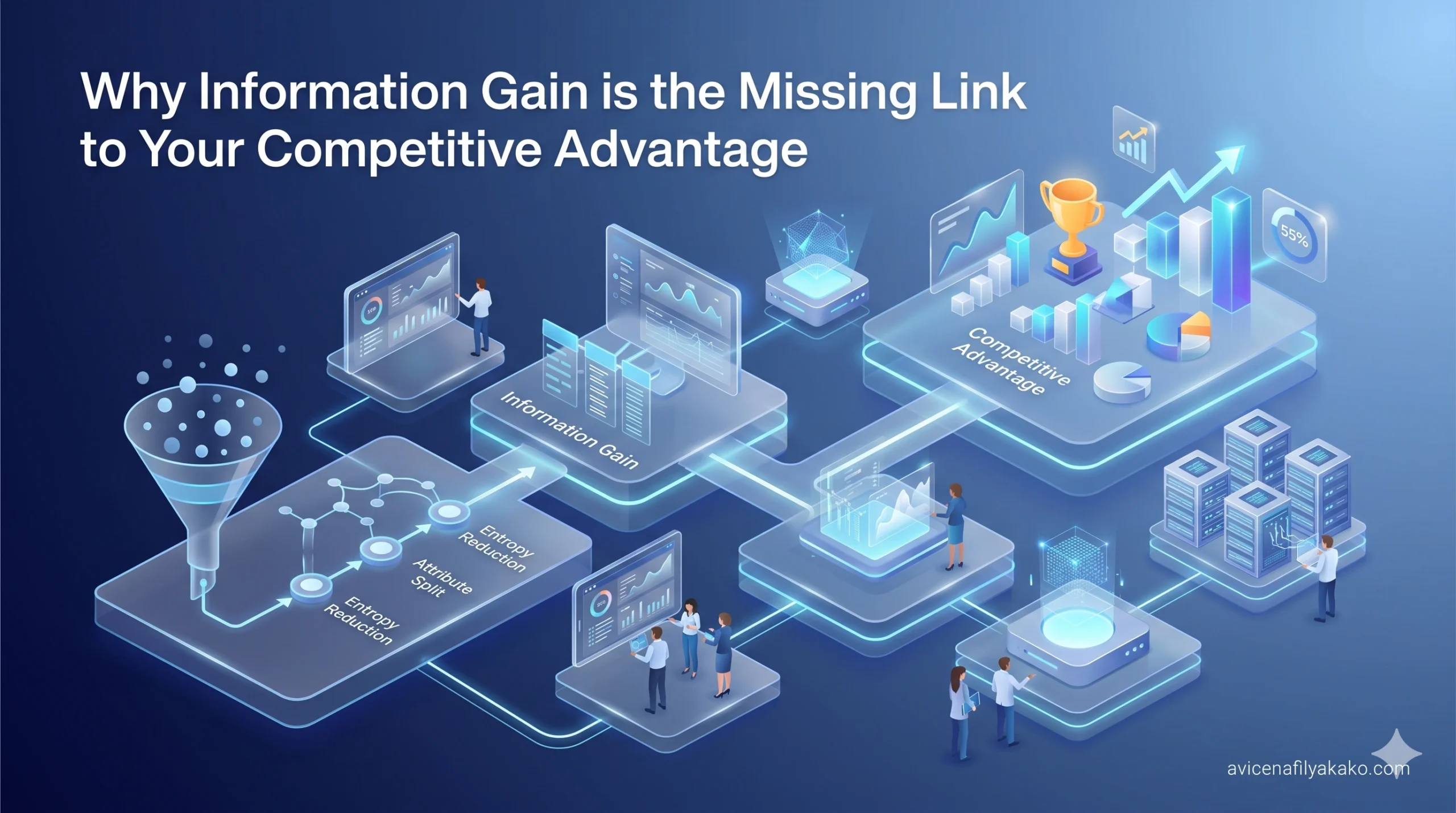
The digital landscape is currently saturated with “copycat content.” When everyone uses the same tools to access the same public data, the result is a sea of sameness that offers little value to the end-user. To stand out, you must embrace a concept borrowed from both machine learning and high-level strategy: Information Gain.
By providing unique insights that cannot be found elsewhere, you build a sustainable competitive advantage. It is no longer enough to be first or loudest; you must be the most informative.
What is Information Gain in Modern Strategy?
Information gain refers to the “extra” value a piece of content or a business model provides beyond what is already known. Think of it like a puzzle. If five people give you the same corner piece, you haven’t made progress. But if the sixth person gives you a piece of the center, that person has provided information gain.
In the context of strategy and innovation, this means moving beyond common knowledge. It involves using unique data or personal experience to offer a perspective that your competitors simply cannot replicate. This creates defensibility, making it harder for others to displace your brand in the minds of your audience.
Why Unique Data is Your Greatest Defensibility

In a world of generative AI, anyone can summarize a top-ten list. However, AI cannot go into the field, conduct a proprietary study, or share a nuanced failure from a decade of business experience.
As Michael Porter famously noted in a Harvard Business Review classic, “The information revolution is sweeping through our economy. No company can escape its effects.” Today, that revolution is centered on originality.
Building a Competitive Advantage Market Growth Strategy Around Insights
To achieve a competitive advantage, your market growth strategy should prioritize the collection and distribution of “Zero-Party” data. This is data you own and that no search engine has indexed yet.
- Proprietary Surveys: Ask your customers questions no one else is asking.
- Case Studies: Document your specific workflows and results.
- Contrarian Analysis: Challenge industry norms with evidence-based arguments.
| Strategy Pillar | Focus Area | Outcome |
| Unique Data | Original research & internal metrics | High Defensibility |
| Information Gain | Adding new value to the conversation | Higher Search Rankings |
| Innovation | New frameworks and mental models | Established USP |
How Information Gain Impacts Search and Authority

Google recently updated its quality rater guidelines to emphasize “Experience.” This was a direct response to the influx of repetitive content. If your article provides the same information as the top five results, you aren’t helping the user; you’re just adding noise.
If your article provides the same information as the top five results, you aren’t helping the user; you’re just adding noise. This is why it is crucial to perform a content pruning audit annually to remove redundant posts and ensure every page on your site offers unique ROI-driven value.
The Link Between SEO and Strategy
According to insights on information gain in SEO, search engines are increasingly rewarding pages that offer something new. When you provide a fresh data point or a unique angle, you are more likely to earn a “Featured Snippet” because you are the sole source of that specific answer.
Developing Competitive Advantage Your Unique Selling Proposition (USP)
Your USP should be rooted in what you know that others don’t. This is the heart of strategic management articles that actually move the needle. If your advice is interchangeable with a competitor’s, your brand is a commodity. If your advice is based on internal experimentation, your brand becomes a destination.
If your advice is based on internal experimentation, your brand becomes a destination. To bridge this gap effectively, you must align your content with high-intent, revenue-first keywords that prioritize business growth over vanity metrics.
“In business, the competition will always try to copy your products, but they can’t copy your unique insights and the trust you’ve built through transparency.” — Industry Maxim
Steps to Implement an Information Gain Framework
You can systematically increase your competitive advantage by following these three steps:
- Identify the “Information Gap”: Look at the top-ranking content for your target keywords. What are they missing? Is there a technical nuance or a practical hurdle they aren’t mentioning?
- Inject Expertise: Use your “boots on the ground” experience. If you are writing about finance, don’t just explain interest rates; show how a specific rate hike affected a real-world project you managed.
- Visual Differentiation: Use custom charts, proprietary frameworks, or unique tables to present your data. This makes your content more linkable and authoritative.
By focusing on these elements, you align your content with a broader strategy and innovation mindset. You stop chasing the algorithm and start leading the industry.
Frequently Asked Questions
How does information gain provide a competitive advantage?
Information gain provides a competitive advantage by offering unique, non-redundant value that distinguishes a brand from its competitors in both search results and customer perception. When you provide insights that others lack, you become an irreplaceable resource.
What are semantic keywords and why do they matter?
Semantic keywords are terms and entities related to your primary topic that help search engines understand the depth and context of your content. Using entities like “defensibility” or “market growth strategy” signals to algorithms that your article is a comprehensive authority on the subject.
Can a business survive without unique data?
While a business can survive on excellent execution alone, it lacks long-term defensibility without unique data or proprietary insights. Over time, competitors will replicate your processes, making your original insights the only lasting barrier to entry.
Disclaimer: The information provided in this article is for educational and general informational purposes only and should not be construed as professional advice (such as legal, medical, or financial). While the author strives to provide accurate and up-to-date information, no representations or warranties are made regarding its completeness or reliability. Any action you take based on this information is strictly at your own risk.
This article was authored by Avicena Fily A Kako, a Digital Entrepreneur & SEO Specialist using AI to scale business and finance projects.