
Efficient coding is rarely about the first draft; it is about the relentless pursuit of refinement. If you have ever asked an AI to “fix my code” and received a mediocre result, you likely hit a wall in prompt engineering. To bridge the gap between “working code” and “high-performance code,” you need to leverage Recursive Prompting.
Think of Recursive Prompting as an iterative dialogue. Instead of a single command, it is a layered process where the output of one prompt becomes the foundation for the next, systematically stripping away technical debt and inefficiency.
The Logic of Recursive Prompting

In traditional scripting, recursion occurs when a function calls itself to solve a smaller part of a larger problem. In SEO and AI engineering, we apply this same logic to our instructions. Before diving into recursive loops, it is essential to understand how mastering taxonomy in deliberate prompting allows you to categorize these instructions for better model alignment.
By using Recursive Prompting, you guide the AI to critique its own logic, profile its performance, and refactor the syntax in stages.
As software engineer Kent Beck famously said:
“Make it work, make it right, make it fast.”
Recursive prompting follows this exact trajectory. You aren’t just asking for a solution; you are managing a digital code review that evolves with every turn.
How to Implement Recursive Prompting for Refactoring
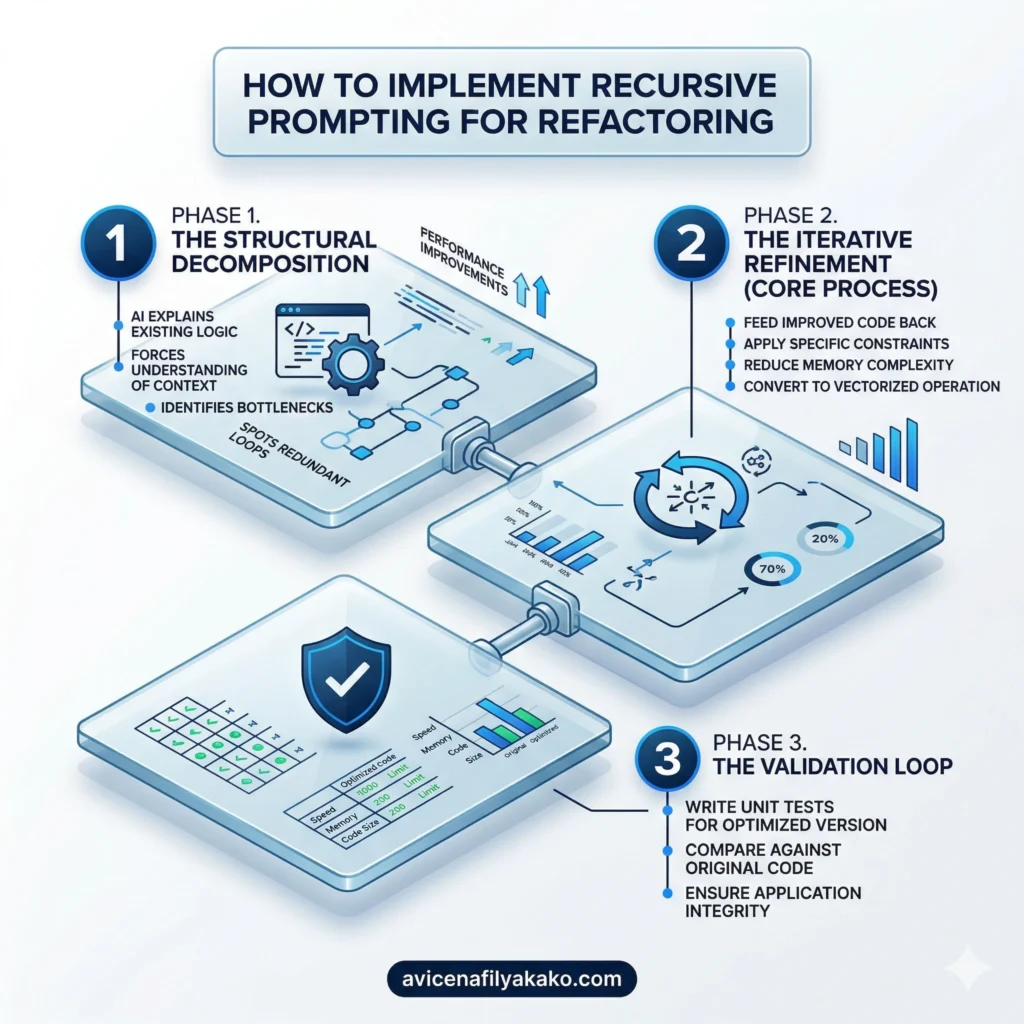
To get the most out of your optimization efforts, you should approach the task in three distinct phases. This ensures the AI doesn’t overlook edge cases or introduce new bugs while trying to be “clever.”
1. The Structural Decomposition
Start by asking the AI to explain the existing logic. This forces the model to “understand” the context before it starts changing things. You might ask it to identify bottlenecks or redundant loops within your initial script.
2. The Iterative Refinement
This is the core of Recursive Prompting. You take the improved code from step one and feed it back with a specific constraint, such as “reduce memory complexity” or “convert this to a vectorized operation.”
3. The Validation Loop
Finally, you ask the AI to write unit tests for the optimized version and compare them against the original. This ensures that your optimization hasn’t compromised the integrity of the application. You can further automate this audit phase by implementing self-querying prompt engineering techniques to let the AI autonomously generate its own validation parameters.
Comparison: Standard vs. Recursive Prompting
| Feature | Standard Prompting | Recursive Prompting |
|---|---|---|
| Primary Goal | Functional Output | Performance & Scalability |
| Process | Single-shot instruction | Multi-stage feedback loop |
| Code Quality | Basic/Working | Refined/Production-ready |
Strategic Scripting and Optimization

When you use Recursive Prompting, you are essentially teaching the AI your coding standards. For example, if you are working on a Python project, your second or third prompt might focus specifically on Refactoring for PEP 8 compliance or memory management.
- Identify Redundancy: Use the AI to spot repeated logic that can be abstracted into functions.
- Enhance Readability: Ask the AI to rewrite the optimization output specifically for human maintainability.
- Security Review: Prompt the model to look for vulnerabilities in the newly generated code.
Building Topical Authority in Code Review

To truly master Recursive Prompting, you must treat the AI as a junior developer who needs specific, sequential guidance. High-authority sources like Microsoft’s Documentation on Clean Code suggest that clear intent is the most critical factor in successful refactoring.
By breaking down your requests, you minimize the “hallucination” risk where the AI might suggest a library that doesn’t exist or a method that is deprecated. Instead, you get a clean, high-performance script that adheres to modern industry standards. Principles of Clean Code – Robert C. Martin
Practical Tips for Your Workflow

- Chain Your Prompts: Use the “Chain of Thought” technique. Ask the AI to think step-by-step before it provides the final code block.
- Constraint Injection: In your second recursion, add a constraint like “Ensure this code runs in O(n) time complexity.”
- The “Reverse” Prompt: Ask the AI, “What information are you missing to make this code 50% faster?” This often reveals gaps in your initial instructions.
To manage the multiple iterations generated during this process, consider using Git for prompt version control to track how your instructions evolve alongside your codebase.
FAQ
What is the main benefit of Recursive Prompting?
The main benefit is the significant increase in code quality and performance by forcing the AI to iteratively audit and improve its own output. This process mimics a professional code review, resulting in fewer bugs and more efficient optimization.
Can Recursive Prompting be used for any programming language?
Yes, it is a language-agnostic technique that works effectively for Python, JavaScript, C++, and even SQL scripting. Because it relies on the logic of the prompt rather than the syntax of the language, you can apply it to any technical stack.
How many iterations are needed for Recursive Prompting?
Generally, three to four iterations provide the best balance between effort and results. Beyond that, you may encounter diminishing returns where the AI starts making lateral changes rather than actual improvements in optimization.
Disclaimer: The information provided in this article is for educational and general informational purposes only and should not be construed as professional advice (such as legal, medical, or financial). While the author strives to provide accurate and up-to-date information, no representations or warranties are made regarding its completeness or reliability. Any action you take based on this information is strictly at your own risk.
This article was authored by Avicena Fily A Kako, a Digital Entrepreneur & SEO Specialist using AI to scale business and finance projects.