
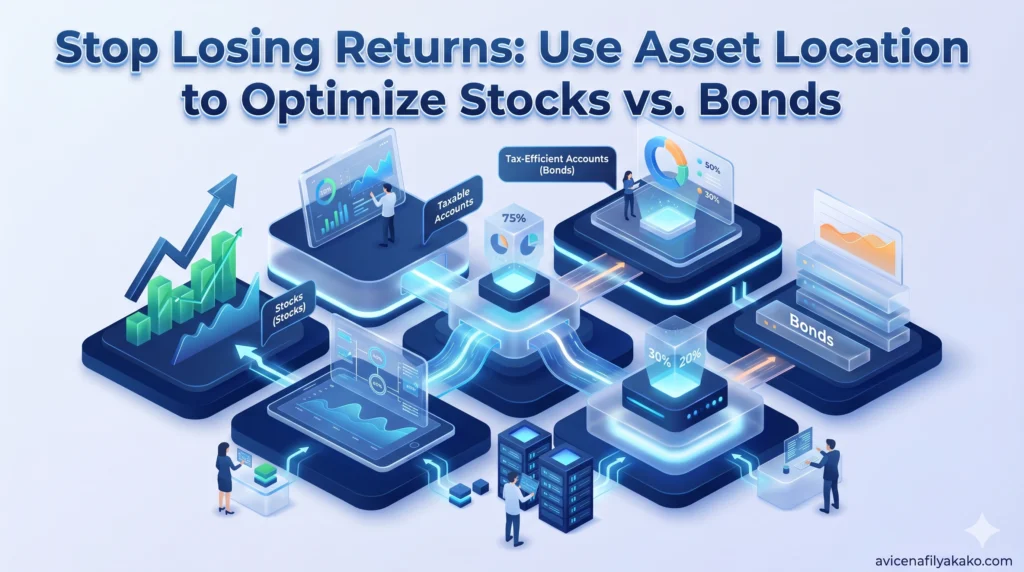
When you build an investment portfolio, your first instinct is likely choosing what to buy. You pick a mix of equities for growth and fixed income for stability. However, seasoned investors know that where you hold those assets is just as critical as what they are. This strategic placement is known as Maximize your after-tax returns by understanding where your investments live through a smart asset location plan., and mastering it can save you thousands of dollars over your investing lifetime.
Think of your investment portfolio like a refrigerator. You do not put the ice cream in the vegetable crisper, nor do you put the lettuce in the freezer. Each belongs in a specific environment to preserve its value. Similarly, different types of investments belong in specific accounts to shield them from unnecessary taxation.
Understanding Asset Location and Tax Drag

Every time your investments generate dividends, interest, or capital gains, Uncle Sam wants a cut. This loss of returns to Uncle Sam is called tax drag. Over a 20- or 30-year horizon, tax drag can quietly erode a massive chunk of your compounding wealth.
To combat this, we use asset location to strategically distribute investments across taxable and tax-advantaged accounts. It is entirely distinct from asset allocation, which focuses on your overall risk balance. Instead, this strategy focuses purely on maximizing your after-tax returns based on current tax rates. To lay the proper groundwork for your portfolio’s risk profile first, you can explore how to build a foundational strategy using strategic asset allocation models before optimizing for taxes.
“In this world, nothing is certain except death and taxes.” — Benjamin Franklin
While you cannot avoid taxes entirely, you can control their timing and impact. By understanding how the IRS treats different asset classes, you can optimize your placement to minimize your yearly income tax burden.
The Big Three: Categorizing Your Investment Accounts
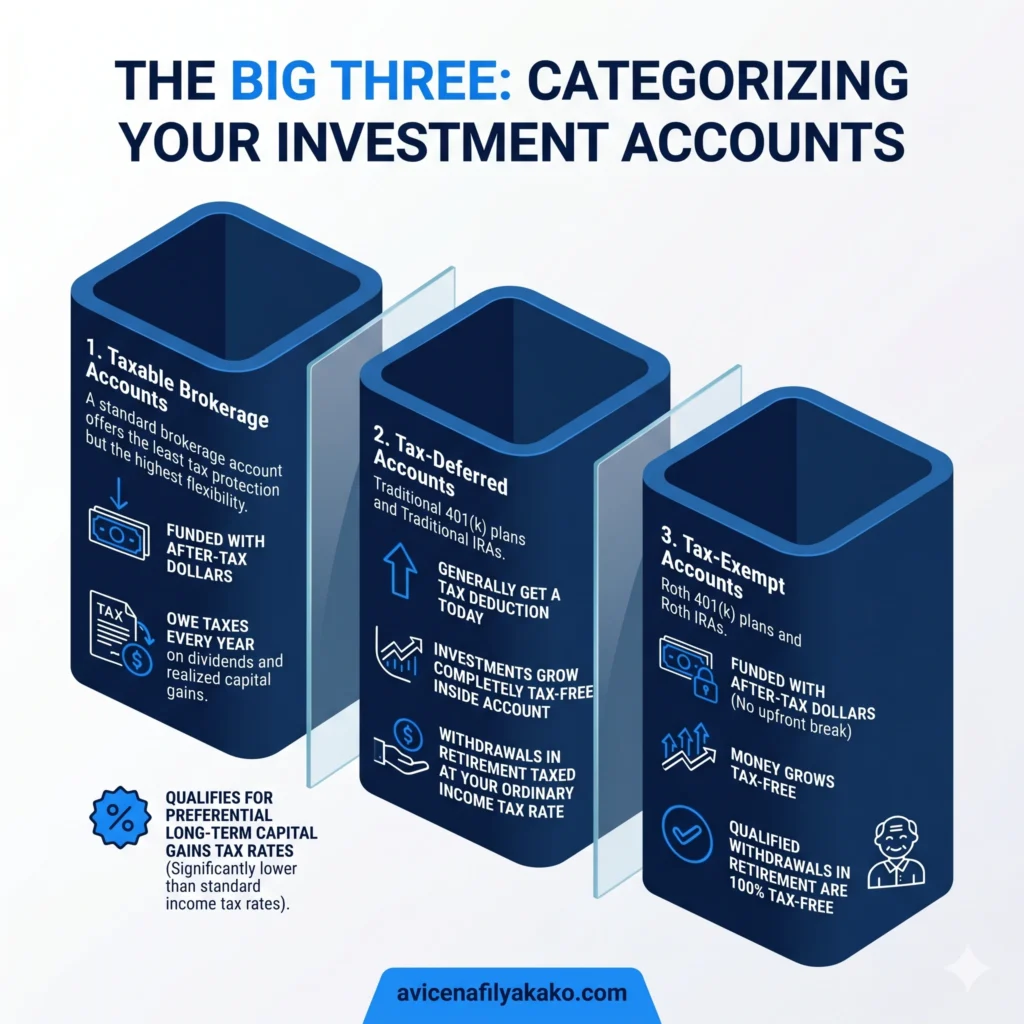
To execute an effective asset location strategy, you must first understand the three primary buckets where your money sits. Each bucket treats your growth and withdrawals differently.
1. Taxable Brokerage Accounts
A standard brokerage account offers the least tax protection but the highest flexibility. You fund it with after-tax dollars, and you owe taxes every year on dividends and realized capital gains. However, it qualifies for preferential long-term capital gains tax rates, which are significantly lower than standard income tax rates.
2. Tax-Deferred Accounts
These are your traditional 401(k) plans and traditional IRAs. You generally get a tax deduction today, and your investments grow completely tax-free inside the account. The catch? When you withdraw the money in retirement, every dollar is taxed at your ordinary income tax rate.
3. Tax-Exempt Accounts
Roth 401(k) plans and Roth IRAs make up this final bucket. You fund them with after-tax dollars, meaning you get no upfront break. However, the money grows tax-free, and qualified withdrawals in retirement are 100% tax-free. This makes them incredibly valuable for high-growth assets. If your income limits prevent direct contributions to these accounts, you can follow a step-by-step Backdoor Roth IRA tutorial to legally bypass the restrictions and capture tax-free growth.
Where Do Stocks and Bonds Belong?
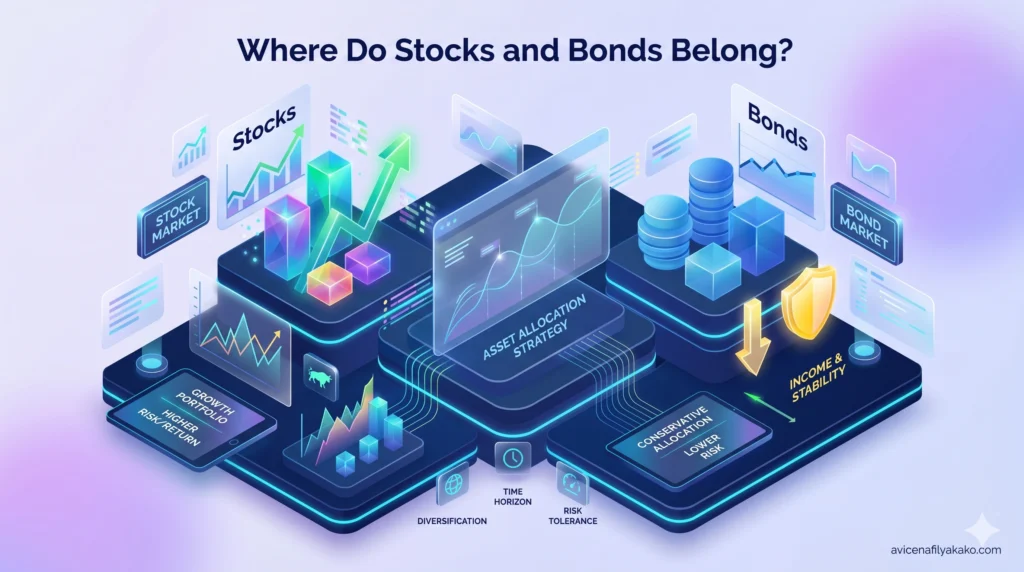
Now that the buckets are clear, let us look at the ideal placement for your core assets. The general rule of thumb is to place tax-inefficient assets into tax-advantaged accounts and tax-efficient assets into taxable accounts.
Why Bonds Fit Best in Tax-Deferred Accounts
Bonds generate regular interest payments. The IRS views this interest as ordinary income, meaning it is subjected to top-tier income tax rates rather than lower capital gains rates. If you hold a high-yield bond fund in a taxable brokerage account, you face a heavy annual tax hit. Placed inside a traditional 401(k), that interest compounds uninterrupted.
Why Stocks Thrive in Taxable Accounts
Equities are inherently more tax-efficient than bonds. Most broad-market stock index funds generate low dividend yields and very little turnover. Furthermore, when you hold stocks for more than a year, your profits qualify for long-term capital gains rates.
Here is a quick reference guide to help you visualize the ideal framework:
| Asset Class | Primary Tax Treatment | Ideal Account Location |
| Bonds & Fixed Income | Ordinary Income Taxes | Tax-Deferred (Traditional 401(k) / IRA) |
| High-Growth Stocks | Long-Term Capital Gains | Tax-Exempt (Roth IRA / Roth 401(k)) |
| Broad Index Funds (Equities) | Qualified Dividends & Capital Gains | Taxable Brokerage Account |
Advanced Strategies: Maximizing Growth While Minimizing Taxes

If you want to take your portfolio optimization a step further, look closely at the specific types of equities you own. Not all stocks are created equal in the eyes of the IRS. High-growth stocks or active mutual funds that trade frequently belong in your Roth accounts. Because Roth accounts are entirely tax-exempt, you want your highest-returning assets there to capture the maximum tax-free growth. This is particularly crucial for tech professionals with equity compensation, who must implement a framework for managing RSU concentrated positions to avoid overexposure and heavy capital gains.
High-growth stocks or active mutual funds that trade frequently belong in your Roth accounts. Because Roth accounts are entirely tax-exempt, you want your highest-returning assets there to capture the maximum tax-free growth.
Conversely, if you have broad-market ETFs that mirror the S&P 500, keep them in your taxable brokerage account. They generate minimal tax liabilities year-over-year and give you access to tax-loss harvesting strategies during market downturns. You can explore deeper research on these technical nuances via this RTD Financial Analysis on Asset Location.
Putting Your Asset Location Plan into Action

Transitioning to a tax-efficient portfolio does not mean you should sell all your assets tomorrow and trigger a massive tax bill. Instead, use a gradual approach to realign your accounts.
- Direct New Contributions: Route your incoming cash flow to the correct accounts. Buy your bond allocations inside your employer 401(k) and purchase your equity ETFs inside your personal brokerage.
- Rebalance Inside Tax-Advantaged Accounts: If you need to adjust your risk profile, do it inside your IRA or 401(k). Buying and selling assets within these wrappers triggers zero capital gains taxes.
- Review External Data: Always base your placement decisions on verified historical tax data and expert frameworks. For a detailed breakdown of the mathematical differences in placement efficiency, review The Finance Buff’s Comprehensive Asset Placement Guide.
Frequently Asked Questions
What is the main difference between asset allocation and asset location?
Asset allocation determines your mix of stocks and bonds based on your risk tolerance, while asset location determines the specific types of tax accounts where those individual investments should live to minimize your tax burden.
Can asset location save me money if I am in a low tax bracket?
Yes, because even in lower brackets, optimizing where you hold assets prevents unnecessary tax drag and preserves more compounding power for your long-term future.
Should I ever hold bonds in a taxable brokerage account?
You should generally avoid holding regular corporate or federal bonds in taxable accounts, though municipal bonds are an exception since their interest is often exempt from federal income taxes.
Disclaimer: The information provided in this article is for educational and general informational purposes only and should not be construed as professional advice (such as legal, medical, or financial). While the author strives to provide accurate and up-to-date information, no representations or warranties are made regarding its completeness or reliability. Any action you take based on this information is strictly at your own risk.
This article was authored by Avicena Fily A Kako, a Digital Entrepreneur & SEO Specialist using AI to scale business and finance projects.