

Imagine preparing for a cross-country road trip. You check your fuel tank, calculate the mileage, and map out gas stations. Retiring feels remarkably similar, but instead of tracking miles, you are measuring decades. How do you ensure your financial tank does not hit empty before you reach your destination?
Enter the Safe Withdrawal Rate, a foundational concept engineered to prevent retirees from outliving their money. At the heart of this strategy is the traditional 4 percent rule, a benchmark designed to guide your spending from day one of your post-career life.
But as market landscapes shift, a critical question arises: can this classic framework survive a modern financial stress test? Let us break down how this rule functions, where it falters, and how to adapt it for your personal retirement plan.
Understanding the Foundation of the 4 Percent Rule

Originating from a landmark 1994 study by financial planner William Bengen, the 4 percent rule offers a straightforward formula for portfolio longevity. The mechanism is simple: you withdraw 4% of your total investment portfolio in your first year of retirement. For every subsequent year, you adjust that initial dollar amount to keep pace with inflation.
First Year Withdrawal = Portfolio Value × 4%
Following Years = Previous Withdrawal + Inflation Adjustment
For instance, if you accumulated a $1 million portfolio, your first-year distribution would be $40,000. If inflation climbs by 3% the following year, you increase your second-year payout to $41,200. This method aims to preserve your purchasing power while maintaining a stable lifestyle.
“The safe withdrawal rate is a powerful concept because it translates an abstract nest egg into a concrete, predictable income stream.” – William Bengen
This framework serves as the bedrock for the FIRE movement (Financial Independence, Retire Early), where adherents calculate their freedom number based on this exact math. To calculate retirement plan milestones effectively, FIRE enthusiasts simply multiply their desired annual expenses by 25 to find their target portfolio size.
To calculate retirement plan milestones effectively, FIRE enthusiasts simply multiply their desired annual expenses by 25 to find their target portfolio size. Ahead of reaching that number, maximizing your investment vehicles through a triple tax-advantaged HSA strategy can significantly accelerate your savings rate by keeping healthcare costs tax-free.
Stress Testing the Safe Withdrawal Rate Against Market Reality
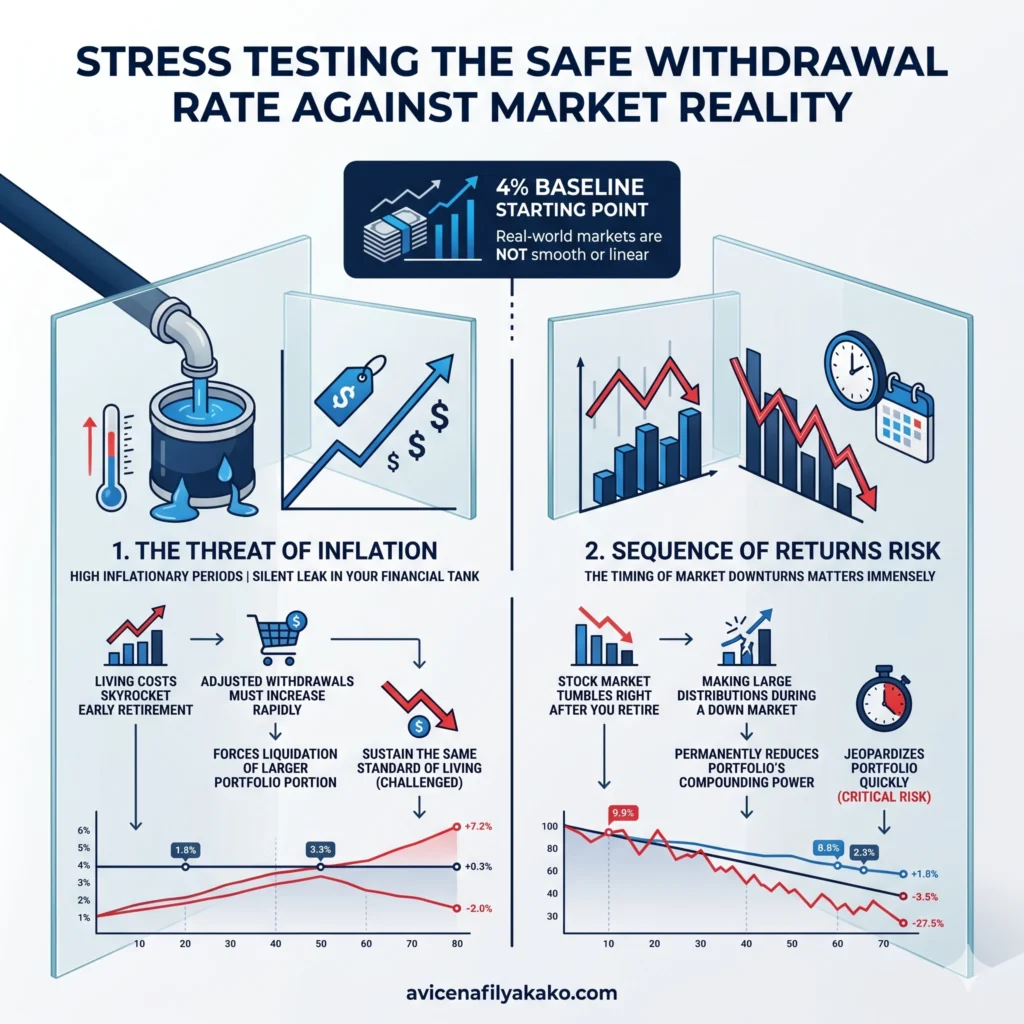
While a 4% baseline provides an excellent starting point, real-world markets do not behave like smooth, linear spreadsheets. Portfolios face severe macro pressures that can disrupt even the most meticulous retirement plan. To find a truly Safe Withdrawal Rate, we must subject our assets to two critical financial stressors.
1. The Threat of Inflation
High inflationary periods act like a silent leak in your financial tank. If your living costs skyrocket early in retirement, your adjusted withdrawals must increase rapidly. This forces you to liquidate a larger portion of your portfolio just to sustain the same standard of living.
2. Sequence of Returns Risk
The timing of market downturns matters immensely. If the stock market tumbles right after you retire, making large distributions during a down market permanently reduces your portfolio’s compounding power. This phenomenon, known as sequence of returns risk, can jeopardize a portfolio far quicker than a market drop occurring late in your retirement timeline.
To visualize how different economic climates dictate portfolio survival, let us look at how alternative withdrawal strategies compare:
| Withdrawal Strategy | Core Mechanism | Primary Benefit | Main Drawback |
| Traditional 4% Fixed | Constant inflation-adjusted dollar amounts. | Highly predictable income. | Vulnerable to early market crashes. |
| Variable Percentage | Adjusts distributions based on market performance. | Protects portfolio longevity. | Income fluctuates year to year. |
| Guardrails Approach | Caps or boosts spending at specific portfolio thresholds. | Maximizes spending flexibility. | Requires active, ongoing management. |
Optimizing Your Safe Withdrawal Rate for Modern Times

Relying blindly on a static rule can be risky. Modern asset management requires flexibility. If you want to protect your financial future, consider implementing these practical, dynamic adjustments to your distribution strategy:
- Establish a Dynamic Guardrail: Agree to reduce your spending by 10% if the market experiences a prolonged downturn. This simple adjustment preserves your core capital and allows your assets to recover faster when the market rebounds.
- Build a Cash Buffer: Maintain one to two years of living expenses in high-yield cash accounts. When markets decline, draw from this cash reserve instead of selling equities at a loss.
- Diversify Asset Allocations: Balance your equity exposure with low-risk fixed income instruments. Integrating tools like short-term treasury bills can stabilize your portfolio against severe volatility.
By embedding flexibility into your strategy, you transform a rigid historical rule into a resilient, personalized financial blueprint. Integrating tools like short-term treasury bills can stabilize your portfolio against severe volatility. To build this foundation, you can learn how to structure your portfolio using strategic asset allocation models that align with your long-term risk tolerance.
Strategic Links & Resources

To explore the mathematical foundations of historical withdrawal limits, look at the comprehensive data breakdowns regarding the four percent rule of retirement. These historical frameworks demonstrate how different asset mixes endure under varying market pressures.
Additionally, tracking modern adjustments to traditional benchmarks is crucial for long-term sustainability. You can evaluate updated portfolio survival rates by reading expert insights on managing a 4 percent rule retirement. Utilizing these data-driven resources will help you stress test your assumptions against modern economic realities.
People Also Ask (FAQ)
What is a Safe Withdrawal Rate for a 30-year retirement?
A Safe Withdrawal Rate for a traditional 30-year retirement horizon is historically estimated at 4%, assuming a balanced portfolio of stocks and bonds. This specific rate has successfully navigated major economic crises, including the Great Depression and the stagflation of the 1970s. However, many modern planners suggest aiming for 3.5% to 3.8% to account for longer life expectancies and lower projected forward yields.
How does the FIRE movement use the 4 percent rule?
The FIRE movement uses the 4 percent rule in reverse to determine the exact portfolio size needed to achieve early financial independence. By multiplying expected annual living expenses by 25, individuals can find their target savings goal. Because early retirement can span 40 to 50 years instead of the standard 30, early retirees often adjust their initial draw down lower to enhance portfolio longevity.
Can inflation break the 4 percent rule?
Yes, sustained high inflation can severely compromise the safety of the 4 percent rule if it occurs early in your retirement cycle. Because the rule mandates increasing your withdrawal amounts to match rising prices, rapid inflation forces you to pull larger sums out of your nest egg. If this occurs alongside a stagnant or declining market, it accelerates portfolio depletion.
Disclaimer: The information provided in this article is for educational and general informational purposes only and should not be construed as professional advice (such as legal, medical, or financial). While the author strives to provide accurate and up-to-date information, no representations or warranties are made regarding its completeness or reliability. Any action you take based on this information is strictly at your own risk.
This article was authored by Avicena Fily A Kako, a Digital Entrepreneur & SEO Specialist using AI to scale business and finance projects.