

For decades, the 60/40 balanced portfolio was the undisputed gold standard of investing. You put 60% of your money into stocks for growth, and 40% into bonds for safety. It was the ultimate “set-it-and-forget-it” blueprint for building a resilient investment portfolio.
But times change, and markets evolve. With shifting interest rates, stubborn inflation, and heightened stock market volatility, relying solely on this classic mix might leave your financial goals exposed. If you want your wealth to thrive in the modern financial landscape, it is time to look at asset allocation through a fresh lens.
Let us dive into how you can look beyond the 60/40 model to build a truly modern, resilient portfolio.
The Foundations of Strategic Asset Allocation

To understand where we are going, we first need to understand how we got here. Traditional asset allocation relies heavily on Modern Portfolio Theory (MPT). Introduced by economist Harry Markowitz in 1952, MPT suggests that you can minimize risk by combining different types of assets that do not move in perfect harmony.
Think of it like preparing for the weather. If you only sell sunglasses, a rainy season ruins your business. But if you sell both sunglasses and umbrellas, you protect your income no matter what the sky looks like. In the investing world, stocks are your sunglasses (bright and sunny growth), and bonds are your umbrellas (protection during a downpour).
“Diversification is the only free lunch in investing.” — Harry Markowitz
While Modern Portfolio Theory remains a foundational pillar of finance, the traditional 60/40 execution of it has hit some roadblocks. When inflation spikes, both stocks and bonds can drop at the same time, shattering the illusion of safety.
Why the Traditional 60/40 Asset Allocation Model is Struggling

The 60/40 rule worked beautifully during a multi-decade bull market where bond yields fell steadily, driving bond prices up. However, relying on just two asset classes creates a concentrated risk.
When macroeconomic conditions shift rapidly, the traditional relationship between equities and fixed income can break down. Data compiled in recent market cycles indicates that the diversification benefits of bonds can temporarily vanish when inflation remains high. According to insights from GMO’s Research Library, relying purely on traditional fixed income may no longer provide the real, inflation-adjusted returns you need to sustain long-term wealth.
In a high-inflation environment, traditional fixed income stops acting as a reliable shield for your investment portfolio. When paper assets lose purchasing power, many institutional investors rotate capital into hard assets; understanding the mechanics of a gold and commodities inflation hedge becomes essential for preserving your real wealth.
The Inflation Problem
Bonds pay a fixed rate of interest. If inflation rises higher than that fixed rate, your purchasing power actually shrinks. In a high-inflation environment, traditional fixed income stops acting as a reliable shield for your investment portfolio.
Modernizing Your Framework: Beyond Stocks and Bonds

If the traditional mix is losing its edge, how should you adapt? The answer lies in expanding your menu to include alternative investments. These are assets that do not trade on public stock exchanges and often move to the beat of a completely different drum.
Traditional Portfolio:  [ Stocks: 60% ] <---> [ Bonds: 40% ]
Modernized Portfolio:   [ Stocks ] <---> [ Bonds ] <---> [ Alternatives (Real Estate, Commodities, Private Credit) ]
By introducing a broader range of asset classes, you can optimize your asset allocation for multiple economic environments, not just ideal ones.
Exploring Alternative Investments
Alternative investments encompass a wide variety of assets, including:
- Real estate and infrastructure
- Commodities and precious metals
- Private equity and private credit
- Hedge fund strategies
A comprehensive report by J.P. Morgan Private Bank highlights that incorporating alternatives can significantly improve a portfolio’s risk-adjusted returns by tapping into completely different drivers of growth.
Advanced Models for Enhanced Asset Allocation

Professional institutional investors—like university endowments and pension funds—rarely use a simple 60/40 split. Instead, they utilize advanced asset allocation frameworks designed to weather any economic storm. Here are three powerful models you can learn from.
1. The Endowment Model
Pioneered by the late David Swensen at Yale University, this model aggressively tilts away from public bonds and toward alternative investments. It focuses on illiquid assets like private equity, venture capital, and real estate to capture higher long-term returns.
2. Risk Parity
The risk parity approach turns traditional allocation on its head. Instead of allocating your money by dollar amounts (like 60% here, 40% there), you allocate by risk. Because stocks are inherently more volatile than bonds, a 60/40 portfolio actually derives about 90% of its total risk from the stock market. Risk parity balances the risk contributions equally across asset classes, often using leverage on the bond side to match the risk profile of equities.
3. The All-Weather Framework
Popularized by billionaire investor Ray Dalio, this model designs an investment portfolio to perform well across four distinct economic seasons: rising inflation, falling inflation, rising economic growth, and falling economic growth. It heavily utilizes commodities and inflation-linked bonds alongside equities.
| Asset Allocation Model | Core Focus | Typical Alternative Exposure |
| Traditional 60/40 | Simplicity and liquidity | 0% |
| Endowment Model | Illiquid, high-growth assets | 40% – 60% |
| Risk Parity / All-Weather | Equalized risk across economic seasons | 15% – 30% |
Practical Steps to Optimize Your Asset Allocation
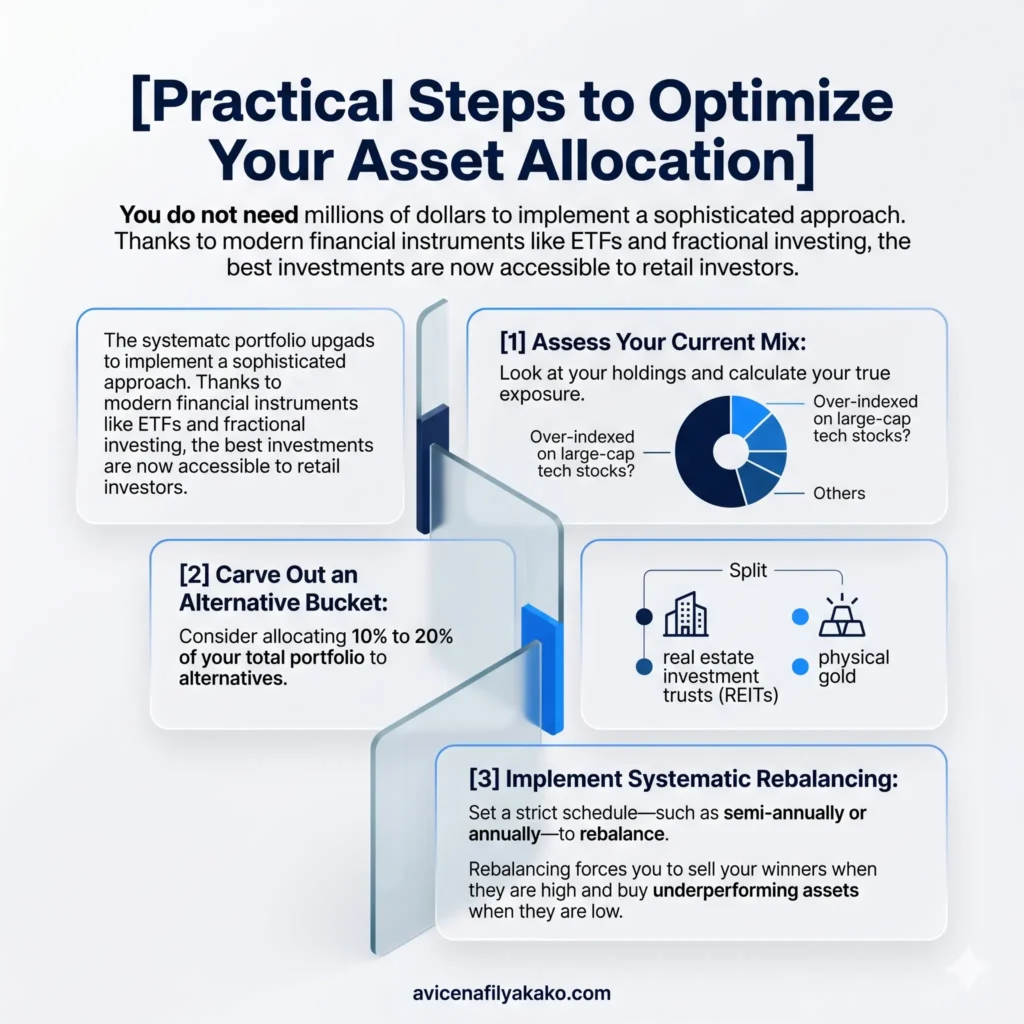
You do not need millions of dollars to implement a sophisticated approach. Thanks to modern financial instruments like ETFs and fractional investing, the best investments are now accessible to retail investors.
Here is how you can systematically upgrade your portfolio:
- Assess Your Current Mix: Look at your holdings and calculate your true exposure. Are you over-indexed on large-cap tech stocks?
- Carve Out an Alternative Bucket: Consider allocating 10% to 20% of your total portfolio to alternatives like real estate investment trusts (REITs) or physical gold.
- Maximize Your After-Tax Returns: Designing a great mix is only half the battle; you also need to implement a strategic tax-efficient asset location framework to ensure your high-yield and alternative assets are placed in accounts that minimize your tax burden.
- Implement Systematic Rebalancing: Set a strict schedule—such as semi-annually or annually—to rebalance. Rebalancing forces you to sell your winners when they are high and buy underperforming assets when they are low.
“The core of a successful portfolio strategy is identifying assets that perform differently under varying economic conditions.” — Ray Dalio
Frequently Asked Questions
What is the main goal of strategic asset allocation?
The main goal of strategic asset allocation is to establish a long-term target asset mix that balances risk and reward based on your specific financial goals, time horizon, and risk tolerance. This foundational blueprint helps ensure you stay invested through market highs and lows without making emotional decisions.
This foundational blueprint helps ensure you stay invested through market highs and lows without making emotional decisions. To see how your allocation holds up during the distribution phase, you can run a safe withdrawal rate stress test to verify your portfolio’s long-term sustainability against market downturns.
How often should I practice portfolio rebalancing?
You should practice portfolio rebalancing once or twice a year, or whenever your target asset mix drifts by more than 5%. Over time, certain investments will grow faster than others, which can unintentionally alter your risk profile if left unchecked.
Are alternative investments safe for retail investors?
Alternative investments carry unique risks, including lower liquidity and higher fees, meaning they require careful due diligence before you invest. While they offer excellent diversification benefits, they should complement a core portfolio rather than replace it entirely.
The financial world is vastly different than it was when the 60/40 model was created. Relying on a rigid, two-asset framework might restrict your growth and expose you to unnecessary volatility. By embracing modern asset allocation techniques, utilizing risk parity, and integrating a thoughtful mix of alternative investments, you can build a resilient portfolio designed to thrive in any market environment.
Disclaimer: The information provided in this article is for educational and general informational purposes only and should not be construed as professional advice (such as legal, medical, or financial). While the author strives to provide accurate and up-to-date information, no representations or warranties are made regarding its completeness or reliability. Any action you take based on this information is strictly at your own risk.
This article was authored by Avicena Fily A Kako, a Digital Entrepreneur & SEO Specialist using AI to scale business and finance projects.