

Imagine waking up to find that a massive chunk of your net worth is tied up in a single basket. For many tech and corporate executives, Restricted Stock Units (RSUs) represent a life-changing financial milestone. However, they also create a classic “eggs in one basket” dilemma. While watching your company stock soar is exhilarating, relying too heavily on one asset puts your financial future at risk.
When you hold a significant portion of your net worth in company stock, you are exposed to concentrated stock wealth. A single market downturn or company-specific crisis can wipe out years of hard work. Implementing a proactive RSU strategy is not about lack of loyalty to your employer. Instead, it is about securing your financial independence and protecting your hard-earned wealth.
The Anatomy of an RSU Strategy: How Vesting and Taxes Work

To build an effective RSU strategy, you must first understand how these assets behave. Unlike traditional stock options, RSUs are a promise from your employer to grant you shares of stock after meeting specific conditions. The timeline of this grant is determined by your vesting schedule.
“Diversification is protection against ignorance. It makes very little sense if you know what you are doing.” — Warren Buffett
While Buffett’s quote applies to elite stock pickers, for individual professionals, holding too much company stock is often a result of inertia rather than strategic choice. When your vesting schedule hits a milestone, those shares become yours completely. At that exact moment, the value of the vested shares is treated as standard income tax. Your company will usually withhold a portion of the shares to cover this tax obligation, but the remaining shares are deposited into your brokerage account.
What Happens After Vesting?
Once the shares vest, the clock starts ticking on your future tax liabilities. Any growth in the stock value from the vesting date onward is subject to capital gains tax. If you sell the shares within a year of vesting, you will face short-term capital gains rates. Holding them for longer than a year qualifies you for more favorable long-term capital gains tax rates.
Beyond understanding holding periods, implementing smart tax-efficient asset location strategies across your taxable and retirement accounts can significantly reduce your overall tax drag during reallocation.
Why Diversification Is Your Financial Safety Net

Think of your financial portfolio like a ship. If your entire net worth is tied to your employer, your salary, health insurance, and investment portfolio are all riding on the exact same hull. If that ship hits an iceberg, your entire financial life takes on water. Shift your perspective by treating vested RSUs exactly like a cash bonus.
If your company handed you a $50,000 cash bonus today, would you immediately use all of it to buy shares of your employer’s stock? If the answer is no, then holding onto your vested RSUs is effectively making that exact choice every single day. Strategic diversification allows you to spread that risk across various asset classes, industries, and geographic regions.
To achieve this balance effectively, you can implement strategic asset allocation models that align with your long-term risk tolerance and financial goals.
[Vesting Event] ➔ [Income Tax Paid] ➔ [Concentrated Position] ➔ [Strategic Diversification]
To manage this transition smoothly, you need a clear framework for decision-making. The table below outlines how to evaluate your current position and choose the right path forward:
| Current Exposure Level | Risk Profile | Recommended RSU Strategy |
| Low (Under 10% of Net Worth) | Manageable risk; aligned with standard market fluctuations. | Hold or selectively liquidate based on short-term cash needs. |
| Moderate (10% to 25% of Net Worth) | Emerging vulnerability; company performance heavily impacts wealth. | Establish a systematic selling schedule to fund other asset classes. |
| High (Over 25% of Net Worth) | Extreme concentration risk; vulnerable to severe financial shocks. | Aggressively diversify using tax-loss harvesting and scheduled sales. |
Crafting a Step-by-Step RSU Strategy for Wealth Preservation
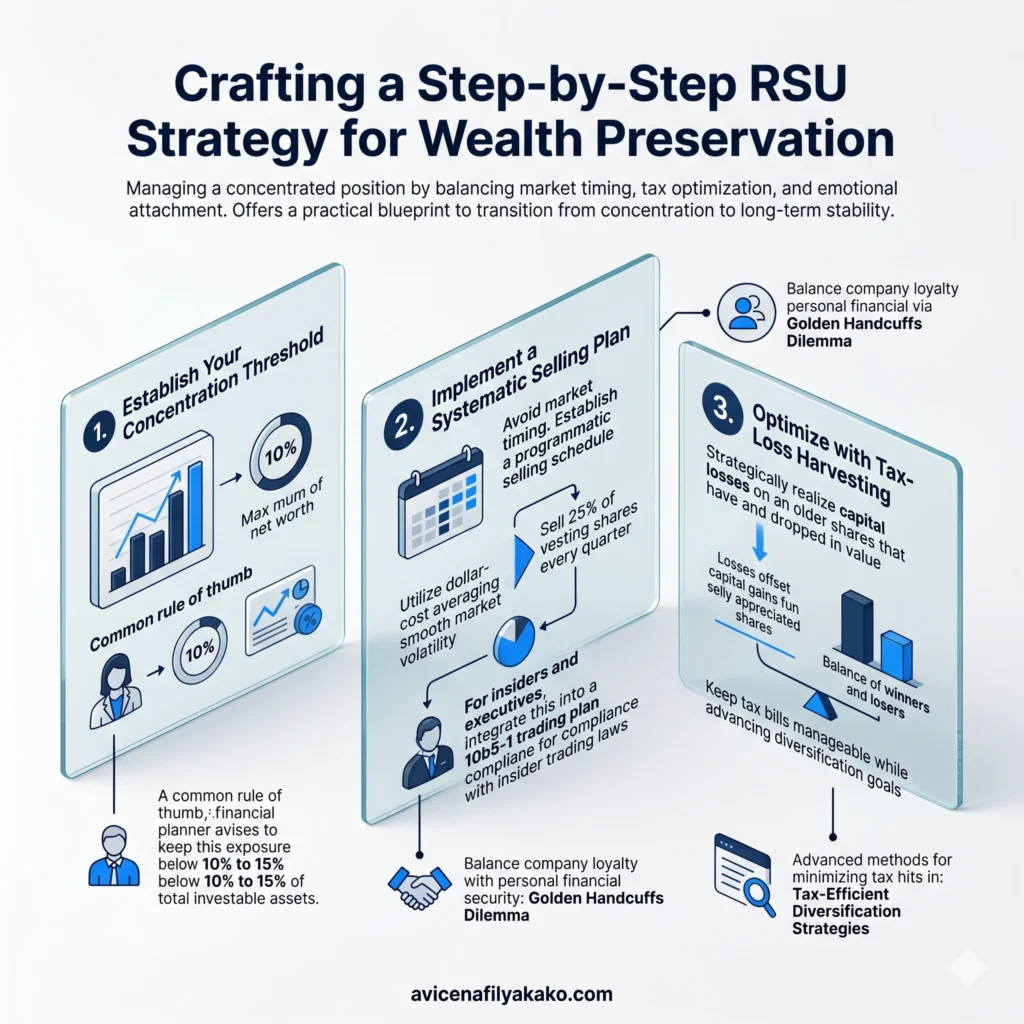
Managing a concentrated position requires balancing market timing, tax optimization, and emotional attachment. Here is a practical blueprint to help you transition from concentration to long-term stability.
1. Establish Your Concentration Threshold
Decide on a maximum percentage of your net worth that you are comfortable holding in company stock. A common rule of thumb among financial planners is to keep this exposure below 10% to 15% of your total investable assets.
2. Implement a Systematic Selling Plan
Avoid trying to time the market perfectly. Instead, establish a programmatic selling schedule, such as selling 25% of your vesting shares every quarter. This approach utilizes dollar-cost averaging in reverse, smoothing out market volatility. For insiders and executives, integrating this into a 10b5-1 trading plan ensures compliance with insider trading laws. Learn more about balancing company loyalty with personal financial security through the Golden Handcuffs Dilemma.
3. Optimize with Tax-Loss Harvesting
If you hold older shares that have dropped in value, you can strategically realize capital losses. These losses can offset the capital gains generated from selling highly appreciated shares. Balancing your winners and losers keeps your tax bill manageable while advancing your diversification goals. Explore advanced methods for minimizing tax hits with Tax-Efficient Diversification Strategies.
Once you have successfully diversified your wealth, the next step is protecting it for the next generation; exploring revocable living trust benefits can ensure these newly secured assets are seamlessly managed and passed down.
Frequently Asked Questions
Are RSUs taxed twice?
No, RSUs are not taxed twice; they are taxed at two different times on two different types of growth. You pay ordinary income tax on the total market value of the shares at the time they vest, and then you pay capital gains tax only on any increase in value that occurs from the vesting date until the day you sell the shares.
Should I sell my RSUs immediately upon vesting?
Selling your RSUs immediately upon vesting is often the most risk-averse strategy because it eliminates future concentration risk without triggering additional capital gains taxes. Since you are already taxed on the income value at vesting, selling right away means there is little to no price appreciation, resulting in zero additional tax liability.
How do capital losses help manage my RSU position?
Capital losses help manage your RSU position by offsetting the taxable profits you realize when selling appreciated shares of your company stock. By intentionally selling underperforming assets in your broader portfolio, you can use those losses to neutralize your capital gains, significantly lowering your overall tax burden during the diversification process.
Disclaimer: The information provided in this article is for educational and general informational purposes only and should not be construed as professional advice (such as legal, medical, or financial). While the author strives to provide accurate and up-to-date information, no representations or warranties are made regarding its completeness or reliability. Any action you take based on this information is strictly at your own risk.
This article was authored by Avicena Fily A Kako, a Digital Entrepreneur & SEO Specialist using AI to scale business and finance projects.