

When you think about saving for your golden years, household names like the 401(k) or a Roth IRA probably come to mind first. But there is a secret weapon hiding in the financial world that many savvy investors are quietly leveraging to build wealth. I am talking about HSA Strategy a specialized health savings plan that pulls double duty as a premier wealth builder.
If you are only using this account to pay for current doctor visits, you are missing out on its true potential. By treating it as a long-term investment vehicle, you can supercharge your financial future. Let’s look at how to master a forward-thinking HSA strategy to fundamentally transform your approach to wealth accumulation.
The Ultimate Wealth Secret: A Triple Tax-Advantaged Vehicle

Most retirement accounts force you to make a compromise. You either get a tax break today (like a traditional 401(k)) or a tax break tomorrow (like a Roth IRA). A Health Savings Account refuses to compromise. It is the only vehicle in the tax code that offers a triple tax-advantaged structure.
To put this into perspective, think of tax advantages as a financial umbrella. While a standard account shields you from a light drizzle, this specific account shields you from a total downpour.
Here is exactly how the triple threat works to your benefit:
- Tax-Deductible Contributions: The money you put into the account lowers your taxable income for the year, functioning similarly to 1040 deductions.
- Tax-Free Growth: Your investments inside the account grow completely free from capital gains taxes.
- Tax-Free Withdrawals: As long as you use the funds for qualified medical expenses, you will never pay a single dime in taxes when you take the money out.
How an Active HSA Strategy Transforms Healthcare into Wealth

To turn a basic medical savings account into a powerhouse retirement fund, you need to shift your mindset. Most people use their account like a medical debit card: money goes in, a medical bill arrives, and money immediately goes out.
An advanced HSA strategy requires you to stop spending those balances today. Instead, let that money sit, invest it in the stock market, and pay for your current medical bills out of pocket if your budget allows.
[Standard Route]  --> Contributes Funds --> Pays Current Bill --> Balance Resets to $0
[Strategic Route] --> Contributes Funds --> Invests Long-Term --> Compounding Exponential Growth
As financial planning expert Ed Slott famously noted, “The HSA is the most tax-efficient account out there because it beats the IRS at its own game.” By leaving your contributions untouched to compound over decades, you build a massive nest egg specifically earmarked for healthcare costs in retirement. As you optimize this account, it is equally vital to understand tax-efficient asset location strategies across your entire portfolio to minimize what you owe to the IRS. According to research on HSA Investment Benefits, investing your contributions early dramatically expands your long-term purchasing power compared to letting it sit in cash.
Mastering the “Medical DIY” Reimbursement Method
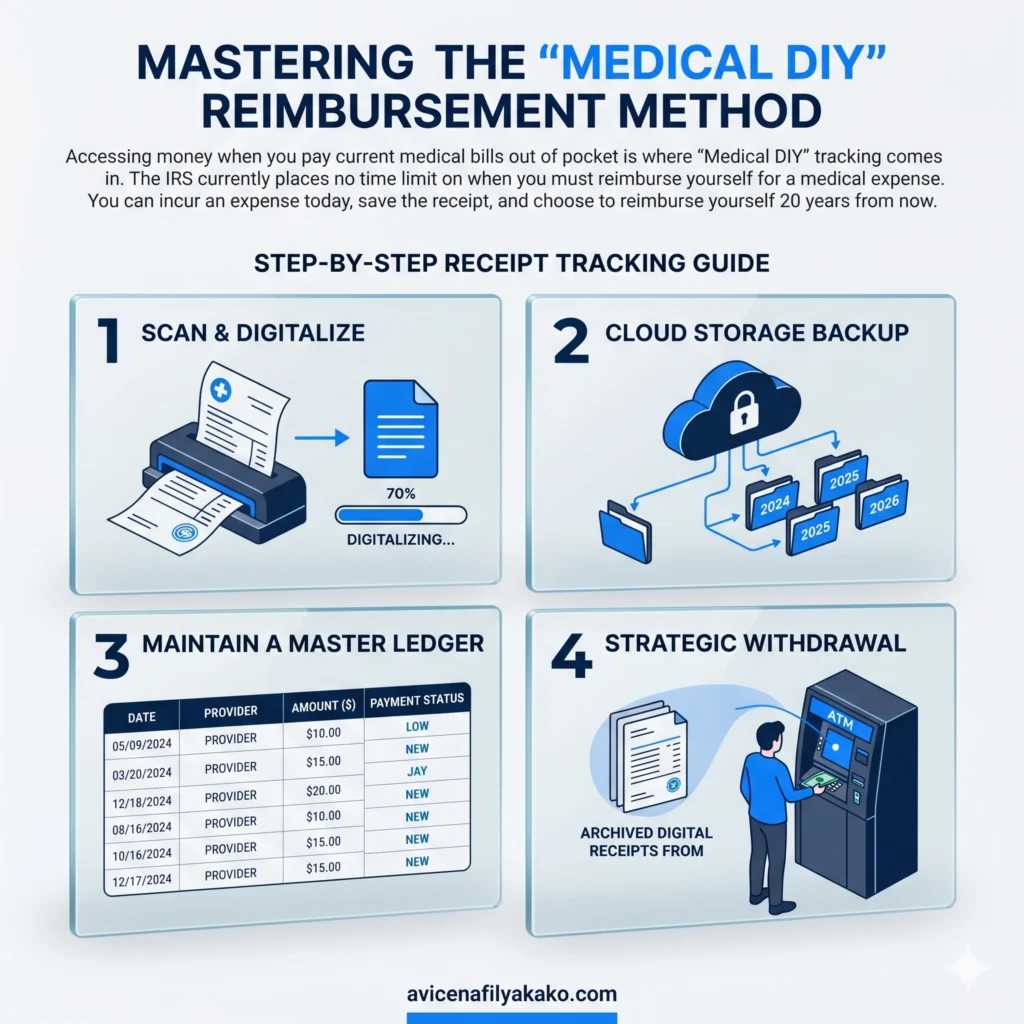
How do you eventually access this money if you are paying for current medical bills out of pocket? This is where a tactic known as Medical DIY tracking comes into play.
The Internal Revenue Service (IRS) currently places no time limit on when you must reimburse yourself for a medical expense. You can incur a medical expense today, save the receipt, and choose to reimburse yourself 20 years from now.
Step-by-Step Receipt Tracking Guide
- Scan and Digitalize: Whenever you pay a medical bill out of pocket, scan the receipt immediately.
- Cloud Storage Backup: Store these receipts in a dedicated secure cloud folder organized by year.
- Maintain a Master Ledger: Keep a simple spreadsheet tracking the date, provider, amount, and payment status.
- Strategic Withdrawal: Years down the road, pull out tax-free cash whenever you need it by matching the withdrawal to your archived receipts.
Account Comparison: HSA vs. Traditional Retirement Accounts

To see exactly why this tool deserves a spot in your portfolio alongside traditional choices, let’s look at how it stacks up against the heavy hitters.
| Feature | Health Savings Account | Traditional 401(k) / IRA | Roth 401(k) / IRA |
| Upfront Tax Deduction | Yes (Reduces 1040 deductions) | Yes | No |
| Tax-Free Investment Growth | Yes | Yes | Yes |
| Tax-Free Medical Withdrawals | Yes | No | No |
Turning Age 65: The Ultimate Financial Flexibility Rule

A common worry is what happens if you stay perfectly healthy and don’t need all that accumulated money for medical bills. Fortunately, the rules change drastically for the better once you hit age 65.
At age 65, your medical savings account effectively morphs into a traditional IRA. If you want to withdraw money for a non-medical expense—like buying a retirement RV or traveling—you can do so completely penalty-free. You will simply pay ordinary income tax on that withdrawal, just like you would with a standard retirement account.
Insights from Raymond James Wealth Insights emphasize that this dual-nature capability removes the risk of over-funding the account, making it an incredibly versatile asset during your retirement years. If you use it for health costs, it’s tax-free; if you use it for lifestyle costs, it behaves exactly like a regular retirement account. When planning these lifestyle distributions, make sure to run a safe withdrawal rate stress test to ensure your accumulated nest egg lasts throughout your entire retirement.
Frequently Asked Questions
Can I contribute to an HSA if I am not enrolled in a High-Deductible Health Plan (HDHP)?
No, you must be actively enrolled in a qualifying High-Deductible Health Plan (HDHP) to make contributions to the account. If you switch to a different type of insurance plan later, you cannot add new funds, but you can absolutely keep investing and spending the money already inside the account.
What happens to my account balance at the end of the calendar year?
Unlike a Flexible Spending Account (FSA), an HSA has absolutely no “use-it-or-lose-it” rules. Every single dollar you contribute rolls over from year to year automatically, remaining yours forever until you choose to spend or invest it.
Are there any investment limits or restrictions inside the account?
Yes, the IRS sets clear annual contribution limits for individuals and families each year. Once your balance crosses a certain threshold determined by your provider, you can freely invest those funds into stocks, mutual funds, or low-cost index funds.
Disclaimer: The information provided in this article is for educational and general informational purposes only and should not be construed as professional advice (such as legal, medical, or financial). While the author strives to provide accurate and up-to-date information, no representations or warranties are made regarding its completeness or reliability. Any action you take based on this information is strictly at your own risk.
This article was authored by Avicena Fily A Kako, a Digital Entrepreneur & SEO Specialist using AI to scale business and finance projects.