

Managing a single website is like tending a garden. Managing a dozen is like running an industrial farm. When you transition from a single-site owner to a digital asset manager, your primary challenge isn’t just “writing more”; it’s Portfolio Management.
If you treat every site as an isolated island, you will eventually drown in administrative debt. To stay afloat and profitable, you need a centralized strategy that prioritizes efficiency and scaling.
Why Portfolio Management is the Engine of Growth

Think of Portfolio Management as the dashboard of a high-performance vehicle. Without it, you’re driving blind. In the context of digital assets, this involves overseeing a collection of websites to ensure they align with your broader business goals while minimizing resource waste.
High-level Portfolio Management allows you to spot patterns. If one site in your portfolio sees a sudden spike in traffic due to a specific SEO tactic, you can quickly replicate that success across your other properties. Conversely, if a Google algorithm update hits one niche, a diversified portfolio protects your total revenue.
Before scaling, it is vital to perform a comprehensive content inventory valuation to understand the true market worth and performance of your existing digital assets.
“Efficiency is doing things right; effectiveness is doing the things right.” – Peter Drucker
The Pillars of Multi-Site SEO Success
To achieve topical authority across multiple domains, you cannot rely on manual checks. You need a framework that treats multi-site SEO as a repeatable process rather than a series of one-off tasks.
- Standardized Workflows: Create “plug-and-play” templates for keyword research and content briefs.
- Centralized Analytics: Use a single dashboard to monitor health metrics across all URLs.
- Cross-Link Synergy: Where relevant, create a spiderweb of internal authority by linking related assets (carefully avoiding “footprint” patterns that look unnatural to search engines).
Choosing the Right Content Management Platform

Your choice of a content management platform dictates how fast you can move. If your team has to log into ten different dashboards every morning, you are losing hours of productive time every week.
Modern cms website management has shifted toward “Headless” or multi-tenant architectures. These systems allow you to push updates to multiple sites from one central hub. For a deeper look at how to handle these technical hurdles, check out this guide on managing multiple websites efficiently.
Management Tool Comparison
| Feature | Legacy CMS | Multi-Site Content Management Tools |
|---|---|---|
| Login Access | Individual per site | Single Sign-On (SSO) |
| Asset Sharing | Manual upload per site | Centralized Media Library |
| SEO Updates | Site-by-site | Bulk Metadata Editing |
Scaling Content Operations Without Losing Quality

The biggest risk in Portfolio Management is “quality dilution.” When you scale, the soul of the content often disappears, replaced by generic AI fluff. You must build a system where efficiency does not kill the user experience.
To maintain a consistent voice across various domains, many managers implement brand scalability and ghostwriting systems that allow for high-volume output without sacrificing the unique authority of each site.
1. Build a Content Assembly Line
Instead of hiring “generalists,” hire specialists. Have one person handle keyword research, another for drafting, and a senior editor for the final polish. This assembly line approach ensures that multi-site SEO standards are met at every stage of the funnel.
2. Leverage Content Management Tools
Automation is your best friend. Use content management tools to schedule posts months in advance. Tools like Zapier or Make can connect your CMS to your project management software (like Trello or Asana), ensuring that no site is neglected.
3. Implement a “Core and Flex” Strategy
Your “Core” content consists of your high-traffic, money-making articles. Your “Flex” content is experimental. Effective Portfolio Management means spending 80% of your resources on the Core and 20% on the Flex to find the next big niche. For more on the fundamentals of this approach, refer to this comprehensive guide on website portfolio management.
Maximizing Efficiency Through Governance
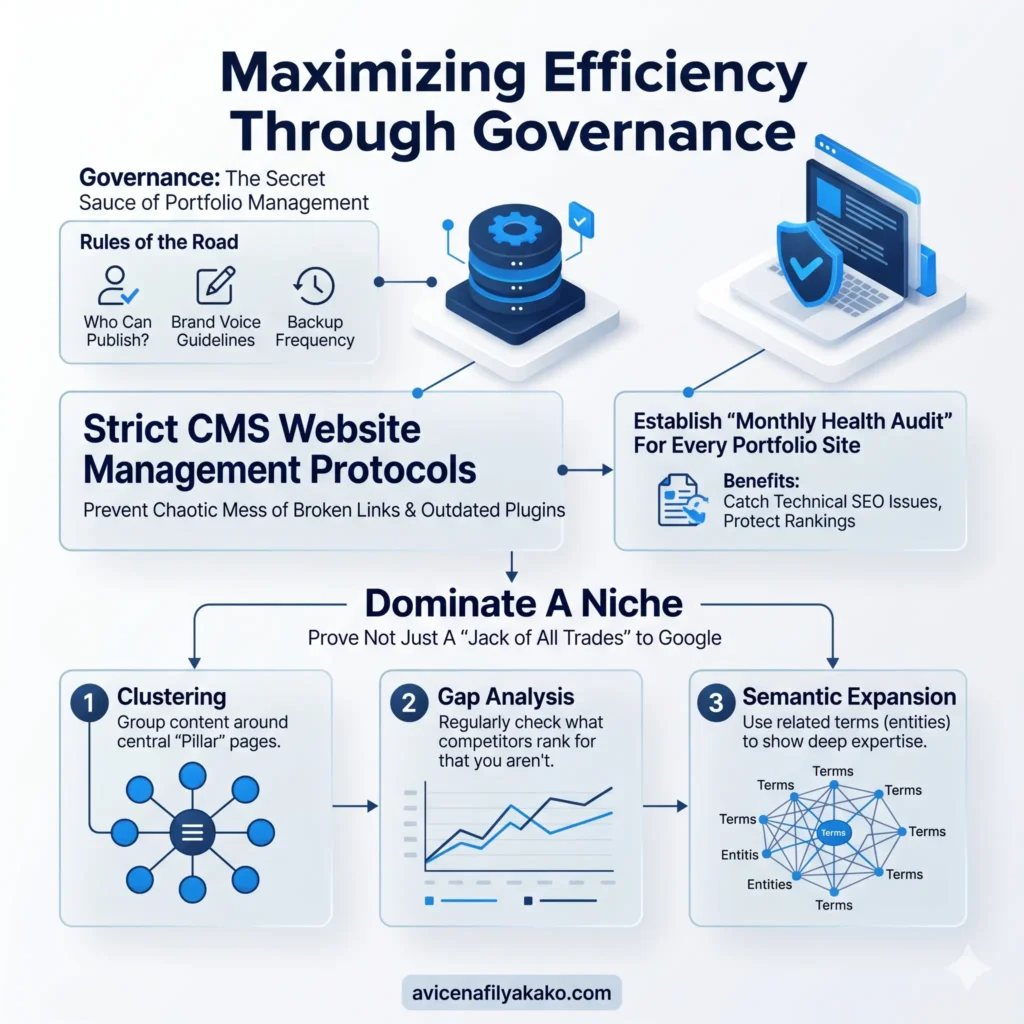
Governance sounds like a boring corporate word, but it is the secret sauce of Portfolio Management. It refers to the rules of the road—who can publish, what the brand voice is, and how often backups are performed.
Without strict cms website management protocols, your portfolio becomes a chaotic mess of broken links and outdated plugins. Establish a “Monthly Health Audit” for every site in your portfolio to catch technical SEO issues before they tank your rankings.
Part of this governance should include a periodic annual content pruning audit to maximize ROI, ensuring that underperforming pages are removed or updated to maintain the overall health of the portfolio.
Strategies for Topical Authority
To dominate a niche, you need to prove to Google that you aren’t just a “jack of all trades.”
- Clustering: Group content around central “Pillar” pages.
- Gap Analysis: Regularly check what your competitors are ranking for that you aren’t.
- Semantic Expansion: Use related terms (entities) to show deep expertise in your subject matter.
FAQ: Navigating Multi-Site Challenges
How many sites can one person effectively manage?
A single manager can typically handle 3 to 5 high-quality sites effectively before needing to delegate tasks or use advanced content management tools. Beyond this point, the administrative burden usually leads to a decline in content quality or SEO performance.
Is it better to have one big site or multiple small ones?
One large site usually gains topical authority faster, but a portfolio of multiple sites provides better risk diversification and allows you to dominate multiple niches simultaneously. Effective Portfolio Management balances these two approaches based on your specific revenue goals.
What is the biggest mistake in multi-site SEO?
The most common mistake is “content cannibalization,” where you accidentally have multiple sites in your portfolio competing for the exact same keywords. Always maintain a master keyword map to ensure your assets complement each other rather than fighting for the same search engine real estate.
The Path Forward
Success in the digital space isn’t just about how much you know; it’s about how much you can manage. By treating your websites as a cohesive unit through professional Portfolio Management, you transform from a webmaster into a digital mogul. Focus on efficiency, lean on your content management tools, and never stop optimizing.
Disclaimer: The information provided in this article is for educational and general informational purposes only and should not be construed as professional advice (such as legal, medical, or financial). While the author strives to provide accurate and up-to-date information, no representations or warranties are made regarding its completeness or reliability. Any action you take based on this information is strictly at your own risk.
This article was authored by Avicena Fily A Kako, a Digital Entrepreneur & SEO Specialist using AI to scale business and finance projects.