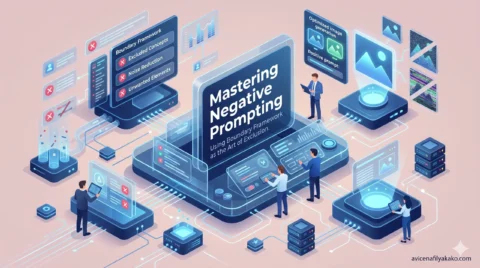
When you prompt an AI, you usually focus on what you want to see. You ask for “a sunset,” “a professional tone,” or “a Python script.” But as AI models become more sophisticated in 2026, the secret to precision isn’t just in the request—it’s in the exclusion.
I like to think of prompting like sculpting. To find the statue inside the block of marble, you have to know exactly which pieces of stone to chip away. This is where the Boundary Framework comes into play. By defining the “No-Go” zones of your prompt, you gain absolute focus control over the output.
What is the Boundary Framework?

The Boundary Framework is a structured approach to negative prompting that treats constraints as architectural walls. Instead of just hoping the AI avoids clichés or off-brand colors, you proactively build a fence around the desired result.
This method relies on negative constraints to narrow the latent space the AI explores. When you use the Boundary Framework, you aren’t just saying “don’t do this”; you are mathematically shifting the probability of certain token exclusion to ensure the model stays on track.
This systemic exclusion works best when integrated into a broader Taxonomy of Deliberate Prompting, which categorizes various input methods to achieve high-fidelity results.
The Three Pillars of Exclusion
- Stylistic Boundaries: Excluding specific tones, eras, or artistic influences.
- Structural Boundaries: Hard limits on word counts, formatting styles, or repetitive phrases.
- Content Boundaries: Removing specific objects, themes, or “hallucination-prone” topics.
Why Negative Prompting Matters for Topical Authority

If you want to establish yourself as an expert, your content needs to be clean. Traditional prompting often results in “AI fluff”—those flowery, repetitive sentences that scream “generated by a machine.” By mastering the Boundary Framework, you can filter out the generic noise that plagues unoptimized outputs.
“The difference between a good prompt and a great one is often found in what is left unsaid—or specifically forbidden.” — SamSeen, Prompt Engineering Specialist.
According to the latest research on structured prompting frameworks, defining what a model should not do is more effective at reducing hallucination than simply repeating what it should do.
Comparison: Standard vs. Boundary Framework
| Feature | Standard Prompting | Boundary Framework |
|---|---|---|
| Primary Focus | Inclusion (What to add) | Exclusion (What to avoid) |
| Control Level | Moderate / Variable | High / Precise |
| Output Quality | Often contains “AI-isms” | Human-like and tailored |
Implementing the Boundary Framework in Your Workflow
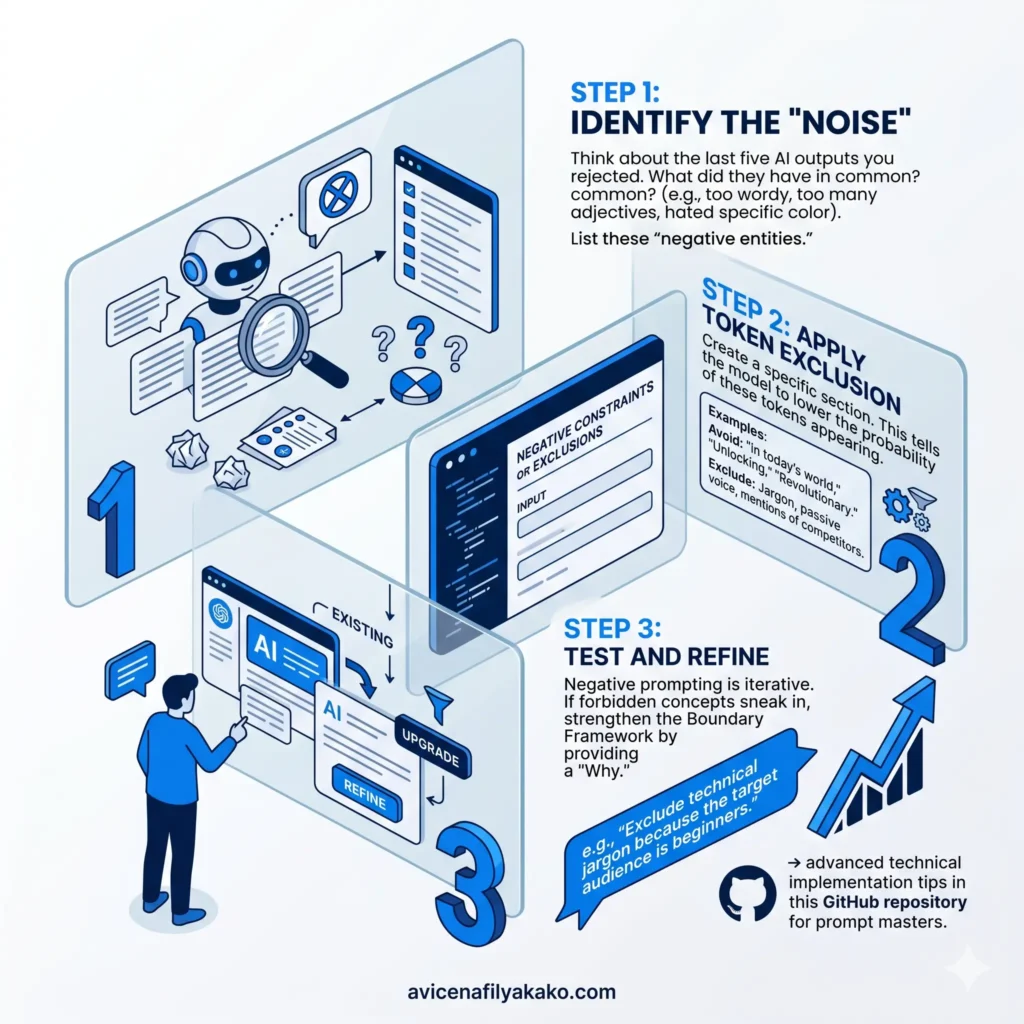
To use the Boundary Framework effectively, you need to think in terms of Focus control. Here is how you can apply it in three simple steps:
1. Identify the “Noise”
Think about the last five AI outputs you rejected. What did they have in common? Maybe they were too wordy, used too many adjectives, or included a specific color you hate. List these “negative entities.”
2. Apply Token Exclusion
In your prompt, create a specific section titled “Negative Constraints” or “Exclusions.” This tells the model to lower the probability of these tokens appearing. For example:
- Avoid: “In today’s world,” “Unlocking,” “Revolutionary.”
- Exclude: Jargon, passive voice, and mentions of competitors.
3. Test and Refine
Negative prompting is iterative. If the AI still sneaks in a forbidden concept, strengthen the Boundary Framework by providing a “Why.” For instance, “Exclude technical jargon because the target audience is beginners.” You can find more advanced technical implementation tips in this GitHub repository for prompt masters.
If a boundary feels too restrictive, try using the Step-Back Prompting Method to help the AI abstract the core principle of the task before applying the final negative constraints.
Advanced Focus Control: Negative Constraints in Action

When working with high-end models like Nano Banana Pro, the Boundary Framework becomes even more powerful. These models respond to “weights.” By explicitly forbidding certain styles, you free up the model’s “attention” to focus entirely on your positive instructions.
Common Negative Constraints to Use:
- For Copywriting: No rhetorical questions, no clichés, no exclamation marks.
- For Coding: No deprecated libraries, no inline CSS, no comments in Spanish.
- For Image Gen: No extra limbs, no blurry backgrounds, no text overlays.
By combining these constraints with Persona-Driven LLM Logic, you ensure the model not only avoids generic fluff but also adopts the specific mental models of a subject matter expert.
FAQ: Mastering the Art of Exclusion
What is the main benefit of the Boundary Framework?
The primary benefit is significantly higher precision by using negative constraints to eliminate unwanted “noise” and AI-generated clichés from the final output.
Can negative prompting cause the AI to fail?
Yes, if you provide too many conflicting boundaries, the model may become “constricted” and produce very short or low-quality responses, so it is best to prioritize your most important exclusions.
Is the Boundary Framework only for text generation?
No, this framework is equally effective for image generation and coding, where token exclusion helps prevent visual artifacts or insecure code patterns.
Moving Forward with Precision
Mastering the Boundary Framework changes your relationship with AI from a “guessing game” to a “design process.” When you take control of what is excluded, you naturally elevate the quality of what remains.
Start by adding a “Negative Constraints” block to your next project. You’ll find that the most powerful word in your prompting vocabulary isn’t “Create”—it’s “Exclude.”
Disclaimer: The information provided in this article is for educational and general informational purposes only and should not be construed as professional advice (such as legal, medical, or financial). While the author strives to provide accurate and up-to-date information, no representations or warranties are made regarding its completeness or reliability. Any action you take based on this information is strictly at your own risk.
This article was authored by Avicena Fily A Kako, a Digital Entrepreneur & SEO Specialist using AI to scale business and finance projects.