

Term vs universal life insurance comes down to how long you need coverage and what you are willing to pay. Term life covers you for a set period, such as 20 years, and usually costs the least for the coverage you get. Universal life is permanent coverage with flexible premiums and a cash value account. It costs more, and it only stays in force while the cash value covers the policy’s charges.
This guide compares how each works, the risks, and the US tax basics. It is educational, not personal financial advice.
How term life insurance works
Term life insurance covers you for a set period. It pays a death benefit only if you die during that term. Most term policies have no cash value.
Common terms run 10, 20, or 30 years. Two features are worth checking:
- Renewable term: you can continue coverage after the term ends, even if your health has changed, but the new premiums are higher.
- Convertible term: you can switch to a permanent policy that builds cash value. Premiums are usually higher for this option, and conversion has deadlines set in the policy.
How universal life insurance works
Universal life is a type of permanent, cash value insurance. It combines insurance coverage with a cash account that earns interest on a tax-deferred basis.
You can usually change how much you pay and adjust the death benefit within limits. Each month, the policy deducts the cost of insurance and other charges from the cash value.
The lapse risk most people miss
A universal life policy stays active only as long as the cash value is enough to cover those charges. If you pay too little, take loans or withdrawals, or the credited interest falls short, the cash value can run out. When that happens, the policy can lapse, and your beneficiaries get nothing.
Some policies add a no-lapse or secondary guarantee. As long as you pay the required premiums, the policy won’t lapse even if the cash value reaches zero. Read exactly what is guaranteed and what is only illustrated.
Types of universal life
- Traditional universal life: cash value earns an interest rate set by the insurer.
- Indexed universal life: interest is linked to a market index, with a guaranteed minimum rate.
- Variable universal life: cash value is invested in subaccounts, so it can lose value. These policies are sold with a prospectus.
Term vs universal life insurance side by side
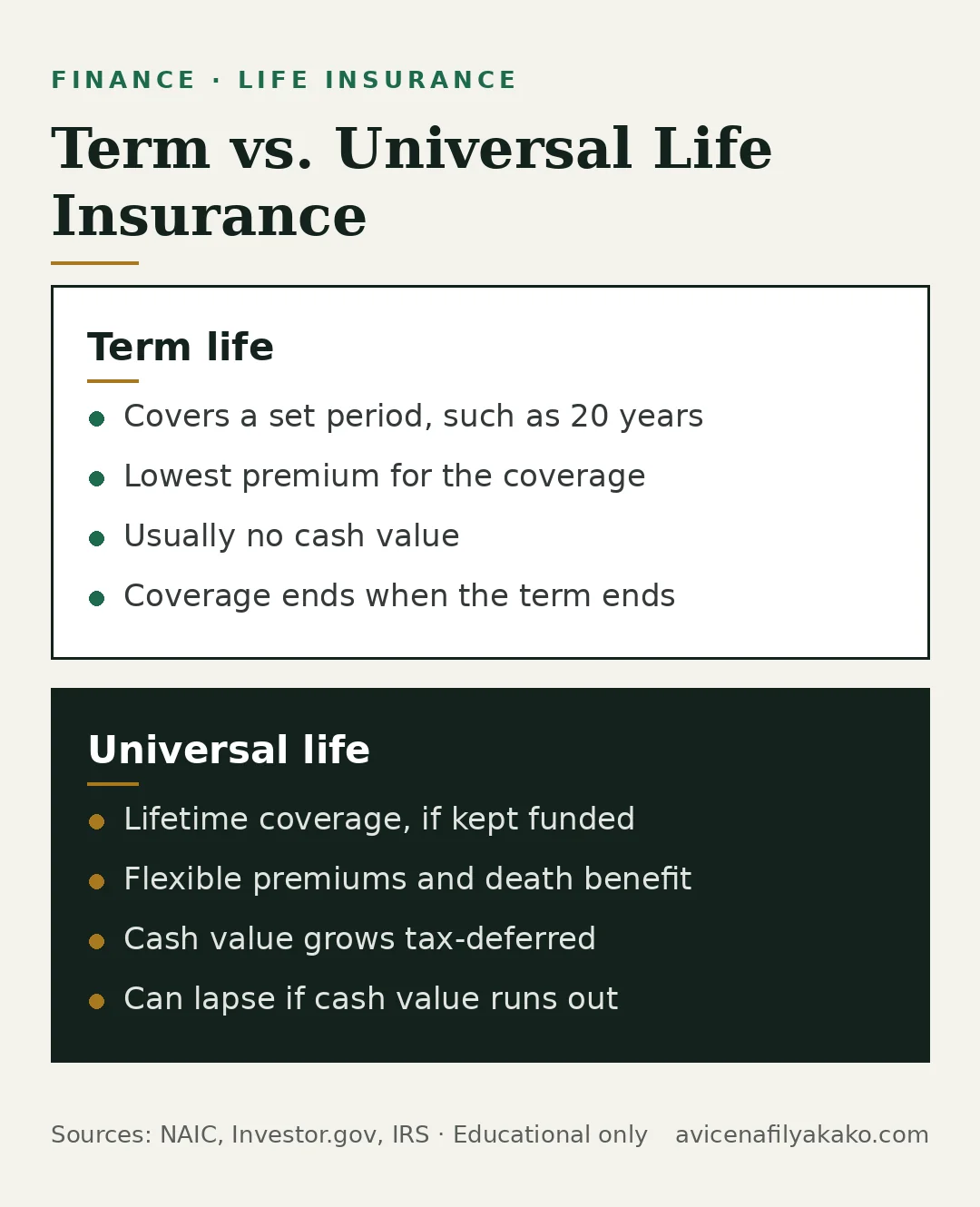
| Feature | Term life | Universal life |
|---|---|---|
| Coverage length | Set period, e.g. 20 years | Lifetime, if funded |
| Cash value | Usually none | Yes, earns interest |
| Premiums | Lowest for the coverage | Higher, flexible |
| Main risk | Coverage ends with the term | Lapse if cash value runs out |
| Complexity | Simple | Fees, illustrations, loans |
Death benefit options in universal life
Many universal life policies let you choose how the death benefit is figured:
- Level (often Option A): beneficiaries receive the face amount. The cash value is part of that amount, not added on top.
- Increasing (often Option B): beneficiaries receive the face amount plus the cash value. Policy charges can differ between options.
Outstanding policy loans and unpaid charges reduce what is paid out under either option.
US tax basics
- Death benefit: life insurance proceeds paid because of the insured’s death generally aren’t taxable income for the beneficiary. Interest paid on proceeds left with the insurer is taxable.
- Cash value: grows without current income tax while it stays in the policy.
- Loans: policy loans are usually not taxed when taken, but they reduce the cash value and raise the risk of lapse.
Special rules apply in some cases, such as policies sold for cash or heavily funded policies. Check with a tax professional.
How to choose
Term often fits when
- You need coverage for a set period, such as until a mortgage is paid or children are independent.
- You want the largest death benefit for your budget.
- You prefer to invest separately, for example in strategic asset allocation models, rather than inside a policy.
Universal life may fit when
- You need coverage that lasts for life, for example for estate planning or a dependent who will always need support.
- You can fund the policy reliably and will review it every year.
- You understand the fees and have compared guaranteed and illustrated values.
Permanent coverage is often discussed alongside other estate tools, such as a revocable living trust. If you are giving through your estate, see also donor-advised funds.
Questions to ask before you buy
- What is the highest premium I might have to pay to keep this coverage?
- Which values are guaranteed, and which are only illustrated?
- What are the surrender charges, and for how many years?
- For term: can I renew or convert, until what age, and at what cost?
Insurance rules and products differ by country. Outside the US, check your local regulator’s guidance, such as OJK in Indonesia.
Frequently Asked Questions
Can I convert term life insurance to universal life?
Often, yes. A convertible term policy lets you switch to a permanent policy that builds cash value. Check the deadline, which permanent policies are allowed, and how the new premium is set.
What happens to the cash value in universal life when I die?
It depends on the death benefit option. With a level option, beneficiaries get the face amount and the cash value isn’t added. With an increasing option, they get the face amount plus the cash value, minus any loans.
Can a universal life policy lapse?
Yes. If the cash value can’t cover the policy’s charges and no no-lapse guarantee is in effect, the policy can end with no death benefit. Loans, withdrawals, and low credited interest raise that risk.
Does term life insurance have cash value?
Most term policies don’t. They pay a death benefit only if you die during the term.
Actionable Next Steps
- Work out how much coverage you need and for how many years.
- Get quotes for term coverage first, as a baseline.
- If you consider universal life, ask for an illustration with guaranteed values and plan to review it every year.
References
- National Association of Insurance Commissioners. Life insurance.
- National Association of Insurance Commissioners. Life insurance buyer’s guide.
- Investor.gov (U.S. SEC). Variable life insurance.
- IRS. Life insurance & disability insurance proceeds.
- IRS. Publication 525: Taxable and nontaxable income.
- SOA and LIMRA. U.S. universal life lapse study, 2015–2021.
Disclaimer: The information provided in this article is for educational and general informational purposes only and should not be construed as professional advice (such as legal, medical, or financial). While the author strives to provide accurate and up-to-date information, no representations or warranties are made regarding its completeness or reliability. Any action you take based on this information is strictly at your own risk.