

A content monetization path is the planned sequence that takes a reader from your free content to a paid product or service. It usually runs in four steps: free content that answers real questions, a way to capture interest such as an email list, a low-cost entry offer, and a core product. Designing that sequence on purpose, rather than adding a “buy” link later, is what turns a side project into a business.
I saw this firsthand building rawatin.com, a new service website. Its early articles were written to answer the comparison questions buyers ask before booking, and one reached #1 on Google for its target query when the domain was only 10 days old. The full breakdown is in the rawatin case study. A ranking only matters if the page leads somewhere, and that idea is what this guide is built on.
What Is a Content Monetization Path?
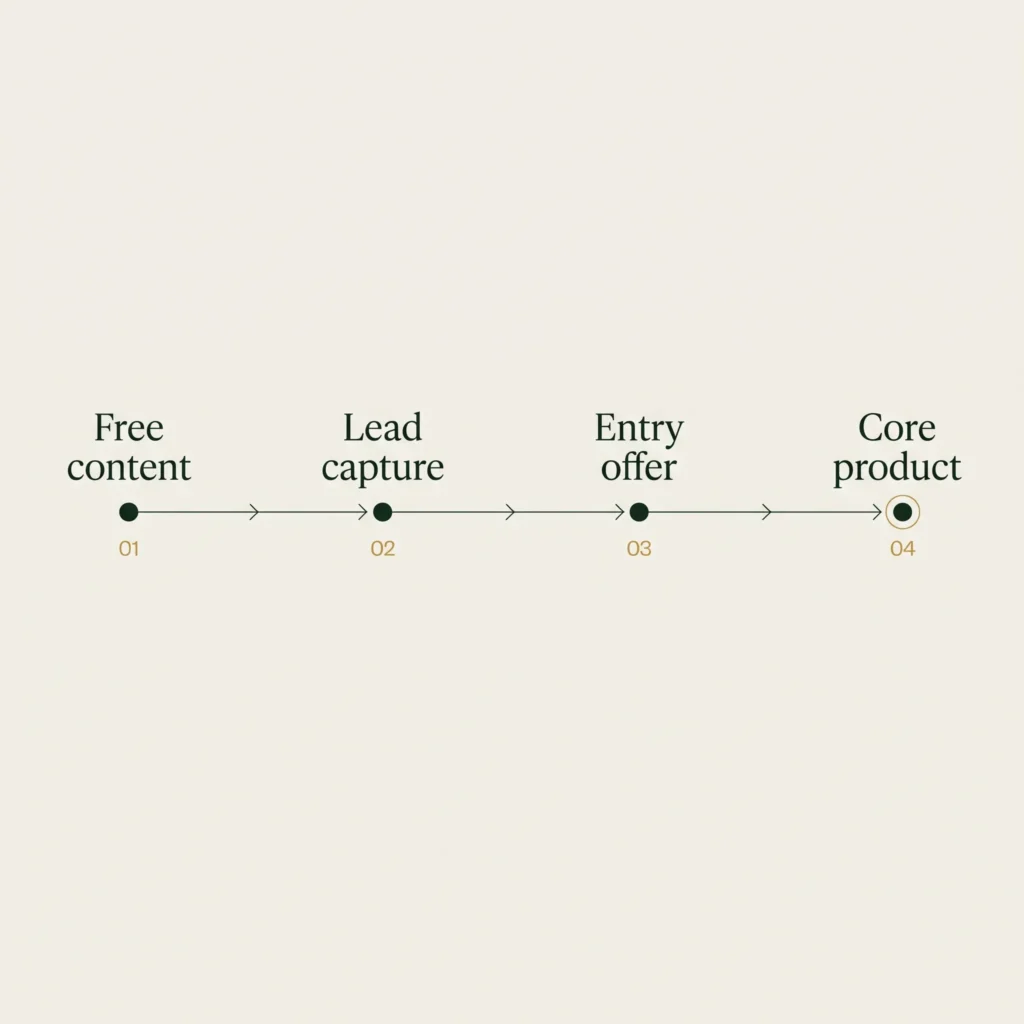
A monetization path is the logical sequence of steps a lead takes from discovering your free content to purchasing your core offering. Think of it like a staircase. Each step should provide enough value to make the user want to climb to the next level.
To grow your business, you must decide whether you are selling your time, your expertise, or a scalable software solution. Each choice dictates how you build your funnel and interact with your community.
Comparison of Popular Revenue Models
| Model | Primary Focus | Scalability |
| SaaS | Product-led growth | High |
| Lead Gen | Relationship building | Medium |
| Consulting | Expertise & Time | Low |
Step 1: Laying the Foundation with Content
Before you can sell, you must attract. High-quality content acts as your digital storefront. By focusing on lead gen early on, you capture the data necessary to understand what your audience actually needs.
Before scaling, it is crucial to perform a content inventory valuation to identify which existing assets have the highest potential for conversion.
If you’re looking for deep dives on sustainable models, you might explore top monetization models to see which aligns with your long-term vision. The goal is to build topical authority so that when you finally present a product, the “sale” feels like a natural recommendation.
Step 2: Transitioning to Product-Led Growth
Once you have an audience, the most effective monetization path usually involves product-led growth. This is where your product itself becomes the primary driver of customer acquisition and retention. The term was coined in 2016 by the venture firm OpenView, which describes it as a strategy where the product drives acquisition, retention, and expansion (OpenView).
- Solve a specific pain point: Don’t build a “nice-to-have”; build a “must-have.”
- Create a feedback loop: Use your initial community to refine the product.
- Lower the friction: Offer a “freemium” tier or a low-cost entry point.
A great example of this is seen in modern community platforms. You can learn a lot from Skool monetization lessons about how to turn engagement into recurring revenue without alienating your followers.
Step 3: Scaling Your SaaS or Digital Product
Scaling is where many entrepreneurs hit a ceiling. To truly grow your business, you need systems that work while you sleep. This is the beauty of SaaS and digital products. Unlike consulting, where each new client needs more of your hours, a digital product can serve many more customers without the same increase in your time, although support, refunds, and infrastructure still grow with it.
- Automate your lead gen: Use email sequences and landing pages.
- Optimize your conversion rate: Test one sales-page change at a time, such as the headline or the offer, and keep what measurably improves sign-ups.
- Focus on LTV: The Lifetime Value of a customer is more important than the first sale.
To ensure your traffic actually converts, focus your SEO efforts on targeting revenue-first keywords that attract users with high commercial intent.
Legal Checks Before You Start Charging
Monetizing content turns readers into customers, and customers have legal rights. Before you launch a paid offer, check four things. Rules differ by country; the examples below cover the US and the EU.
- Terms and refunds. Publish terms of sale and a refund policy before the first sale, and make sure your sales page says the same thing.
- Subscriptions and auto-renewal. In the US, the FTC’s “click-to-cancel” amendments to the Negative Option Rule were vacated by the Eighth Circuit on July 8, 2025, on procedural grounds. State automatic-renewal laws, such as California’s (Bus. & Prof. Code § 17600 et seq.), still apply, and the FTC has signaled interest in new rulemaking, so check the current status before you launch a subscription.
- EU withdrawal rights. EU consumers generally have 14 days to withdraw from an online purchase. For downloadable digital content such as an e-book or course files, Article 16(m) of the Consumer Rights Directive lets that right end only if the buyer gives prior express consent to immediate access and acknowledges losing it. Courts read this exception narrowly, especially for subscription services.
- Disclosures and claims. If you recommend tools through affiliate links, the FTC’s Endorsement Guides (16 CFR Part 255) treat that as a material connection that needs a clear disclosure near the link. Avoid income or results promises you cannot substantiate.
None of this is exotic, but fixing it after launch costs more than building it in. If your offer is significant or sold across borders, have a lawyer review your terms.
Avoiding the “Free Content Trap”
Many creators get stuck giving away too much for free. They fear that charging will drive people away. Yet the readers who trust you most are often the ones willing to pay for a solution that saves them time or solves a specific problem.
Think of your free content as the “What” and your paid product as the “How.” You tell them what they need to do for free, and you show them how to do it (or provide the tool to do it) for a fee. This split keeps your free content genuinely useful without giving away the implementation.
Building Resilience in Your Monetization Path
Market trends change, but a well-structured monetization path is resilient. By diversifying your income streams—perhaps combining a SaaS tool with a high-ticket mastermind—you protect your start up business from volatility.
Remember, the path isn’t a straight line. It’s an iterative process of testing, learning, and refining. Stay close to your data, listen to your customers, and don’t be afraid to pivot if the market signals a different need.
Where This Approach Falls Short
- It assumes you have an audience. With little traffic, a monetization path has nothing to move through. Fix discovery first, and value what you already have with a content inventory valuation.
- Product-led growth fits software best. Services and consulting usually need a human sales step, which is where a B2B funnel lead generation strategy helps shorten the cycle.
- Scalability is directional, not guaranteed. Digital products still carry support, payment fees, refunds, and compliance costs that grow with your customer base.
For more frameworks on building revenue around content, browse the Business section.
Frequently asked questions
What is a content monetization path?
A content monetization path is the planned sequence a reader follows from your free content to a paid offer. Free articles answer the first questions, an email list or lead magnet captures interest, a low-cost entry offer tests willingness to pay, and a core product or service delivers the full solution.
What is the best monetization path for beginners?
For most beginners, the safest path is free content that answers real questions, then one paid offer close to what readers already ask for, such as a service, template, or course. This validates demand with little upfront cost before you invest in software or a large product build.
How does product-led growth differ from traditional sales?
Product-led growth uses the product itself as the main driver of acquisition, conversion, and expansion, usually through a free plan or trial. Traditional sales relies on people, outreach, and campaigns to persuade buyers before they use the product. Many businesses mix both as they grow.
What legal steps should I take before selling a digital product?
At minimum, publish clear terms, a refund policy, and honest product claims, and disclose any affiliate or paid relationships. If you sell subscriptions or sell to EU consumers, check auto-renewal and withdrawal rules for each market you serve. This is educational information, not legal advice.
Disclaimer: The information provided in this article is for educational and general informational purposes only and should not be construed as professional advice (such as legal, medical, or financial). While the author strives to provide accurate and up-to-date information, no representations or warranties are made regarding its completeness or reliability. Any action you take based on this information is strictly at your own risk.
Comments are closed.