
Have you ever found yourself staring at a complex prompt, watching your AI model hallucinate or provide a surface-level answer that misses the mark? It’s a common frustration. To get better results, sometimes we need to stop pushing forward and instead take a collective breath.
This is where Step-Back Prompting comes into play. Developed by researchers at Google DeepMind, this technique encourages Large Language Models (LLMs) to distance themselves from the immediate “noise” of a question and identify the underlying principles at play.
Think of it like a chess grandmaster. They don’t just look at the piece you moved; they “step back” to recognize the overall opening strategy you are employing. By abstracting the problem, the AI can find a more accurate, high-level solution.
What is Step-Back Prompting?

At its core, Step-Back Prompting is a strategy that involves two distinct stages: abstraction and reasoning. Instead of answering a query directly, the model is first asked a broader, related question. This “step-back” question helps the model retrieve a fundamental concept or principle that governs the specific problem.
By focusing on principle-based AI interactions, we reduce the likelihood of the model getting lost in the weeds of specific, often confusing, details. This method is particularly effective for math, coding, and deep logic tasks.
This structured approach is part of a broader framework of mastering the taxonomy of deliberate prompting, where every instruction is categorized to maximize the model’s reasoning capabilities.
“The art of being wise is the art of knowing what to overlook.” — William James
The Two-Step Mechanism
- Abstraction: The model identifies the core concept behind the user’s prompt.
- Reasoning: Using the high-level principle derived from the abstraction, the model circles back to solve the original query.
Why Abstraction Matters in Problem Solving

Standard prompting often forces an AI to jump straight into a task. However, complex problems are often layered. If the AI doesn’t understand the “Why” or the “How” behind a rule, it relies on probabilistic guessing rather than logical deduction.
Using Step-Back Prompting, we guide the AI toward problem solving by grounding it in factual or scientific laws. This significantly increases the accuracy of the output because the model is now working from a foundation of verified principles rather than just word associations.
Comparison: Standard vs. Step-Back Methods
| Feature | Standard Prompting | Step-Back Prompting |
|---|---|---|
| Initial Focus | Immediate answer | Underlying principle |
| Error Rate | Higher in complex logic | Lowered via abstraction |
| Logic Path | Linear / Direct | Hierarchical / Principles-first |
How to Implement Step-Back Prompting in Your Workflow
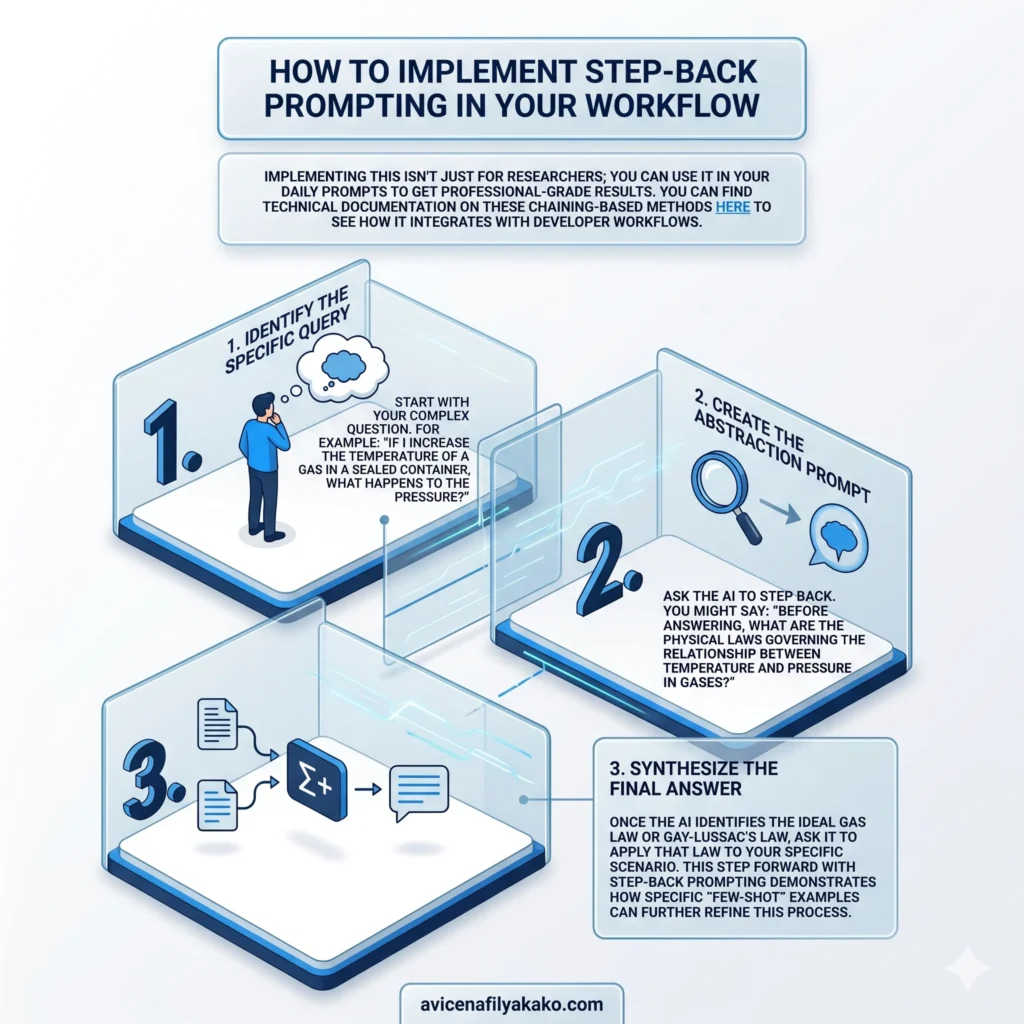
Implementing this isn’t just for researchers; you can use it in your daily prompts to get professional-grade results. You can find technical documentation on these chaining-based methods here to see how it integrates with developer workflows.
For tasks requiring extreme factual precision, you can combine this with a Chain of Verification prompting workflow to double-check the principles the AI identifies before it generates a final response.
1. Identify the Specific Query
Start with your complex question. For example: “If I increase the temperature of a gas in a sealed container, what happens to the pressure?”
2. Create the Abstraction Prompt
Ask the AI to step back. You might say: “Before answering, what are the physical laws governing the relationship between temperature and pressure in gases?”
3. Synthesize the Final Answer
Once the AI identifies the Ideal Gas Law or Gay-Lussac’s Law, ask it to apply that law to your specific scenario. This step forward with Step-Back Prompting demonstrates how specific “few-shot” examples can further refine this process.
The Power of Principle-Based AI

When I use Step-Back Prompting for SEO analysis or technical writing, I notice a massive shift in quality. Instead of the AI giving me generic advice, it begins to reference the core tenets of search intent and user experience.
Integrating these techniques allows for advanced semantic discovery prompts that help map out complex topical authorities more effectively than standard keyword research.
By leveraging abstraction, the AI mimics human expertise. We don’t just memorize answers; we learn the rules that generate those answers. Research published on arXiv proves that this specific “step-back” approach can improve performance on challenging benchmarks by double digits in some cases.
- Improved Accuracy: Reduces hallucinations in technical fields.
- Better Context: Ensures the AI understands the “bigger picture.”
- Scalability: Works across various domains, from physics to law.
FAQs About Step-Back Prompting
Does Step-Back Prompting work on all AI models?
Yes, Step-Back Prompting is a logic-based technique that works on most advanced LLMs, including GPT-4, Claude, and Gemini. While larger models handle the abstraction phase more effectively, even smaller models show improvement when guided to identify principles first.
How is this different from Chain-of-Thought (CoT)?
While Chain-of-Thought focuses on breaking a problem into sequential steps, Step-Back Prompting focuses on moving from the specific to the general (abstraction) before returning to the specific. CoT is a “horizontal” progression, whereas Step-Back is a “vertical” movement to a higher level of understanding.
Can I use this for creative writing?
Absolutely, you can apply these principles by asking the AI to first identify the themes or narrative structures of a successful genre before drafting your story. This ensures the creative output aligns with the fundamental “rules” of compelling storytelling rather than just mimicking random prose.
Final Thoughts on Advanced Prompting
Mastering Step-Back Prompting is a game-changer for anyone looking to move beyond basic AI interactions. By forcing the model to engage in abstraction and prioritize principle-based AI logic, you turn a simple chatbot into a sophisticated reasoning engine.
The next time you face a wall with a complex task, don’t just rephrase your question. Ask the AI to take a step back. You’ll be surprised at how much clearer the path forward becomes.
Disclaimer: The information provided in this article is for educational and general informational purposes only and should not be construed as professional advice (such as legal, medical, or financial). While the author strives to provide accurate and up-to-date information, no representations or warranties are made regarding its completeness or reliability. Any action you take based on this information is strictly at your own risk.
This article was authored by Avicena Fily A Kako, a Digital Entrepreneur & SEO Specialist using AI to scale business and finance projects.