Have you ever asked an AI a question, only to receive a response so vague it felt like reading a generic horoscope? Usually, the culprit isn’t the AI’s lack of intelligence—it’s a lack of context. As a Senior SEO Content Writer, I’ve seen how precision in prompting separates professional-grade outputs from digital noise.
To fix this, we are moving toward a Self-Querying approach. Instead of you doing all the heavy lifting to define parameters, you build a system where the AI interviews you first. By implementing context gathering and input validation as pre-processing steps, you ensure the final output is surgically precise.
What is a Self-Querying Prompt?
At its core, Self-Querying is a recursive prompting technique where the AI is instructed to identify gaps in its own understanding before it attempts to fulfill a request. Think of it like a professional consultant. A good consultant doesn’t just take an order; they ask clarifying questions to ensure they deliver exactly what you need.
As Andrej Karpathy, co-founder of OpenAI, once noted: “The hottest new programming language is English.” If that’s true, then Self-Querying is the “debugging” phase of your code. It forces the Interactive AI to pause and validate the intent behind your prompt.
This logic mirrors the way developers utilize recursive prompting for code refactoring, where the system continuously reviews and improves its own logic until the desired efficiency is reached.
Why Traditional Prompting Fails
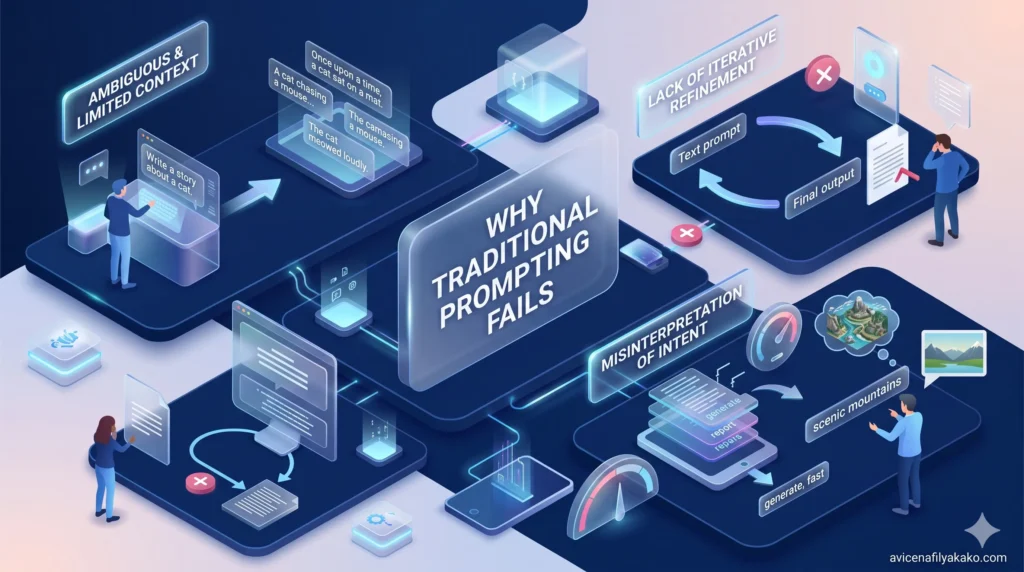
Standard prompts often suffer from “context leakage” or “intent ambiguity.” You might ask for a “marketing plan,” but the AI doesn’t know if you’re a local bakery or a SaaS giant.
| Feature | Standard Prompting | Self-Querying System |
|---|---|---|
| Initial Accuracy | Often low; requires multiple iterations. | High; context is locked in early. |
| User Effort | High manual refinement needed. | High initial setup; low repetitive effort. |
| Output Quality | Generic and broad. | Highly tailored and niche-specific. |
To move beyond these common pitfalls, it is essential to understand the foundational taxonomy of deliberate prompting which categorizes how specific instructions influence model behavior.
The Role of Context Gathering
The first pillar of a Self-Querying system is context gathering. By using a meta-prompt, you can instruct the AI to behave as an interviewer. You provide the goal, and the AI provides the questions.
For more technical implementations of this logic, you can explore how developers are building intelligent systems with query routing. This ensures that the data being retrieved is actually relevant to the user’s specific problem.
Steps to Build Your Self-Querying System
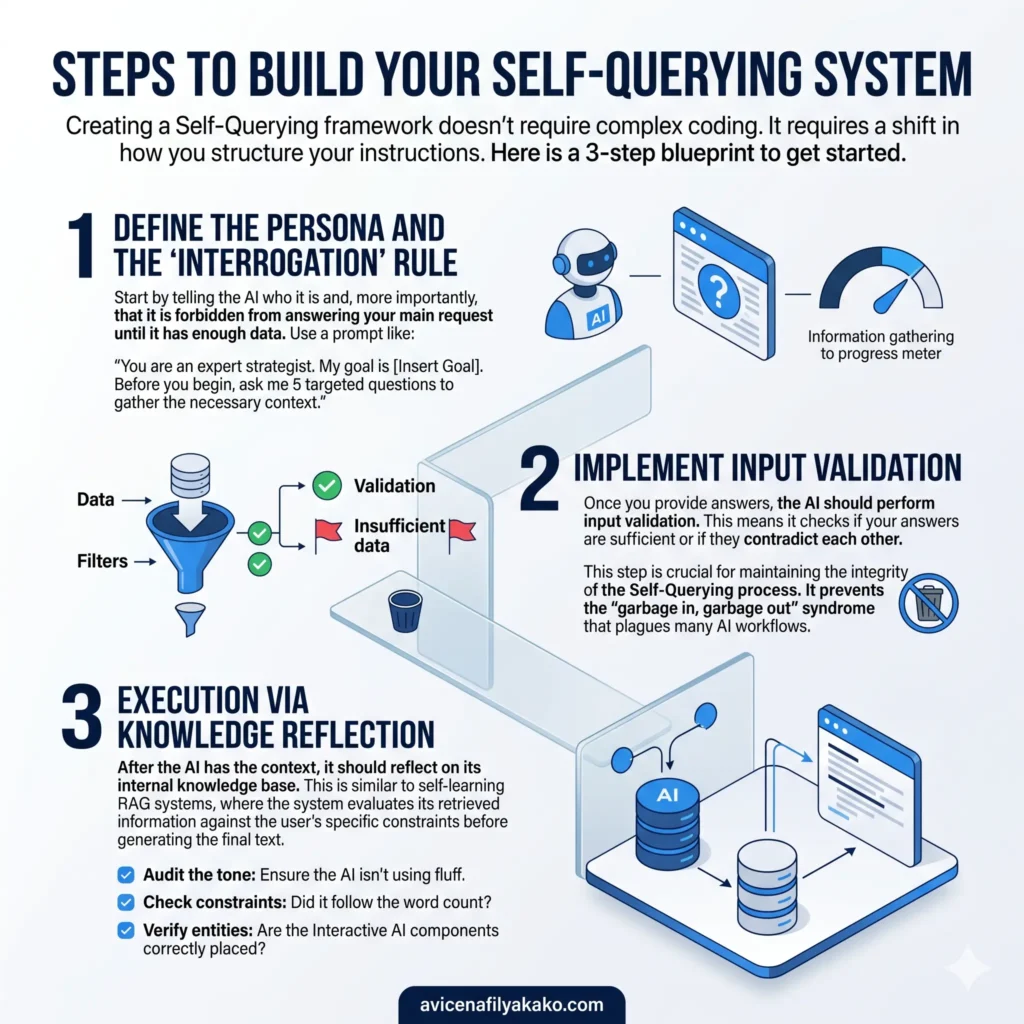
Creating a Self-Querying framework doesn’t require complex coding. It requires a shift in how you structure your instructions. Here is a 3-step blueprint to get started.
1. Define the Persona and the “Interrogation” Rule
Start by telling the AI who it is and, more importantly, that it is forbidden from answering your main request until it has enough data. Use a prompt like: “You are an expert strategist. My goal is [Insert Goal]. Before you begin, ask me 5 targeted questions to gather the necessary context.”
2. Implement Input Validation
Once you provide answers, the AI should perform input validation. This means it checks if your answers are sufficient or if they contradict each other. This step is crucial for maintaining the integrity of the Self-Querying process. It prevents the “garbage in, garbage out” syndrome that plagues many AI workflows.
3. Execution via Knowledge Reflection
After the AI has the context, it should reflect on its internal knowledge base. This is similar to self-learning RAG systems, where the system evaluates its retrieved information against the user’s specific constraints before generating the final text.
- Audit the tone: Ensure the AI isn’t using fluff.
- Check constraints: Did it follow the word count?
- Verify entities: Are the Interactive AI components correctly placed?
Advanced Agent Capabilities

When you move beyond simple chat interfaces, Self-Querying becomes the backbone of autonomous agents. These systems use internal loops to ask themselves: “Do I have enough information to complete this task?”
If the answer is “No,” the agent triggers a search or asks the user for more details. This level of Interactive AI sophistication is what allows for production-ready AI agents to handle complex, multi-step business processes without constant human hand-holding.
“The goal of AI is not to replace human thinking, but to augment it by handling the architectural complexity of information retrieval.” — Paraphrased from industry insights on LLM orchestration.
Tips for Refining Your System
- Be Specific with “Unknowns”: Tell the AI it’s okay to say “I don’t know” or to ask for external links if its training data is insufficient.
- Use Iterative Feedback: If the first set of questions from the Self-Querying loop isn’t deep enough, tell the AI to “dig deeper into the financial constraints” or “focus more on the brand voice.”
- Save the Framework: Once you find a Self-Querying sequence that works for your industry, save it as a “System Instruction” or a custom GPT profile.
As your library of system instructions grows, consider implementing prompt version control via Git to track iterations and ensure you can always roll back to a stable configuration.
FAQ
What is Self-Querying in prompt engineering?
Self-Querying is a technique where an AI is programmed to ask clarifying questions to the user to gather necessary context before generating a final response. This ensures the output is aligned with the user’s specific intent and data requirements.
How does input validation improve AI outputs?
Input validation improves outputs by checking the clarity and completeness of the user’s instructions before the AI processes them. It reduces errors and prevents the AI from making assumptions that lead to hallucinations or irrelevant content.
Can I use Self-Querying for creative writing?
Yes, you can use Self-Querying for creative writing by having the AI ask you about character motivations, world-building rules, and tone preferences before it starts drafting. This results in a much more cohesive and personalized narrative.
Disclaimer: The information provided in this article is for educational and general informational purposes only and should not be construed as professional advice (such as legal, medical, or financial). While the author strives to provide accurate and up-to-date information, no representations or warranties are made regarding its completeness or reliability. Any action you take based on this information is strictly at your own risk.
This article was authored by Avicena Fily A Kako, a Digital Entrepreneur & SEO Specialist using AI to scale business and finance projects.