
If you have ever asked an AI to “act as a world-class lawyer” or “write like a weary detective,” you have dabbled in the basics of persona engineering. But beneath the surface of these simple requests lies a sophisticated mechanism called persona-driven logic.
By assigning a specific identity to a Large Language Model (LLM), you aren’t just changing its vocabulary. You are actually recalibrating its reasoning paths and decision-making framework. This shift in perspective allows the AI to access specific patterns of data it might otherwise ignore.
Why Persona-Driven Prompting Works
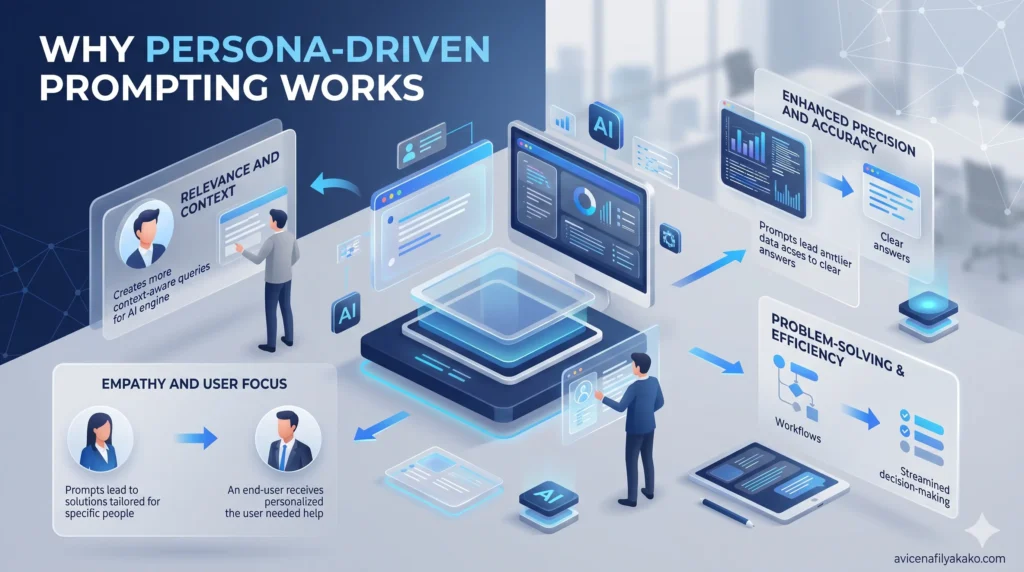
Most users treat AI as a generic encyclopedia. However, a persona-driven approach treats the model as a specialist. When you define a role, the LLM narrows its focus, prioritizing certain linguistic patterns and ethical frameworks associated with that identity.
Think of it like a professional actor preparing for a role. An actor doesn’t just change their clothes; they change how they think, react, and solve problems. In AI, we call this Cognitive Profiling. By providing a mental “blueprint,” you guide the model’s internal logic toward a more specialized output.
“The art of prompting is not about telling the AI what to do, but rather defining who it needs to be to solve the problem effectively.” — Prompt Engineering Research Collective
The Mechanics of Persona Engineering

To master persona-driven outputs, you need to understand the three pillars of a high-quality persona. It’s not enough to say “be a teacher.” You must define the teacher’s background, their audience, and their specific goals.
To achieve this level of precision, many practitioners combine persona roles with a structured taxonomy for deliberate prompting to categorize and refine complex instructions.
1. Tone Modulation
This determines the “vibe” of the response. A persona-driven prompt for a startup founder will sound urgent and visionary, while a prompt for a lab scientist will be precise and clinical. Modulating the tone ensures the AI speaks the language of your industry.
2. Constraints and Reasoning Paths
Every professional operates under constraints. A judge follows the law; a marketer follows consumer psychology. By embedding these rules into your persona, you force the AI to follow specific reasoning paths. This prevents the model from hallucinating irrelevant or “out of character” information.
3. Knowledge Retrieval
When a model is in a specific persona-driven state, it prioritizes relevant semantic clusters. For example, a “Cybersecurity Expert” persona will weigh information about encryption and vulnerabilities more heavily than general IT support tips.
Comparing General vs. Persona-Driven Logic
| Feature | General Prompting | Persona-Driven Logic |
|---|---|---|
| Primary Goal | General accuracy | Contextual expertise |
| Logic Flow | Broad and generic | Specialized reasoning paths |
| Vocabulary | Simple and universal | Domain-specific terminology |
Steps to Implement Cognitive Profiling in Your Prompts
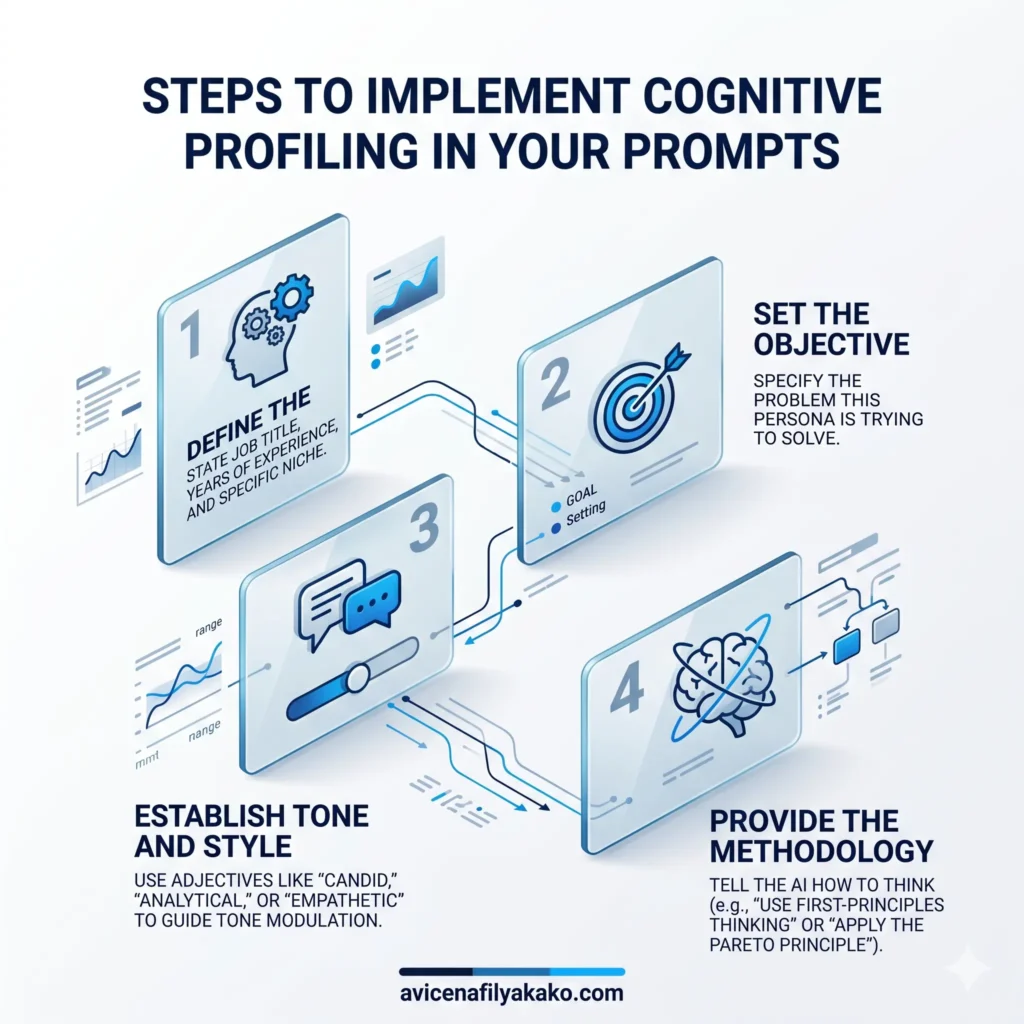
Creating a robust persona-driven prompt requires more than a single sentence. Follow these steps to build a high-authority AI identity:
- Define the Identity: State the job title, years of experience, and specific niche.
- Set the Objective: What is the specific problem this persona is trying to solve?
- Establish Tone and Style: Use adjectives like “candid,” “analytical,” or “empathetic” to guide tone modulation.
- Provide the Methodology: Tell the AI how to think (e.g., “Use first-principles thinking” or “Apply the Pareto Principle”).
To further sharpen the persona’s output, consider integrating few-shot learning examples to provide the model with specific patterns of the desired reasoning style.”
Moving Beyond Simple Roleplay

Sophisticated persona-driven logic involves “Chain of Thought” prompting. This is where you ask the persona to explain its reasoning before giving the final answer. For instance, you might ask a “Financial Analyst” persona to first list the risks of an investment before providing a recommendation.
This approach builds Topical Authority. It shows the “work” behind the conclusion, making the AI’s output significantly more reliable for complex business or technical tasks. Research on LLM reasoning from Stanford University or OpenAI.
The Ethics of Persona-Driven AI

As we refine persona-driven interactions, we must remain aware of biases. A persona is a reflection of the data it was trained on. If you ask for a “traditional CEO,” the AI might lean into outdated stereotypes. Always audit your persona-driven results for fairness and accuracy.
One effective way to mitigate these biases and hallucinations is to apply a negative prompting framework that explicitly defines the boundaries of what the AI should avoid saying or assuming.
Using Cognitive Profiling is a tool for precision, not a replacement for human oversight. You are the director; the AI is the performer. The quality of the performance always comes back to the quality of your script.
Frequently Asked Questions (FAQ)
Does persona-driven prompting improve AI accuracy?
Yes, persona-driven prompting improves accuracy by narrowing the model’s focus to relevant data subsets and specialized reasoning patterns. By defining a specific role, you reduce the likelihood of the AI providing generic or irrelevant “filler” content.
What is the difference between persona engineering and simple roleplay?
Persona engineering involves detailed Cognitive Profiling, including specific constraints, knowledge requirements, and defined reasoning paths, whereas simple roleplay is often just a surface-level change in tone. Engineering focuses on how the AI solves a problem, not just how it talks.
Can I use persona-driven logic for creative writing?
Absolutely, using a persona-driven approach allows you to maintain consistent character voices and unique perspectives throughout a narrative. It helps in maintaining tone modulation across long-form content, ensuring the “voice” of the character doesn’t drift over time.
Disclaimer: The information provided in this article is for educational and general informational purposes only and should not be construed as professional advice (such as legal, medical, or financial). While the author strives to provide accurate and up-to-date information, no representations or warranties are made regarding its completeness or reliability. Any action you take based on this information is strictly at your own risk.
This article was authored by Avicena Fily A Kako, a Digital Entrepreneur & SEO Specialist using AI to scale business and finance projects.