

Have you ever looked at your website and wondered, “What is all this actually worth?” Most business owners view their blog posts and landing pages as marketing expenses. In reality, your library of articles is a portfolio of income-generating assets.
Determining a Content Inventory Valuation is the process of shifting your mindset from seeing words on a page to seeing capital on a balance sheet. It’s the difference between owning a pile of bricks and owning a high-yield apartment complex.
Why Content Inventory Valuation Matters for Your Bottom Line

If you aren’t calculating your Content Inventory Valuation, you’re flying blind. Knowing the dollar value of your intellectual property allows you to make smarter decisions about acquisitions, mergers, or even simple budget allocations.
Think of your content like a fleet of delivery trucks. Some are brand new and fast; others are old and breaking down. You wouldn’t manage a fleet without knowing the resale value of each vehicle, and your digital assets deserve the same level of scrutiny.
This baseline understanding is the first step toward professional multi-site portfolio management ops, ensuring that every domain in your network contributes to your total digital net worth.
The Role of Asset Valuation in Digital Strategy
Traditional Asset Valuation often focuses on physical property or equipment. However, in the digital economy, your “equity” is built through visibility and trust. When we value a content inventory, we aren’t just looking at word counts; we are looking at the potential for future cash flow.
When we value a content inventory, we aren’t just looking at word counts; we are looking at the potential for future cash flow and how to map a content-to-product monetization path that converts informational readers into high-value customers.
Strategic Optimization and Legal Security
To truly maximize the value of these assets, one must look at the intersection of inventory management and legal compliance. Research published on ResearchGate highlights that Asset Optimization is heavily influenced by three pillars: accurate valuation, a comprehensive asset inventory, and a rigorous legal audit.
Without a legal audit, your content assets may carry hidden risks regarding copyrights or licensing, which can diminish their market value. By maintaining a precise inventory and ensuring legal “cleanliness,” you transform static content into optimized tools for business growth.
Integrating Content Value into Business Worth
When preparing for high-stakes scenarios like selling a company or seeking investment, content valuation becomes a core component of your business’s overall “goodwill.” As noted in this guide on how to value a business, valuation is not just about current profit—it is about the reliability of future earnings.
Digital assets act as an “intangible asset” that boosts your market price. A well-valued content inventory proves to potential buyers that your business has a sustainable engine for lead generation and brand authority, making your company far more attractive than a competitor with undocumented digital equity.
How to Calculate Your Content Inventory Valuation

Valuing digital assets isn’t an exact science, but we can get remarkably close by using a combination of historical data and market projections. Here are the three primary pillars I use to determine a Content Inventory Valuation.
1. The Cost to Replace (Reproduction Value)
This is the simplest method. You calculate how much it would cost to hire writers, editors, and SEO specialists to recreate your entire library from scratch today. If you have 500 high-quality articles and the market rate is $300 per piece, your baseline valuation starts at $150,000.
2. Traffic Cost (The PPC Equivalent)
This is a powerful metric for establishing Content ROI. If your content library generates 100,000 organic visits per month, how much would you have to pay Google Ads to get that same traffic?
“Content is the only marketing channel that provides a compounding return over time. Unlike ads, you don’t stop getting results the moment you stop paying.” – Joe Pulizzi, Founder of Content Marketing Institute.
3. Revenue Multiples
For established sites, the Content Inventory Valuation is often tied to the net profit it generates. Many digital brokers value content-heavy businesses at 3x to 5x their annual earnings.
Valuation Methods Comparison
| Method | Focus | Best For |
| Replacement Cost | Production Expenses | New sites or brand protection |
| Traffic Cost | Market Value of Visibility | SEO-heavy informational sites |
| Income Approach | Net Profit & Multiples | E-commerce or Affiliate blogs |
Building Content Equity: From Expenses to Assets
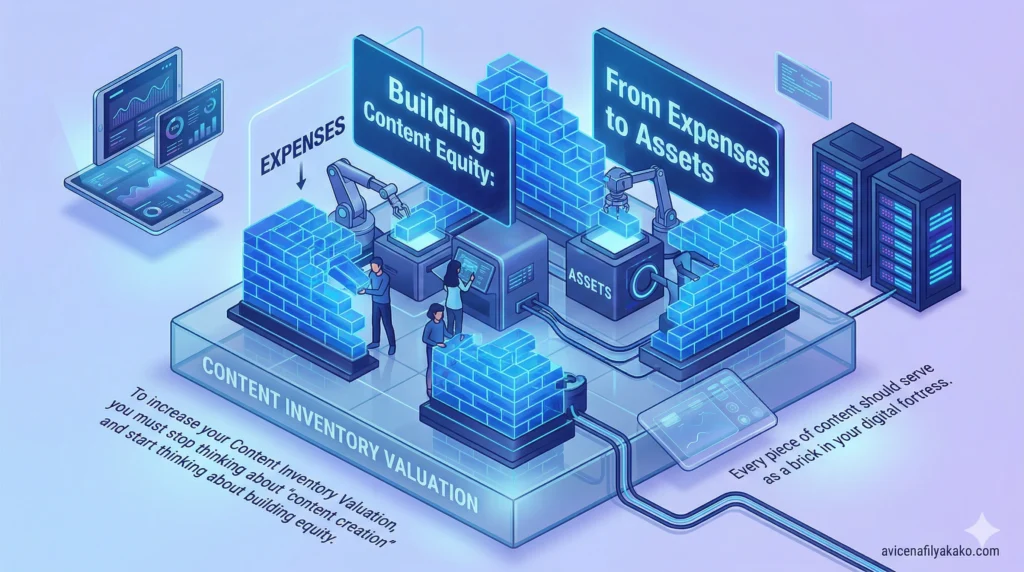
To increase your Content Inventory Valuation, you must stop thinking about “content creation” and start thinking about building equity. Every piece of content should serve as a brick in your digital fortress.
Improving Your Content ROI
High ROI content isn’t always the “viral” stuff. Usually, it’s the evergreen, middle-of-the-funnel content that answers specific user problems. By optimizing for Content ROI, you ensure that the money spent on production today yields dividends for the next three to five years.
- Audit for Decay: Update old posts to maintain their “Asset Valuation.”
- Prune Dead Weight: Low-quality pages can actually drag down the value of your entire inventory; therefore, you should conduct an annual content pruning audit to identify and remove underperforming assets that dilute your site’s authority.
- Strengthen Internal Links: This distributes “link equity” across your site, making every page more valuable.
Technical Metrics That Drive Content Inventory Valuation

When an investor looks at your site, they aren’t just reading your prose. They are looking at the “engine” under the hood. To maximize your Content Inventory Valuation, you need to focus on metrics that prove stability and growth.
Assessing Traffic Cost and Stability
High-value inventory shows steady or growing traffic over a 12-month period. If your traffic looks like a heart monitor with massive spikes and crashes, your valuation will take a hit. Consistency is a signal of a “low-risk” asset.
The Significance of Semantic Keywords
Modern search engines use entities to understand your site’s authority. By covering a broad range of semantic keywords related to your niche, you build “Topical Authority.” A site that is seen as an authority in its field commands a much higher Content Inventory Valuation than a site with random, disconnected articles.
Practical Steps to Conduct Your Own Inventory Audit
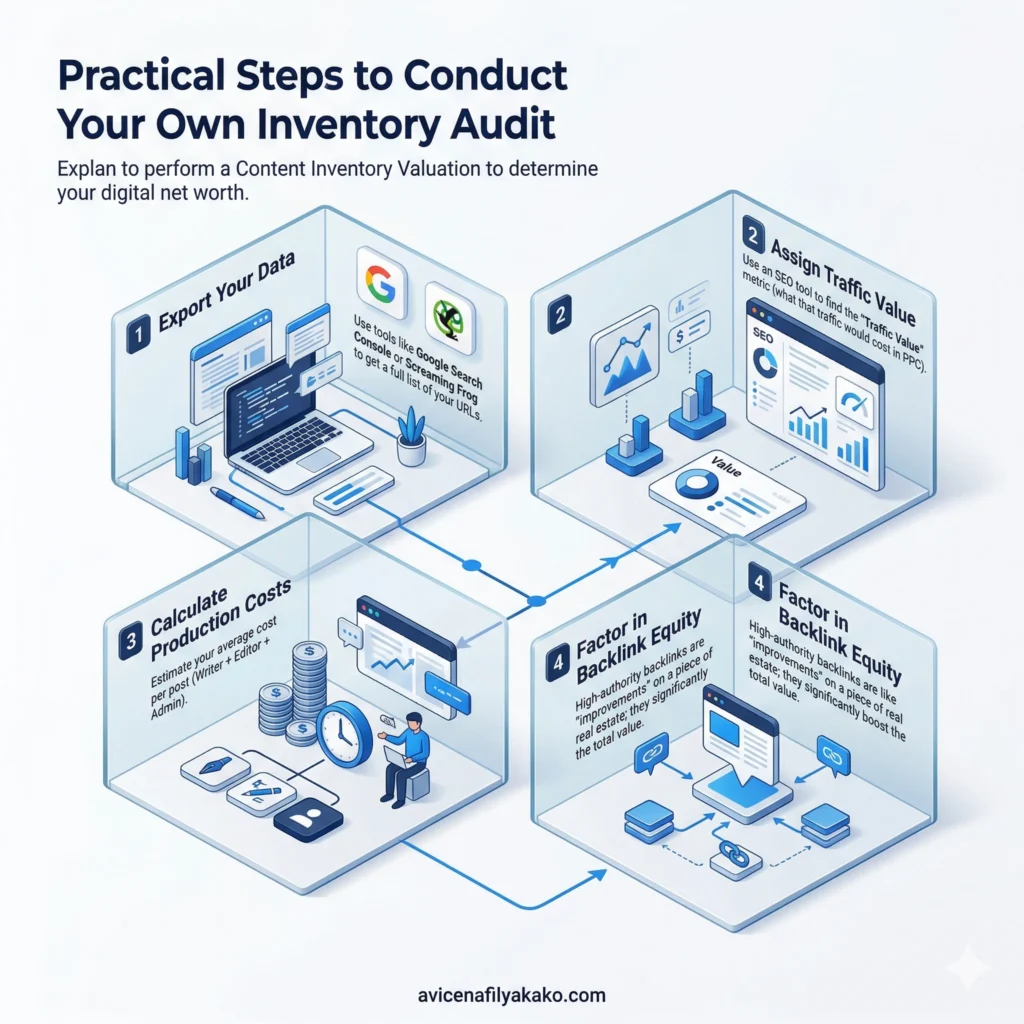
If you want to perform a Content Inventory Valuation today, follow these steps to get a clear picture of your digital net worth.
- Export Your Data: Use tools like Google Search Console or Screaming Frog to get a full list of your URLs.
- Assign Traffic Value: Use an SEO tool to find the “Traffic Value” metric (what that traffic would cost in PPC).
- Calculate Production Costs: Estimate your average cost per post (Writer + Editor + Admin).
- Factor in Backlink Equity: High-authority backlinks are like “improvements” on a piece of real estate; they significantly boost the total value.
Valuation Guidelines for SBICs
FAQs About Content Inventory Valuation
What is Content Inventory Valuation?
Content Inventory Valuation is the process of quantifying the monetary worth of a website’s total library of articles, videos, and pages based on production costs, traffic value, and revenue potential. It helps businesses treat their digital content as a tangible financial asset.
How do I increase the value of my existing content?
You can increase the value of your content by updating outdated information, improving on-page SEO to capture higher traffic cost keywords, and pruning “thin” content that provides no value. Consistently refreshing assets ensures they continue to produce a high Content ROI.
Can I include content valuation on a balance sheet?
While traditional accounting often treats content as an expense, modern digital businesses often list “Intellectual Property” or “Intangible Assets” under their Asset Valuation during a sale or merger. Consult with a specialized financial advisor to see how it fits your specific business structure.
Final Thoughts on Digital Assets
Your content is more than just words; it is a long-term investment. By performing a regular Content Inventory Valuation, you gain the clarity needed to scale your business effectively. You move from “hoping” your blog works to “knowing” exactly what your digital footprint is worth.
Treat your website like a portfolio. Diversify your topics, maintain your high-performers, and always keep an eye on the bottom line.
Disclaimer: The information provided in this article is for educational and general informational purposes only and should not be construed as professional advice (such as legal, medical, or financial). While the author strives to provide accurate and up-to-date information, no representations or warranties are made regarding its completeness or reliability. Any action you take based on this information is strictly at your own risk.
This article was authored by Avicena Fily A Kako, a Digital Entrepreneur & SEO Specialist using AI to scale business and finance projects.