
If you are looking to maximize your savings without locking your cash in a financial vault for years, you have likely heard of a CD ladder. In the shifting economic landscape of 2026, where interest rates have finally begun to stabilize after years of volatility, this strategy is more relevant than ever.
Think of a CD ladder like a staircase for your money. Instead of putting all your eggs in one basket—or in this case, one long-term Certificate of Deposit—you spread your investment across multiple accounts with staggered maturity dates. This approach allows you to capture higher yields while maintaining a steady stream of liquidity.
Why a CD Ladder is Your Best Strategy This Year

The primary goal of a CD ladder is to balance two competing financial needs: high interest rates and access to cash. If you put all your money into a 5-year CD, you might get a great APY, but you’ll face an early withdrawal penalty if an emergency arises.
As financial expert Suze Orman often suggests, “The beauty of a ladder is that it protects you against interest rate swings.” By staggering your investments, you ensure that a portion of your portfolio is always maturing, giving you the flexibility to either spend the cash or reinvest it at the newest market rates.
While CDs are excellent for bank-based security, you can also learn how to build a US Treasury bond ladder to achieve similar staggered liquidity with the added benefit of federal tax advantages on the interest earned.
The Anatomy of a High-Yield Ladder
To build a robust CD ladder, you need to understand three core pillars:
- The Rungs: These are your individual CDs. Each rung represents a different maturity term (e.g., 1-year, 2-year, 3-year).
- The Spacing: This is the time interval between your maturity dates. Common spacing includes six months or one year.
- The Reinvestment: This is the “climbing” part of the ladder. When the shortest rung matures, you reinvest it into a new long-term rung at the top.
Step-by-Step: Constructing Your 2026 CD Ladder
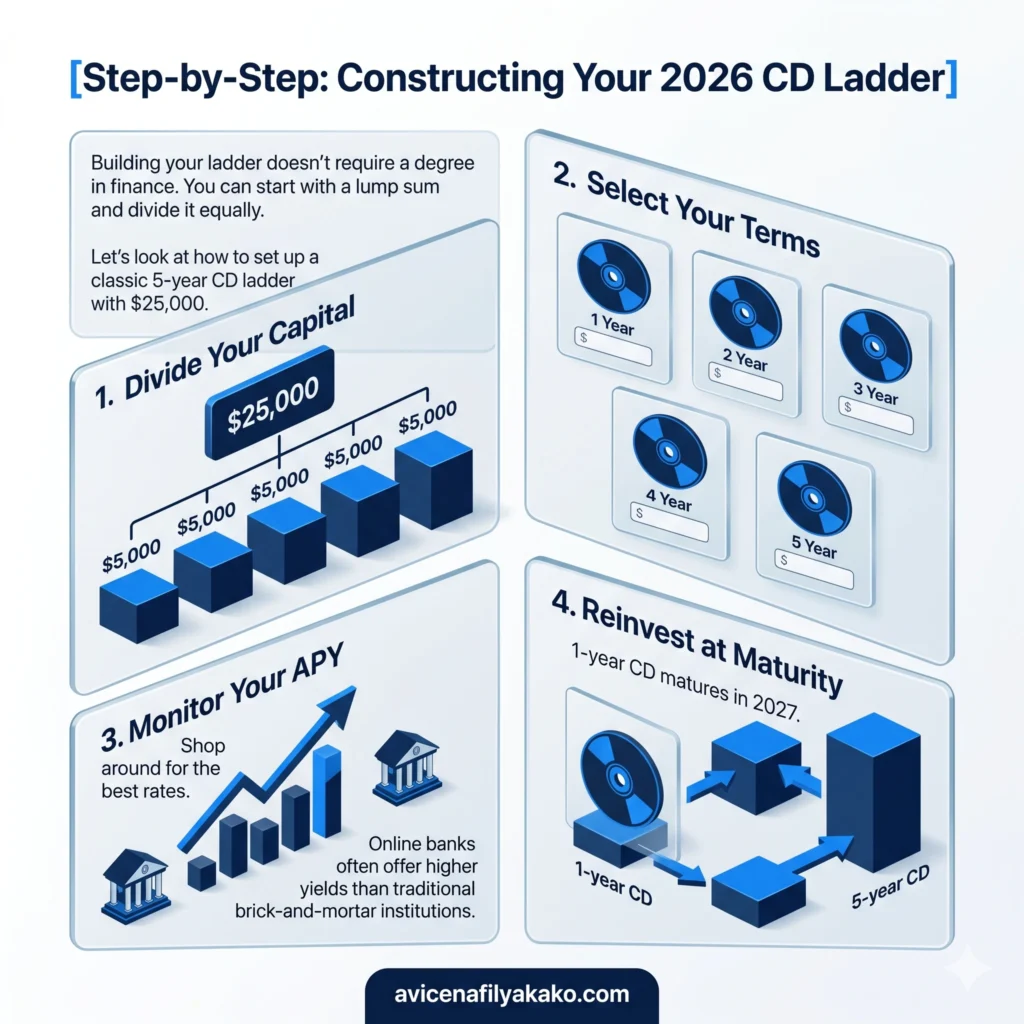
Building your ladder doesn’t require a degree in finance. You can start with a lump sum and divide it equally. Let’s look at how to set up a classic 5-year CD ladder with $25,000.
- Divide Your Capital: Split your $25,000 into five equal parts of $5,000.
- Select Your Terms: Open five different CDs with terms of 1, 2, 3, 4, and 5 years.
- Monitor Your APY: Ensure you are shopping around for the best rates. Online banks often offer higher yields than traditional brick-and-mortar institutions.
- Reinvest at Maturity: When your 1-year CD matures in 2027, you don’t just put it back into another 1-year CD. Instead, you move it to a 5-year term.
If you are in a high tax bracket and find that standard CD interest is being heavily taxed, it may be worth exploring municipal bonds for tax-free income as a more efficient way to preserve your take-home yield.
By the time five years have passed, you will have a 5-year CD maturing every single year. This provides you with the highest available APY on the market while keeping 20% of your total investment accessible annually.
2026 Strategy Comparison
| Strategy Type | Best For | Liquidity Level |
|---|---|---|
| Standard CD Ladder | Consistent long-term growth | Moderate |
| Mini-Ladder | Short-term goals (under 2 years) | High |
| Barbell Strategy | Hedging against rate drops | Low to Moderate |
Navigating FDIC Limits and Penalties

While a CD ladder is one of the safest investment vehicles available, you must stay within certain guardrails to protect your wealth.
Staying Within FDIC Limits
Your deposits are typically insured up to $250,000 per depositor, per insured bank, for each account ownership category. If you are building a massive CD ladder, consider spreading your rungs across different financial institutions to ensure every penny is protected. For more on safety protocols, check out Bankrate’s guide to CD safety.
Avoiding the Early Withdrawal Penalty
The “kryptonite” of any CD ladder is the early withdrawal penalty. These fees can sometimes eat into your principal investment, not just your earned interest. This is why the laddering strategy is so vital—it provides scheduled “exit ramps” for your money so you never have to break a contract early.
“A CD ladder is the ultimate ‘set it and forget it’ tool for the conservative investor who still wants to beat inflation.” — Financial Industry Insight
Maximizing Your Returns in 2026

In the current market, “specialty CDs” are becoming more common. You might find “no-penalty” CDs or “bump-up” CDs that allow you to increase your APY if market rates rise. Integrating these into your CD ladder can add a layer of sophistication to your portfolio.
For a deeper dive into the specific rates available this quarter, you can review the The Motley Fool’s 2026 CD strategy analysis. Using these insights, you can adjust the “width” of your rungs based on whether you believe interest rates will climb or fall in the next 24 months.
A CD ladder is a perfect ‘defensive’ play, but to outpace inflation significantly over the long term, I recommend pairing it with a dividend growth investing framework to capture the compounding power of high-quality equities.
Frequently Asked Questions
What happens if I need my money before a CD in my ladder matures?
You will likely have to pay an early withdrawal penalty, which is typically a set number of months of interest. To minimize this risk, ensure your CD ladder is built with enough rungs to provide the liquidity you need for your lifestyle.
Can I build a CD ladder with a small amount of money?
Yes, you can build a CD ladder with as little as $500 to $1,000 if you use banks with low minimum deposit requirements. Many digital banks allow you to open accounts with very small sums, making this strategy accessible to everyone.
Is a CD ladder better than a high-yield savings account?
A CD ladder generally offers a higher APY than a standard savings account because you are committing your funds for a fixed term. While savings accounts offer more immediate liquidity, the laddered approach historically provides better long-term protection against falling interest rates. For a comparison of current yields, see Fortune’s guide on CD building.
Disclaimer: The information provided in this article is for educational and general informational purposes only and should not be construed as professional advice (such as legal, medical, or financial). While the author strives to provide accurate and up-to-date information, no representations or warranties are made regarding its completeness or reliability. Any action you take based on this information is strictly at your own risk.
This article was authored by Avicena Fily A Kako, a Digital Entrepreneur & SEO Specialist using AI to scale business and finance projects.