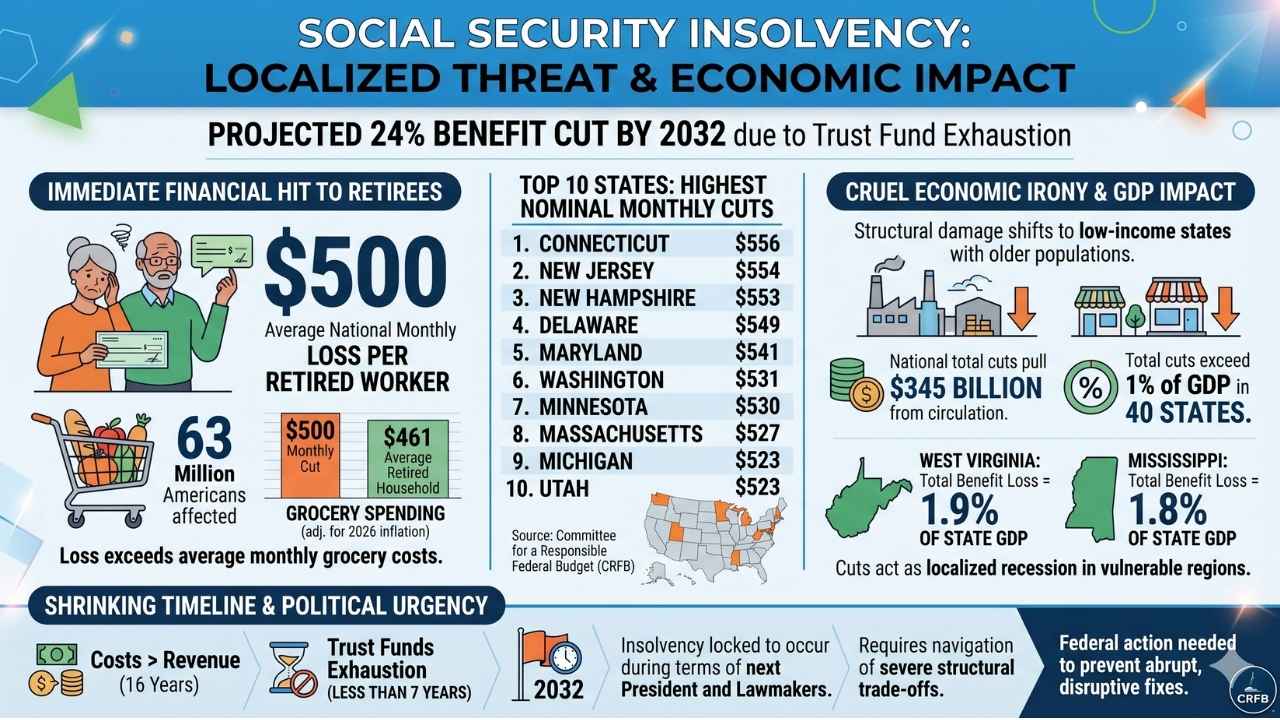
Continued legislative inaction will trigger an immediate, legally mandated 24% across-the-board reduction in retirement benefits for 63 million Americans by 2032, according to a comprehensive data analysis released Wednesday by the Committee for a Responsible Federal Budget (CRFB).
The new report, titled No State Spared: Mapping the Impact of Social Security’s Insolvency, combines the latest state-level figures from the Social Security Administration (SSA) and the Bureau of Economic Analysis (BEA) to simulate how a sudden 24% slash to the trust fund would degrade household budgets and local commerce. The findings demonstrate that Social Security insolvency is no longer a distant macroeconomic talking point; it is a localized threat to every state economy in the country.
The Immediate Financial Hit to Retirees
Nationally, a 24% benefit cut equates to an average monthly loss of $500 per retired worker. To contextualize this loss, the CRFB noted that $500 exceeds what the average retired household spends on groceries each month, which amounts to roughly $461 when adjusted for 2026 inflation.
The baseline monthly damage varies across state lines due to regional differences in lifetime earnings and historical wage structures. In 29 states, the average monthly benefit cut will surpass the $500 threshold.
Top 10 States: Average Monthly Benefit Cut
The following table highlights the ten states where individual beneficiaries face the sharpest drop in their monthly income under the projected 2032 Social Security trust fund exhaustion scenario:
| Rank | State | Average Monthly Benefit Cut |
|---|---|---|
| 1 | Connecticut | $556 |
| 2 | New Jersey | $554 |
| 3 | New Hampshire | $553 |
| 4 | Delaware | $549 |
| 5 | Maryland | $541 |
| 6 | Washington | $531 |
| 7 | Minnesota | $530 |
| 8 | Massachusetts | $527 |
| 9 | Michigan | $523 |
| 10 | Utah | $523 |
| — | National Average | $500 |
Source: Committee for a Responsible Federal Budget and Social Security Administration
News Analysis: A Cruel Economic Irony
A deeper diagnostic review of the CRFB data reveals a compounding crisis for low-income states. While affluent states like Connecticut and New Jersey face the highest nominal cuts, the structural economic damage shifts heavily toward the American South and rural parts of New England.
At the national level, a 24% reduction would pull $345 billion out of consumer circulation this year alone, representing 1.1% of total U.S. Gross Domestic Product (GDP). However, total benefit cuts will exceed 1% of GDP in 40 states.
The data highlights a harsh reality: the states facing the deepest economic contractions are those with the oldest populations and the lowest per-capita incomes. For example, West Virginia faces a total benefit loss equal to 1.9% of its state GDP, followed closely by Mississippi at 1.8%.
In these regions, Social Security checks do not simply fund supplemental retirement; they act as the primary economic engine for local grocery stores, healthcare clinics, and small businesses. Inflicting a sharp reduction on these vulnerable populations scales the damage from a personal budgeting strain to a systemic localized recession.
Shrinking Timeline Puts Pressure on Federal Leaders
The historical timeline of the program shows that its retirement costs have outpaced cash revenue for the last 16 years. To maintain full payouts, the system has relied entirely on draining its trust fund reserves.
The CRFB confirms that these reserves will completely dry up in 2032—less than seven years from today. Because federal law prohibits the Social Security retirement program from paying out more in benefits than it receives in raw tax revenue, the 24% cut happens automatically without a swift legislative intervention.
This seven-year window carries immense political urgency. The 2032 insolvency deadline falls squarely within the terms of the lawmakers and the U.S. President elected in the upcoming voting cycles. This shifts the policy debate away from abstract generational modeling and transforms it into an active, measurable assignment for sitting politicians.
Policymakers maintain a variety of tools to restore structural solvency, including adjusting revenue mechanisms, altering tax caps, or modifying future benefit formulas. However, as the CRFB emphasizes, the timeline for gradual optimization is over. Resolving the cliff before 2032 requires navigating severe structural trade-offs, and any further delay guarantees that the eventually required fixes will be abrupt and disruptive to the national economy.
What You Need to Know: Social Security Insolvency FAQ
Why will Social Security benefits be cut by 24% in 2032?
By federal law, the Social Security retirement program cannot spend more money than it collects in revenue once its trust fund reserves are entirely depleted. Because expenditures have outpaced cash income for 16 years, the trust fund will run dry by 2032, forcing an automatic reduction to match incoming tax revenues.
Which states will experience the worst economic impact from the cuts?
West Virginia and Mississippi will experience the worst economic impacts, with total benefit losses projected to hit 1.9% and 1.8% of their state GDP, respectively. States with older populations and lower per-person average incomes face the highest macroeconomic risk.
Can Congress prevent the 2032 Social Security benefit cuts?
Yes, Congress can prevent the automatic cuts by passing legislation that alters the program’s tax revenue, adjusts the benefit formulas, or reallocates federal funds before the 2032 exhaustion date. However, policymakers must enact these changes soon to avoid abrupt disruptions for current beneficiaries.
Disclaimer: This article is provided for general informational and news purposes only and should not be construed as professional advice (such as legal, medical, or financial). The author strives for accuracy and timeliness, but no representations or warranties are made regarding completeness or reliability, and details may change as a story develops. Any action you take based on this information is strictly at your own risk. Corrections or updates can be requested via the site’s contact page.