
If you feed raw, unedited email data into a large language model, you will get a broken assistant. Most generic tutorials claim you can export your sent folder, throw it into a training script, and instantly get an AI that writes exactly like you. It does not work that way. Instead, the model ends up generating corporate disclosure footers, broken HTML tags, and repetitive “Best regards” sign-offs.
To build a true digital clone, you must focus entirely on style mimicry. This requires shifting the training objective from teaching the model new knowledge to teaching it your specific linguistic patterns. By leveraging a local LLM and Low-Rank Adaptation (LoRA), you can train an open-source model to clone your voice securely on your own hardware without exposing sensitive communication history to external APIs.
Why Prompt Engineering Fails for Voice Mimicry

Many users begin by stuffing their longest emails into a system prompt, instructing a commercial model to “copy this tone.” While few-shot prompting works for simple tasks, it fails for deep stylistic replication.
First, context windows are expensive. Wasting thousands of tokens on sample emails in every single prompt limits the space available for the actual conversation history. Second, prompting cannot reliably capture subtle syntactic habits—like your specific usage of em-dashes, paragraph lengths, or how you transition between professional and casual tones.
Fine-tuning modifies the internal weights of the AI models themselves. Instead of asking a model to act like you, you alter its foundational probability distribution for token prediction. A 2024 study by researchers investigating stylistic alignment in large language models highlighted that parameter-efficient fine-tuning methods capture nuanced stylistic features far more effectively than zero-shot or few-shot prompting, which often reverts to generic baseline distributions under long context pressures.
Preparing Your Personal Dataset: The Cleaning Blueprint
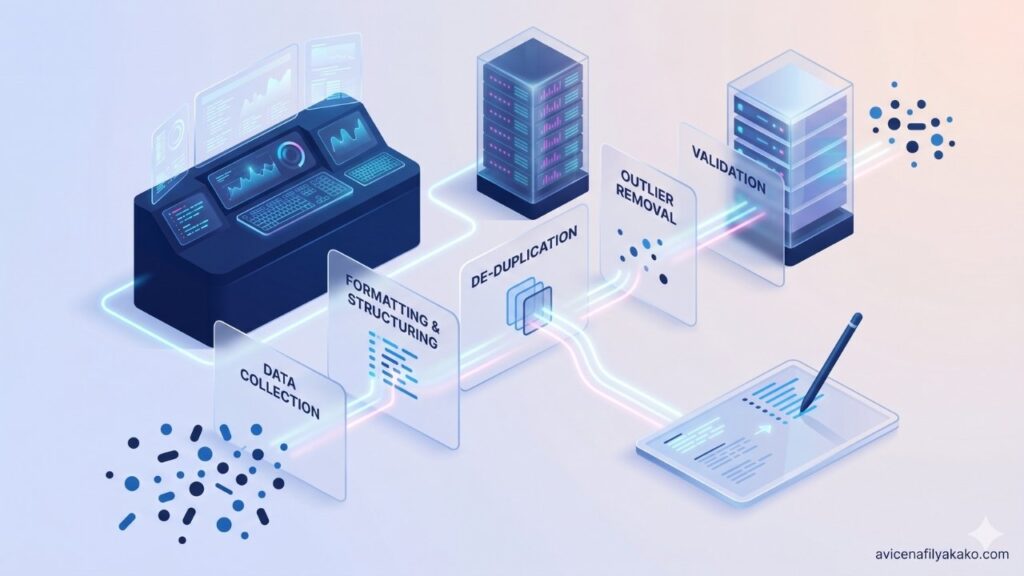
The quality of your fine-tuned model depends entirely on how you clean your personal dataset. Your sent folder is full of noise that will corrupt the training process.
Step 1: Parsing and Filtering
Export your emails (typically via an MBOX or JSON export from your email provider). You must programmatically strip out:
- Automated signatures and legal disclaimers.
- Thread replies from other people (the model should only train on your words).
- Tracking pixels, unsubscribe links, and HTML formatting markup.
- One-word responses like “Thanks” or “Received,” which dilute the model’s complex generation capabilities.
Step 2: The Instruction-Response Mapping
An email copy is useless without its context. You need to structure your data into a clear instruction-response format. The incoming email or user intent becomes the Prompt, and your sent email becomes the Response.
📋 Instruction
Reply to the client explaining that the project deliverable is delayed by two days due to API instability.
✉️ Suggested Response
“Hey Mark, quick heads-up: we are pushing the dashboard delivery to Wednesday. Ran into some unexpected rate-limiting issues with the new endpoint this morning and need the extra 48 hours to smooth it out. Let me know if that disrupts your team’s review schedule.”
Before feeding these pairs into your model, it is highly effective to categorize your dataset by priority and type. You can streamline this preprocessing phase by setting up automated systems to sort email intents using AI, which filters out operational noise and organizes inbound messages before they are mapped to your training responses.
The Local Fine-Tuning Stack: LoRA vs. Full Training
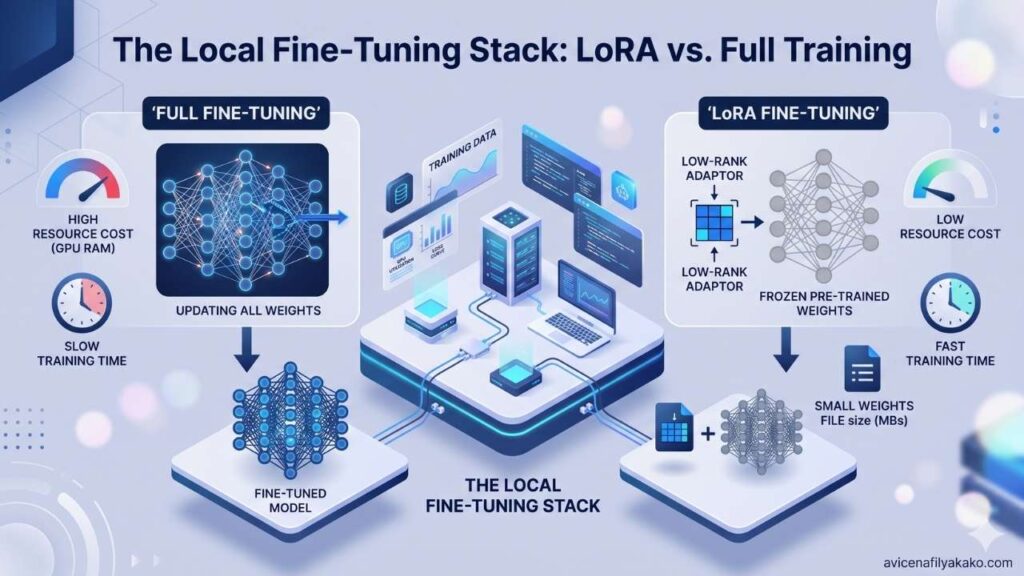
Running a full parameter fine-tune on modern AI models requires enterprise-grade infrastructure. For an individual or small business operator, Low-Rank Adaptation (LoRA) is the standard path forward.
LoRA freezes the original weights of the base model and inserts small, trainable adapter layers into the attention mechanisms. This slashes VRAM requirements, allowing you to run the training process on consumer-grade GPUs.
| Optimization Strategy | Hardware Requirement | Training Time (1k Examples) | Risk of Overfitting |
|---|---|---|---|
| Full Parameter Fine-Tuning | Multiple A100/H100 GPUs | Hours (Expensive) | High (Catastrophic Forgetting) |
| LoRA (Low-Rank Adaptation) | Single RTX 3090/4090 (24GB VRAM) | Under 1 Hour | Low |
| QLoRA (Quantized LoRA) | Single Consumer GPU (12GB–16GB VRAM) | 1–2 Hours | Low to Medium |
By using QLoRA, you compress the base model down to 4-bit precision, making it possible to execute style mimicry training locally. This guarantees absolute privacy; your personal dataset never leaves your local machine. If you are exploring broader architectures, understanding how platforms approach personal data can provide valuable baseline context, such as how Google’s Personal Intelligence systems structure contextual user data safely. If you are still deciding on your underlying development path, you can evaluate whether to build a custom local pipeline or use accessible visual tools by comparing the trade-offs of a Python environment vs no-code platforms for AI assistants.
Setting Up Your Hyperparameters for Style
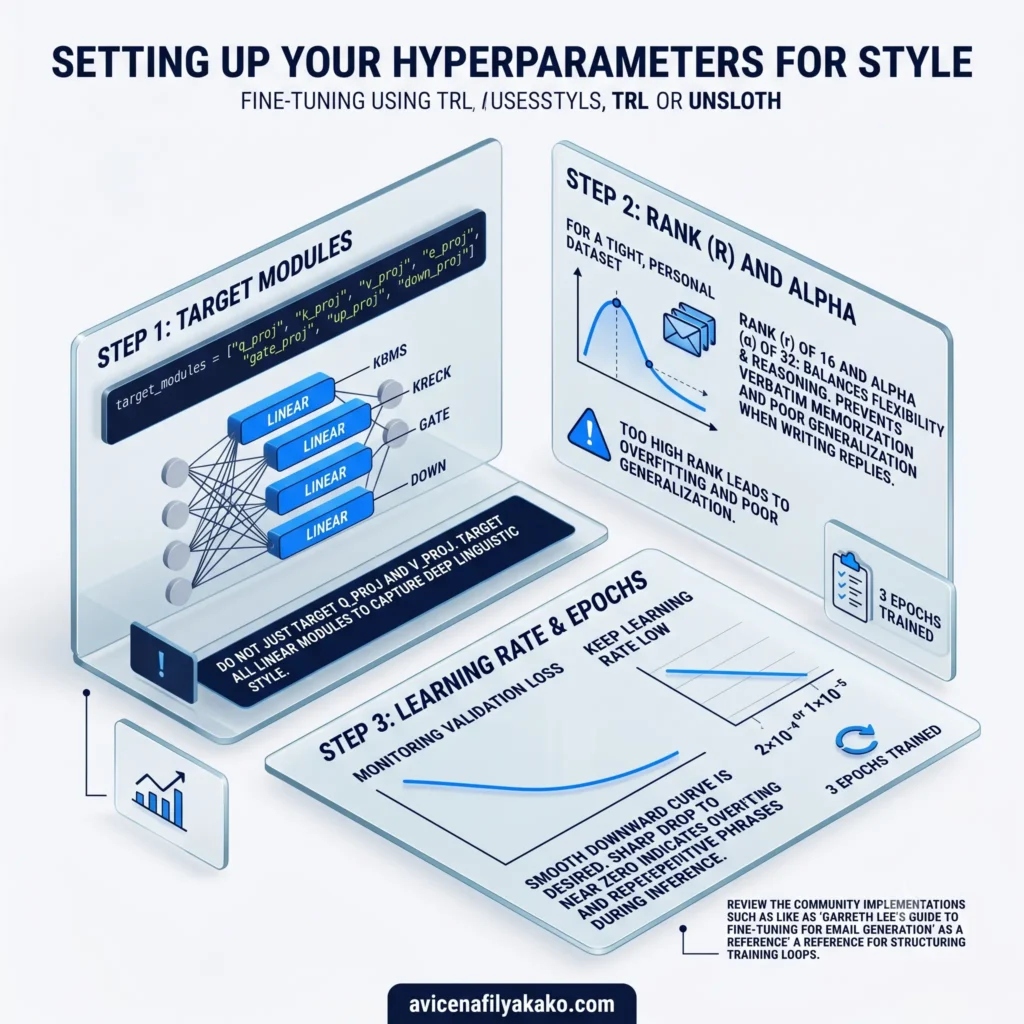
When configuring your training run using libraries like TRL (Transformer Reinforcement Learning) or Unsloth, your hyperparameter choices dictate whether the model successfully adopts your voice or simply breaks.
Target Modules
Do not just target the q_proj and v_proj matrices. To capture deep linguistic style, target all linear modules within the network:
target_modules = ["q_proj", "k_proj", "v_proj", "o_proj", "gate_proj", "up_proj", "down_proj"]Rank (r) and Alpha
For style adaptation based on a tight, personal dataset, a rank (r) of 16 and an alpha (α) of 32 balance flexibility without distorting the underlying reasoning capabilities of the base model. Setting the rank too high causes the model to memorize your training emails verbatim, leading to poor generalization when writing replies to entirely new topics.
Learning Rate and Epochs
Keep your learning rate low—around 2×10⁻⁴ or 1×10⁻⁵. Run the training for 3 epochs while monitoring the validation loss. You want to see a smooth downward curve. If the loss drops sharply to near zero, your model is overfitting and will likely output repetitive phrases during inference.
For a hands-on technical walkthrough of setting up these configurations using Hugging Face tools, reviewing community implementations like Garreth Lee’s guide to fine-tuning open-source models for email generation offers a solid reference for structuring training loops.
Evaluating Your ‘Mini-Me’

Once the training run completes, merge the LoRA weights back into the base model or load them dynamically using an inference engine like LM Studio or Ollama.
Test your model with three tiers of prompts:
- Direct Replication: Give it a prompt identical to a training example. It should capture the essence of your original response without repeating it word-for-word.
- Extrapolation: Present a scenario you have never encountered. Look closely at the sentence structure, greeting habits, and choice of adjectives.
- Edge Cases: Push it to write a hostile or highly formal email. A successful style fine-tune will maintain your signature voice even when forced into unfamiliar thematic territory.
Frequently Asked Questions
How many emails do you need to fine-tune an LLM?
You need at least 500 to 2,000 high-quality, deeply cleaned email pairs to successfully fine-tune a model for style mimicry. Submitting fewer examples prevents the model from identifying recurring syntactic patterns, while larger uncurated datasets introduce too much noise and formatting debris.
Can you fine-tune an LLM on personal data safely?
Yes, you can safely fine-tune an LLM by running open-source models locally using tools like QLoRA on your own hardware. This approach ensures your personal correspondence remains entirely on your local machine, completely isolated from external servers, third-party APIs, or cloud data collection practices.
What is the best base model for personal email fine-tuning?
Mistral-7B and Llama-3-8B are currently the best base models for personal fine-tuning due to their low hardware requirements and strong native instruction-following capabilities. These models can fit comfortably within consumer GPU memory limits during the LoRA training process while offering excellent text generation performance.
Successful style mimicry through fine-tuning is an exercise in data curation, not raw computing power. The determining factor of your model’s accuracy is the elimination of noise from your training data. By stripping away structural email debris and using parameter-efficient tuning like LoRA, you transform a generic open-source model into a precise reflection of your professional voice, running locally and securely on your own hardware.
Disclaimer: The information provided in this article is for educational and general informational purposes only and should not be construed as professional advice (such as legal, medical, or financial). While the author strives to provide accurate and up-to-date information, no representations or warranties are made regarding its completeness or reliability. Any action you take based on this information is strictly at your own risk.