

High tax bills can feel like an annual penalty for your financial success. If you are searching for a way to minimize your liability while making a meaningful impact, a Donor-Advised Fund (DAF) might be your best financial move.
Think of a Donor-Advised Fund as a personal charitable savings account. You dump money, stocks, or assets into the account today, take an immediate tax deduction, and then choose which charities to support over time. It separates the timing of your tax benefit from the actual act of giving.
As standard deduction limits remain high, traditional year-end giving rarely moves the tax needle for individual filers. A donor advised fund changes the game by allowing you to “bunch” multiple years of donations into a single tax year to clear that high hurdle.
Strategic Advantages of a Donor-Advised Fund

When you utilize a Donor-Advised Fund, you gain access to a highly flexible wealth-management strategy. It is not just about writing checks; it is about maximizing the power of your wealth.
1. Immediate Income Tax Benefits
The moment you contribute cash or assets to your donor advised fund, you qualify for a federal income tax deduction. This applies even if the fund sits idle for months before you distribute a single penny to an actual charity.
2. Capital Gains Tax Avoidance
If you own appreciated stock, selling it triggers a massive tax bill. Contributing that exact asset to a Donor-Advised Fund lets you bypass capital gains taxes entirely, meaning more money goes directly to the causes you care about.
“The habit of giving is the highest art of living.” — John David Wright
3. Tax-Free Growth Potential
Your contributions do not just sit there gathering dust. The assets within your Donor-Advised Fund are invested, allowing the balance to grow entirely tax-free, which ultimately increases your future charitable impact. To maximize your overall portfolio, it is equally important to master tax-efficient asset location strategies across your taxable and retirement accounts.
Maximizing Your Charitable Deduction with Appreciated Stock

Donating cash is simple, but it is often the least efficient way to fund your charitable donations. A far smarter strategy involves funding your Donor-Advised Fund with long-term appreciated assets like stocks, bonds, or crypto.
When you donate appreciated stock held for more than one year, you get a double tax benefit. You claim a charitable deduction for the full market value of the asset, and you never pay capital gains tax on the appreciation.
[Your Appreciated Stock] ---> [Donor-Advised Fund] ---> [No Capital Gains Tax]
                                         |
                                         v
                         [Full Market Value Tax Deduction]
To optimize this, you must keep IRS limits in mind. Cash contributions to a donor advised fund are generally deductible up to 60% of your Adjusted Gross Income (AGI). However, donating appreciated assets like stock is capped at 30% of your AGI, though any excess can be carried forward for up to five years. For a deeper dive into these thresholds, you can check out the National Philanthropic Trust guide on DAF tax considerations.
Comparing Your Options: DAF vs. Private Foundation
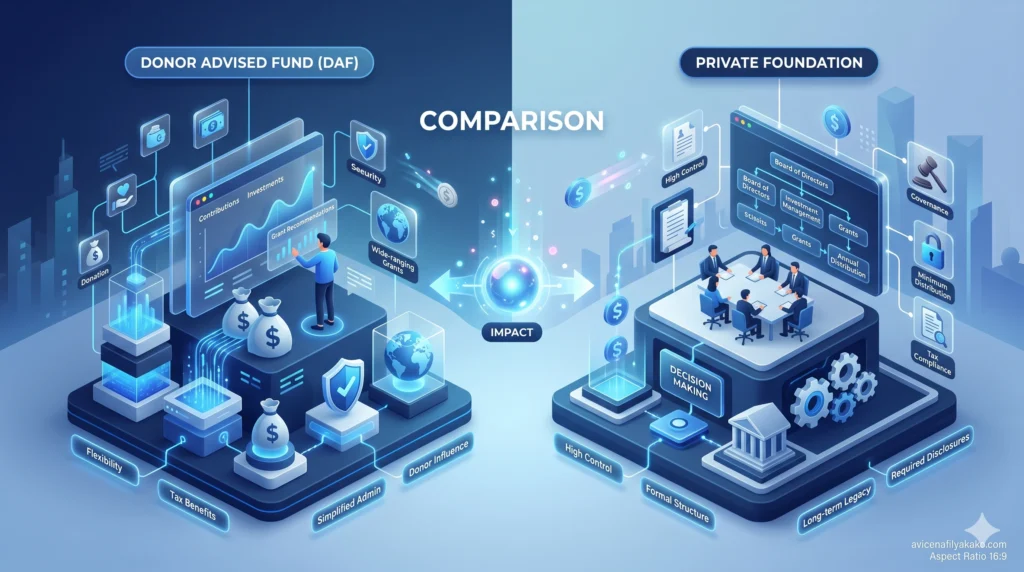
Many affluent families debate whether to establish a Donor-Advised Fund or a private foundation. While foundations offer total control, they come with high setup costs, annual distribution mandates, and public disclosure requirements.
| Feature | Donor-Advised Fund (DAF) | Private Foundation |
|---|---|---|
| Setup Cost & Speed | Low cost; setup takes minutes | High cost; requires legal setup |
| Tax Deduction Limits | Up to 60% AGI (cash) / 30% (stock) | Up to 30% AGI (cash) / 20% (stock) |
| Anonymity | Fully anonymous grants allowed | Publicly disclosed tax returns |
As the data shows, a donor advised fund offers superior tax deduction limits and complete privacy without the administrative headache.
Step-by-Step Guide to Funding Your Donor-Advised Fund
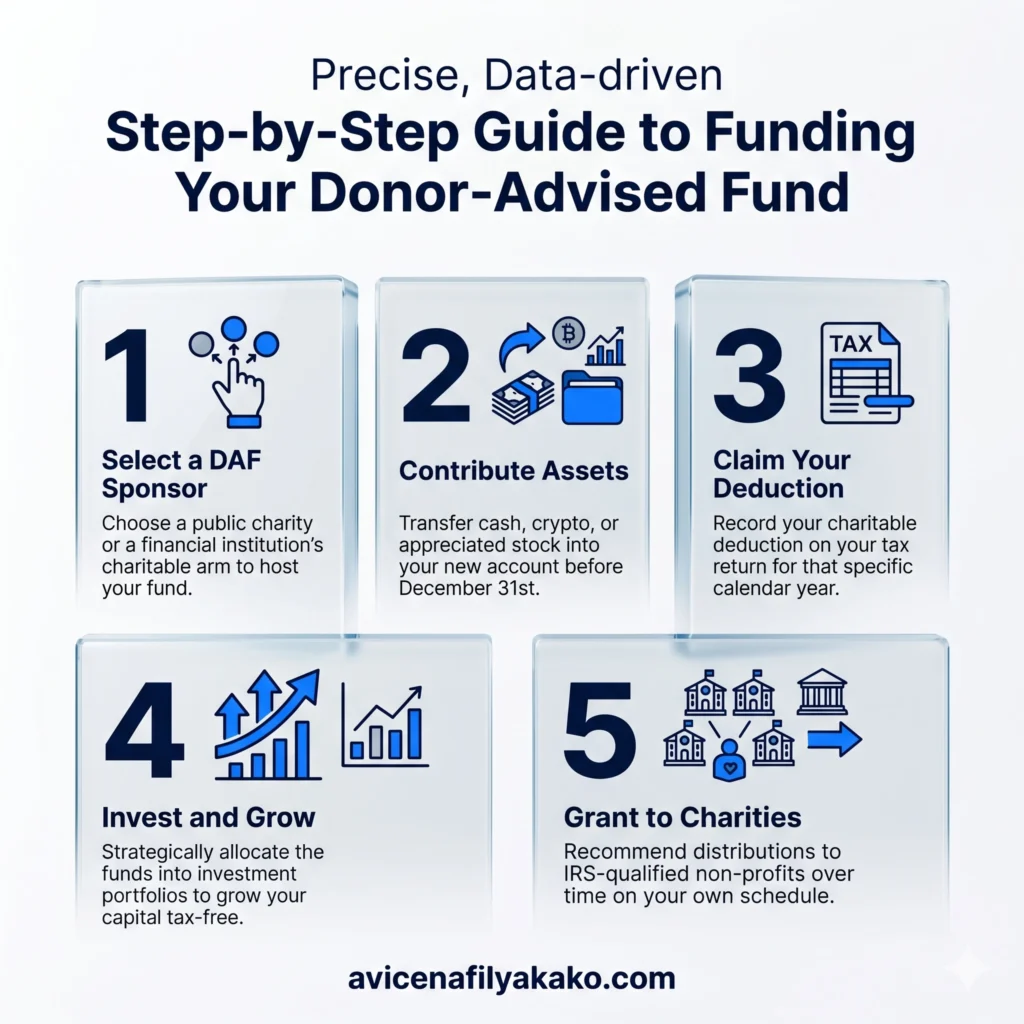
Ready to optimize your tax strategy? Setting up and executing a plan is straightforward if you follow these precise steps.
- Select a DAF Sponsor: Choose a public charity or a financial institution’s charitable arm to host your fund.
- Contribute Assets: Transfer cash, crypto, or appreciated stock into your new account before December 31st.
- Claim Your Deduction: Record your charitable deduction on your tax return for that specific calendar year.
- Invest and Grow: Strategically allocate the funds into investment portfolios to grow your capital tax-free.
- Grant to Charities: Recommend distributions to IRS-qualified non-profits over time on your own schedule.
Reviewing current financial case studies on the Greater Houston Community Foundation analysis of DAF benefits reveals how structured giving plans consistently outperform spontaneous cash donations.
Frequently Asked Questions
Can I withdraw money back from a Donor-Advised Fund for personal use?
No, contributions to a Donor-Advised Fund are irrevocable, meaning once you transfer assets into the fund, they belong permanently to the charitable sponsor and cannot be returned to you.
What are the IRS limits on deductions for DAF contributions?
The IRS limits allow you to deduct cash contributions to a donor advised fund up to 60% of your Adjusted Gross Income (AGI), while appreciated stock deductions are capped at 30% of your AGI.
Can a donor advised fund be inherited by my children?
Yes, you can name your children or heirs as successor advisors to your donor advised fund, allowing them to manage and distribute the remaining charitable assets after your passing. If you want to integrate your charitable giving into a comprehensive estate plan, you might also want to explore the benefits of a revocable living trust to protect your family’s broader inheritance.
Disclaimer: The information provided in this article is for educational and general informational purposes only and should not be construed as professional advice (such as legal, medical, or financial). While the author strives to provide accurate and up-to-date information, no representations or warranties are made regarding its completeness or reliability. Any action you take based on this information is strictly at your own risk.
This article was authored by Avicena Fily A Kako, a Digital Entrepreneur & SEO Specialist using AI to scale business and finance projects.