

Digital marketing often feels like gardening. If you never pull the weeds or trim the dead branches, your prized roses eventually get smothered. In the world of search engines, content pruning is that essential pair of shears.
By removing or refreshing underperforming pages, you aren’t just “cleaning up”; you are sharpening your site’s focus. This process ensures that search engines spend their energy on your high-value pages, directly impacting your bottom line and overall revenue growth.
Why Content Pruning is Vital for Site Health
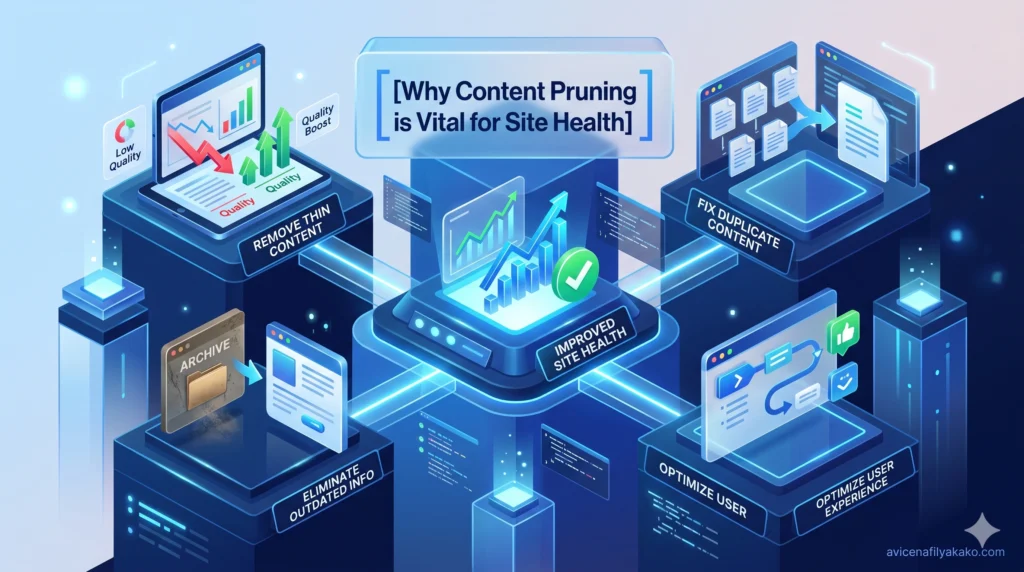
Think of your website like a library. If half the books are outdated or falling apart, visitors will stop trusting the collection. Content pruning helps you maintain a high standard of quality that both users and algorithms crave.
When a site is bloated with “thin” or irrelevant content, it suffers from poor crawl equity. Search engine bots have a limited budget for how many pages they crawl on your site. If they waste that budget on 404 errors or outdated blog posts from years ago, your new, high-converting pages might stay hidden.
“The best place to hide a dead body is the second page of Google search results.” — Anonymous Industry Proverb
To avoid becoming a graveyard of forgotten links, a regular visibility check is mandatory. You need to know which pages are pulling their weight and which are simply taking up space. Research shows that maintaining high standards is the only way to enhance content quality consistently.
The Benefits of a Leaner Website
| Benefit | Impact on ROI |
|---|---|
| Improved Crawl Equity | Faster indexing of new, revenue-generating content. |
| Enhanced User Experience | Higher engagement rates as users find only relevant info. |
| Authority Boosting | Concentrates “Link Juice” into your best-performing assets. |
The Step-by-Step SEO Audit for Content Pruning
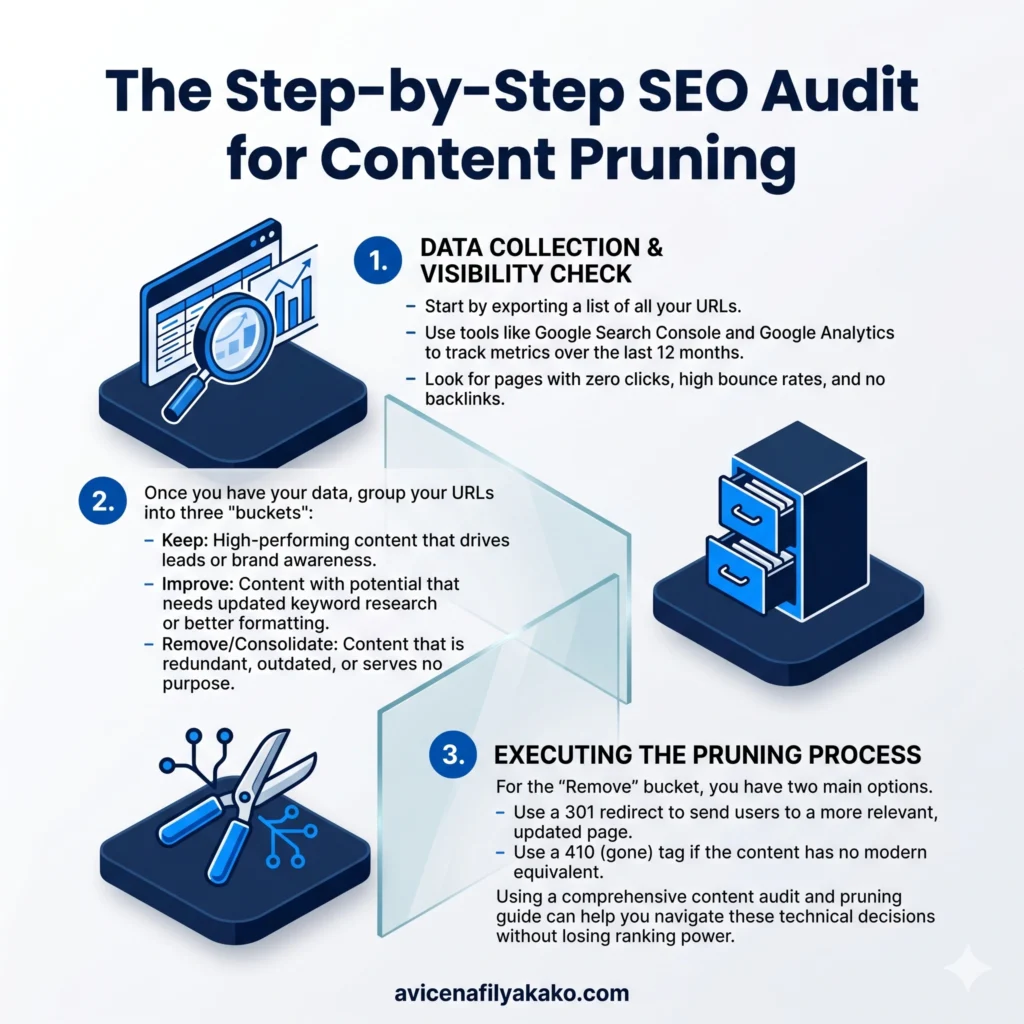
Conducting a content pruning audit requires a surgical approach. You don’t want to accidentally delete a page that, while low in traffic, is actually a vital part of your customer’s conversion journey.
This level of precision is even more critical when managing multiple assets, where you must optimize your multi-site portfolio management operations to ensure consistency across different digital properties.
1. Data Collection and Visibility Check
Start by exporting a list of all your URLs. Use tools like Google Search Console and Google Analytics to track metrics over the last 12 months. Look for pages with zero clicks, high bounce rates, and no backlinks.
To treat your website as a true financial asset, you should perform a comprehensive content inventory valuation to determine which URLs are contributing the most to your business’s equity.
2. Categorizing Your Content
Once you have your data, group your URLs into three “buckets”:
- Keep: High-performing content that drives leads or brand awareness.
- Improve: Content with potential that needs updated keyword research or better formatting.
- Remove/Consolidate: Content that is redundant, outdated, or serves no purpose.
3. Executing the Pruning Process
For the “Remove” bucket, you have two main options. You can use a 301 redirect to send users to a more relevant, updated page, or you can use a 410 (gone) tag if the content has no modern equivalent. Using a comprehensive content audit and pruning guide can help you navigate these technical decisions without losing ranking power.
Strategic Keyword Research: Identifying Redundancy

A common mistake in digital growth is “Keyword Cannibalization.” This happens when you have five different articles all trying to rank for the same term. Instead of dominating the SERPs, these pages compete against each other, diluting your visibility check scores.
During your content pruning audit, look for these overlaps. If you find multiple pages targeting the same intent, merge them into one “Power Page.” This strategy signals to Google that you are the ultimate authority on that specific topic.
Beyond just merging pages, you should aim to provide unique value that competitors lack; leveraging information gain as a competitive advantage ensures your ‘Power Pages’ offer the original insights that search engines now prioritize over generic content.
According to SEO expert Brian Dean, “Focusing on quality over quantity is the only way to survive modern algorithm updates.” By consolidating your efforts, you turn a scattered presence into a focused powerhouse.
Boosting Revenue Growth Through Content Quality

It seems counterintuitive to delete content to grow, but the math checks out. When you remove low-quality pages, the average “weight” of your site increases. This often leads to a site-wide lift in rankings because your site health is no longer being dragged down by “zombie pages.”
As your site becomes more streamlined, your conversion rates usually follow. Visitors are no longer landing on broken pages or reading advice that is no longer relevant. They are seeing your best work, which builds the trust necessary for sustainable revenue growth.
FAQs About Content Pruning
Will deleting pages hurt my SEO?
Deleting low-quality or irrelevant pages actually helps your SEO by improving your site’s overall quality score and crawl equity. As long as you redirect pages that have existing backlinks to relevant alternatives, your authority will remain intact or even increase.
How often should I perform a content pruning audit?
You should conduct a comprehensive content pruning audit at least once a year, though high-growth sites benefit from quarterly checks. Regular maintenance prevents “content bloat” from slowing down your site’s technical performance and search visibility.
What is the difference between pruning and updating?
Content pruning is the overarching process of removing or consolidating dead weight, while updating involves refreshing “Keep” or “Improve” content with new keyword research and data. Both are essential pillars of a professional seo audit strategy.
Implementation Strategy
- Audit: Identify pages with zero traffic or conversions in the last 365 days.
- Analyze: Check if these pages have any valuable backlinks using professional tools.
- Action: Redirect, Delete, or Refresh based on the data.
- Monitor: Watch your Google Search Console for a lift in average position across your remaining pages.
By treating your website as a living ecosystem rather than a static filing cabinet, you ensure that every page serves a purpose. Content pruning isn’t about having less; it’s about making sure that what you do have is the very best in your niche.
Disclaimer: The information provided in this article is for educational and general informational purposes only and should not be construed as professional advice (such as legal, medical, or financial). While the author strives to provide accurate and up-to-date information, no representations or warranties are made regarding its completeness or reliability. Any action you take based on this information is strictly at your own risk.
This article was authored by Avicena Fily A Kako, a Digital Entrepreneur & SEO Specialist using AI to scale business and finance projects.