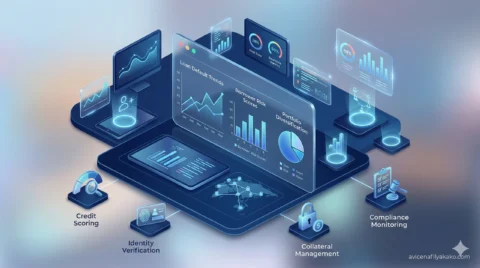
Entering the world of alternative investments can feel like navigating a high-stakes digital frontier. You are likely here because you’ve heard of the impressive returns, but you are also smart enough to ask: “What happens when things go wrong?”
Managing a P2P Lending portfolio isn’t about avoiding risk entirely—it’s about documenting, measuring, and mitigating it. Think of this guide as your flight recorder. By maintaining a disciplined risk management log, you can transform a speculative gamble into a calculated wealth-building strategy.
The Pillars of Risk in P2P Lending

Before you commit your first dollar, you must understand that P2P Lending functions differently than a traditional savings account. You are the bank. Because you are assuming significant credit risk here, it is wise to balance your portfolio with “risk-free” assets; for instance, you can learn how to build a US Treasury bond ladder to create a rock-solid foundation of government-backed security alongside your P2P ventures. When you lend money to individuals or small businesses, you assume the role of the underwriter.
Understanding Default Rates
The most significant threat to your capital is the default rate. This is the percentage of loans in your portfolio where the borrower stops making payments. While a platform might advertise a 10% return, a 3% default rate effectively drags your net yield down.
“In investing, what is comfortable is rarely profitable.” — Robert Arnott
To protect your “principal,” you must keep a close eye on the platform’s historical performance data. If a platform’s average default rate spikes, it may indicate loosening credit standards.
Navigating Credit Tiers
Platforms typically categorize borrowers into Credit Tiers (e.g., Grade A through Grade E).
- Grade A: Low risk, lower interest rates (stable borrowers).
- Grade E: High risk, high interest rates (speculative borrowers).
A balanced P2P Lending log should track your exposure across these tiers to ensure you aren’t over-leveraged in high-risk “junk” debt.
Strategy: The Power of Diversified Notes

If you put $5,000 into a single loan and that borrower defaults, you lose 100% of your investment. However, if you spread that $5,000 across 200 diversified notes at $25 each, a single default only impacts 0.5% of your portfolio.
Why Fractional Ownership Wins
By using fractional notes, you create a statistical safety net. Even if several borrowers face financial hardship, the interest gathered from the performing loans typically covers the losses, keeping your overall P2P Lending experience profitable.
| Feature | Single Large Loan | Diversified Notes |
|---|---|---|
| Risk Concentration | Extremely High | Very Low |
| Impact of Default | Portfolio-Ending | Minimal & Absorbable |
| Yield Stability | Volatile | Consistent |
Your Step-by-Step Risk Management Log
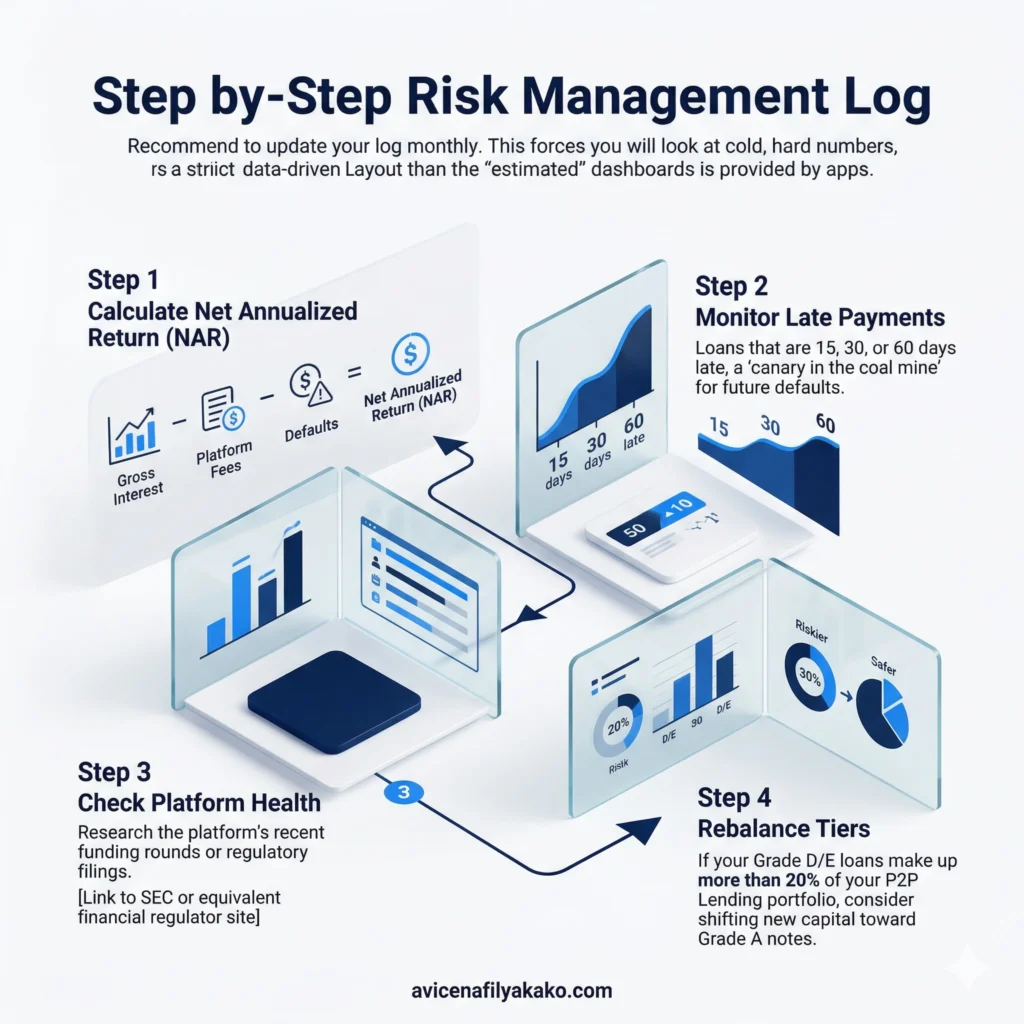
I recommend updating your log monthly. This practice forces you to look at the cold, hard numbers rather than the “estimated” dashboards provided by apps.
- Calculate Net Annualized Return (NAR): Subtract platform fees and defaults from your gross interest.
- Monitor Late Payments: Track loans that are 15, 30, or 60 days late. This is a “canary in the coal mine” for future defaults.
- Check Platform Health: Research the platform’s recent funding rounds or regulatory filings.
- Rebalance Tiers: If your Grade D/E loans make up more than 20% of your P2P Lending portfolio, consider shifting new capital toward Grade A notes.
Advanced Tactics for the Savvy Investor
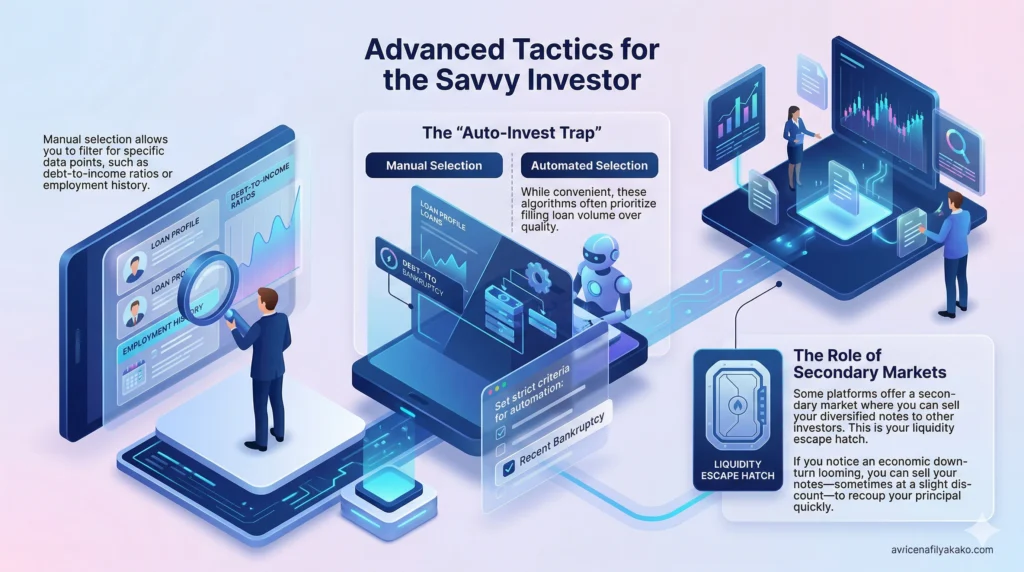
One unique perspective often overlooked is the “Auto-Invest Trap.” Many P2P Lending platforms offer automated tools that pick loans for you. While convenient, these algorithms often prioritize filling loan volume over quality.
Manual vs. Automated Selection
If you have the time, manual selection allows you to filter for specific data points, such as debt-to-income ratios or employment history. If you prefer automation, ensure your filters are set strictly. For example, I often set my automated tools to exclude any borrower with a recent bankruptcy on their record, regardless of the offered interest rate.
The Role of Secondary Markets
Some platforms offer a secondary market where you can sell your diversified notes to other investors. This is your liquidity escape hatch. If you notice an economic downturn looming, you can sell your notes—sometimes at a slight discount—to recoup your principal quickly.
If the lack of immediate liquidity in P2P lending concerns you, a more traditional approach to managing cash flow is to use this CD ladder guide to ensure your capital remains accessible and insured while still earning a predictable return.
Frequently Asked Questions
What is a “normal” default rate for P2P Lending?
A normal default rate typically ranges between 2% and 7%, depending on the credit quality of the borrowers you choose. Generally, lower-tier loans (Grades D-E) will have significantly higher default rates, which are intended to be offset by their higher interest rates.
Can I lose all my money in P2P Lending?
Yes, it is possible to lose your principal if the platform itself collapses or if you fail to diversify your notes across many different borrowers. Unlike bank deposits, P2P Lending investments are usually not insured by government entities like the FDIC.
How do diversified notes reduce my overall risk?
Diversified notes reduce risk by spreading your capital across hundreds of individual loans, ensuring that no single borrower’s failure can significantly harm your portfolio. This application of the “Law of Large Numbers” helps stabilize your returns over time.
Final Thoughts on P2P Strategy
Success in P2P Lending isn’t about finding the one “perfect” borrower. It’s about building a robust system that expects—and accounts for—failure. By maintaining a rigorous risk management log and focusing on Credit Tiers, you move from a place of uncertainty to a place of financial mastery. While P2P lending is an excellent tool for high-yield interest, it works best when paired with equity-based income; I recommend integrating a dividend growth investing framework to capture long-term capital appreciation that P2P notes cannot provide. Consumer Financial Protection Bureau – Risks of Alternative Lending
Disclaimer: The information provided in this article is for educational and general informational purposes only and should not be construed as professional advice (such as legal, medical, or financial). While the author strives to provide accurate and up-to-date information, no representations or warranties are made regarding its completeness or reliability. Any action you take based on this information is strictly at your own risk.
This article was authored by Avicena Fily A Kako, a Digital Entrepreneur & SEO Specialist using AI to scale business and finance projects.