
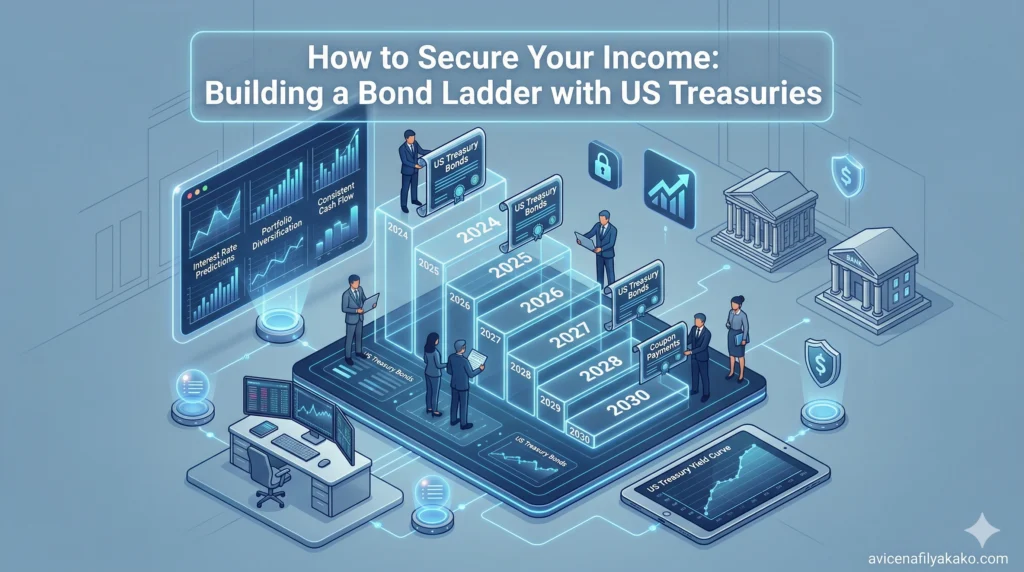
Investing in fixed income often feels like trying to time a moving target. If you buy a long-term bond today and interest rates rise tomorrow, you might feel the sting of “buyer’s remorse” as the market value of your investment drops.
This is where a bond ladder comes into play. Think of it like a staircase for your savings. Instead of putting all your money into one maturity date, you stack your investments across different time intervals. This strategy allows you to capture current yields while maintaining the flexibility to reinvest as rates change.
What is a Bond Ladder?
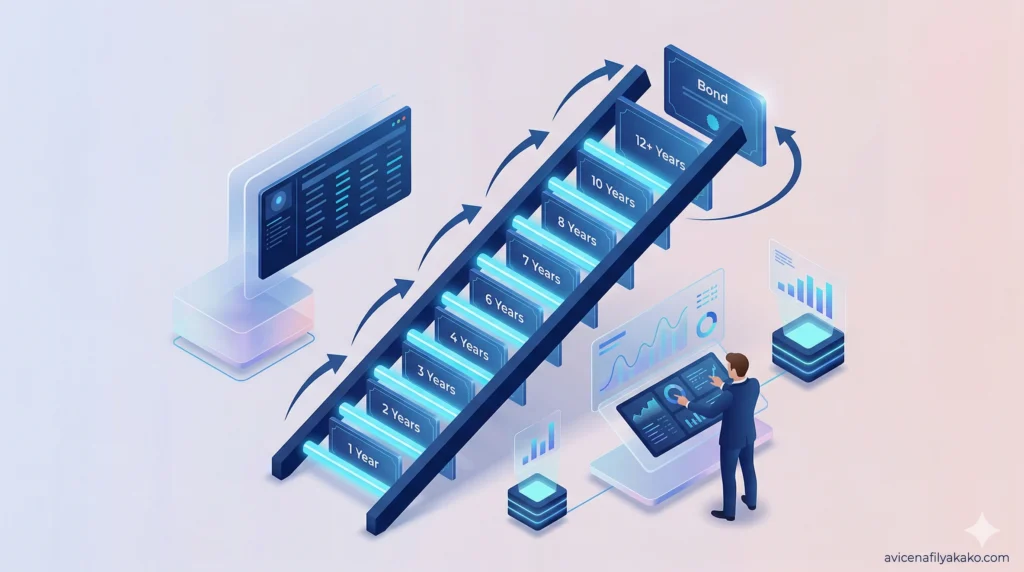
A bond ladder is a portfolio of individual bonds that mature at regular intervals. By staggering your maturity dates, you ensure that a portion of your principal is returned to you every few months or years.
I like to compare a bond ladder to a relay race. Instead of one runner trying to go the whole distance alone, you have multiple runners (your bonds) handing off the baton (the cash) at specific checkpoints. This keeps your liquidity flowing and reduces your exposure to interest rate swings.
While Treasuries are a staple for federal safety, many investors also utilize a CD ladder guide to compare bank-specific yields and FDIC protections against these government-backed securities.
“The strategy of laddering is a way to manage the uncertainty of interest rates. It’s about being roughly right rather than precisely wrong.” — Common industry wisdom among fixed-income strategists.
Why Use US Treasuries for Your Ladder?

When building a bond ladder, the “rungs” need to be sturdy. US Treasuries are backed by the full faith and credit of the United States government, making them one of the safest assets on the planet.
- Safety: Minimal default risk compared to corporate bonds.
- Tax Efficiency: Interest is generally exempt from state and local taxes. Treasuries shield you from local taxes, but if you are in a particularly high tax bracket, you might find even greater savings by exploring municipal bonds for tax-free income at the federal level as well.
- Liquidity: The Treasury market is incredibly deep, meaning you can sell if you need cash urgently.
Analyzing the Yield Curve
Before you start clicking “buy” on TreasuryDirect, you need to look at the yield curve. Usually, you get paid more for holding debt longer. However, when the curve is inverted, short-term rungs might actually offer higher returns than long-term ones. Understanding this helps you decide how far apart to space your rungs.
| Ladder Strategy | Typical Maturity Gap | Best For |
|---|---|---|
| Short-Term | 3 – 12 Months | Emergency funds & liquidity |
| Intermediate | 2 – 5 Years | Balancing yield and stability |
| Long-Term | 10 – 30 Years | Retirement income planning |
How to Build a Bond Ladder Step-by-Step
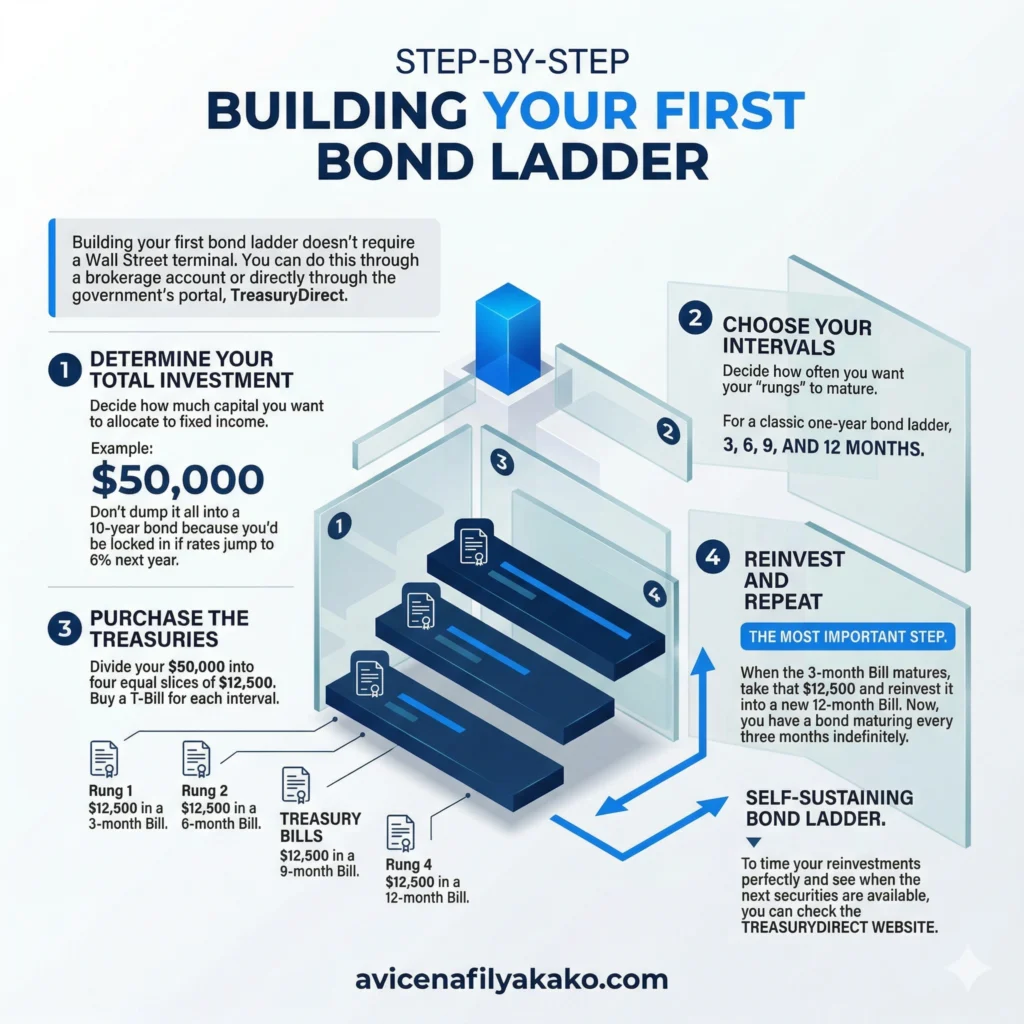
Building your first bond ladder doesn’t require a Wall Street terminal. You can do this through a brokerage account or directly through the government’s portal, TreasuryDirect.
1. Determine Your Total Investment
Decide how much capital you want to allocate to fixed income. Let’s say you have $50,000. You don’t want to dump it all into a 10-year bond because you’d be locked in if rates jump to 6% next year.
2. Choose Your Intervals
Decide how often you want your “rungs” to mature. For a classic one-year bond ladder, you might choose maturities of 3, 6, 9, and 12 months.
3. Purchase the Treasuries
Divide your $50,000 into four equal slices of $12,500. Buy a T-Bill for each of the intervals you selected.
- Rung 1: $12,500 in a 3-month Bill.
- Rung 2: $12,500 in a 6-month Bill.
- Rung 3: $12,500 in a 9-month Bill.
- Rung 4: $12,500 in a 12-month Bill.
4. Reinvest and Repeat
This is the most important step. When the 3-month Bill matures, you take that $12,500 and reinvest it into a new 12-month Bill. Now, you have a bond maturing every three months indefinitely. You have successfully built a self-sustaining bond ladder.
To time your reinvestments perfectly and see when the next securities are available, you can check the Upcoming Treasury Auction Schedule.
Managing Interest Rate Risk
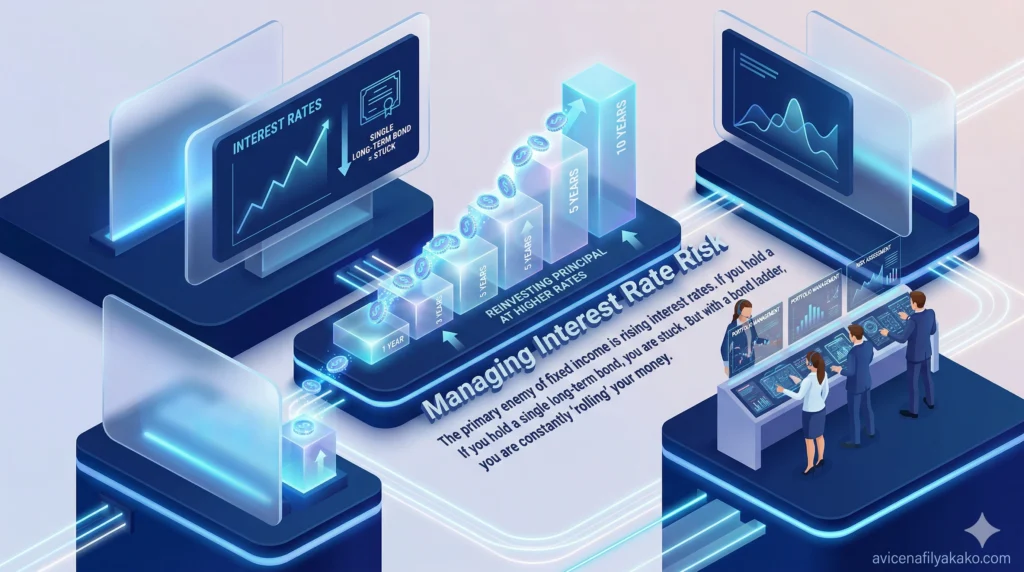
The primary enemy of fixed income is rising interest rates. If you hold a single long-term bond, you are stuck. But with a bond ladder, you are constantly “rolling” your money.
If interest rates go up, your maturing rungs will be reinvested at those higher rates. If rates go down, you still have your older, higher-yielding rungs locked in for a longer duration. It’s a built-in hedge that keeps you from making a massive timing mistake.
Common Mistakes to Avoid
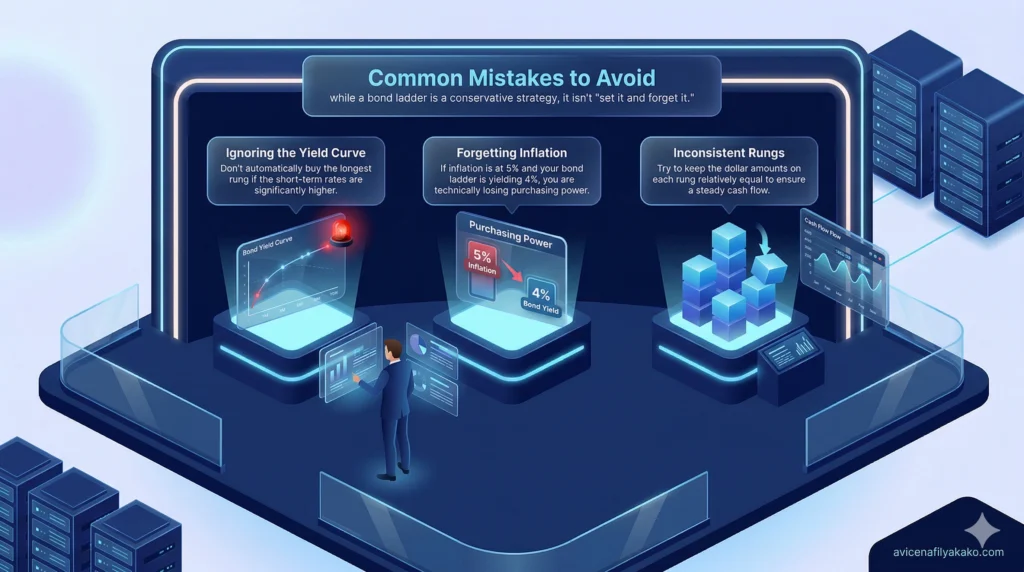
While a bond ladder is a conservative strategy, it isn’t “set it and forget it.”
- Ignoring the Yield Curve: Don’t automatically buy the longest rung if the short-term rates are significantly higher.
- Forgetting Inflation: If inflation is at 5% and your bond ladder is yielding 4%, you are technically losing purchasing power. To combat the eroding effects of inflation on fixed-income rungs, it is often effective to anchor your total portfolio with a dividend growth investing framework that provides a rising stream of income to maintain your purchasing power over time.
- Inconsistent Rungs: Try to keep the dollar amounts on each rung relatively equal to ensure a steady cash flow.
Frequently Asked Questions
Can I build a bond ladder with small amounts of money?
Yes, you can start a bond ladder with as little as $100 through TreasuryDirect, as that is the minimum purchase amount for most Treasury securities. Many brokerage firms also allow for small-increment purchases of fractional or individual bonds.
What happens if I need my money before a rung matures?
You can sell your Treasury bonds on the secondary market through a brokerage before they mature, though you may receive more or less than your original investment depending on current interest rates. If you use TreasuryDirect, you would need to transfer the security to a bank or broker first to sell it before maturity.
Is a bond ladder better than a bond ETF?
A bond ladder gives you more control over exact maturity dates and guarantees the return of your principal if held to maturity, whereas a bond ETF does not have a fixed maturity date and its price fluctuates constantly. Ladders are generally preferred by investors who need specific cash flows at specific times.
Disclaimer: The information provided in this article is for educational and general informational purposes only and should not be construed as professional advice (such as legal, medical, or financial). While the author strives to provide accurate and up-to-date information, no representations or warranties are made regarding its completeness or reliability. Any action you take based on this information is strictly at your own risk.
This article was authored by Avicena Fily A Kako, a Digital Entrepreneur & SEO Specialist using AI to scale business and finance projects.