
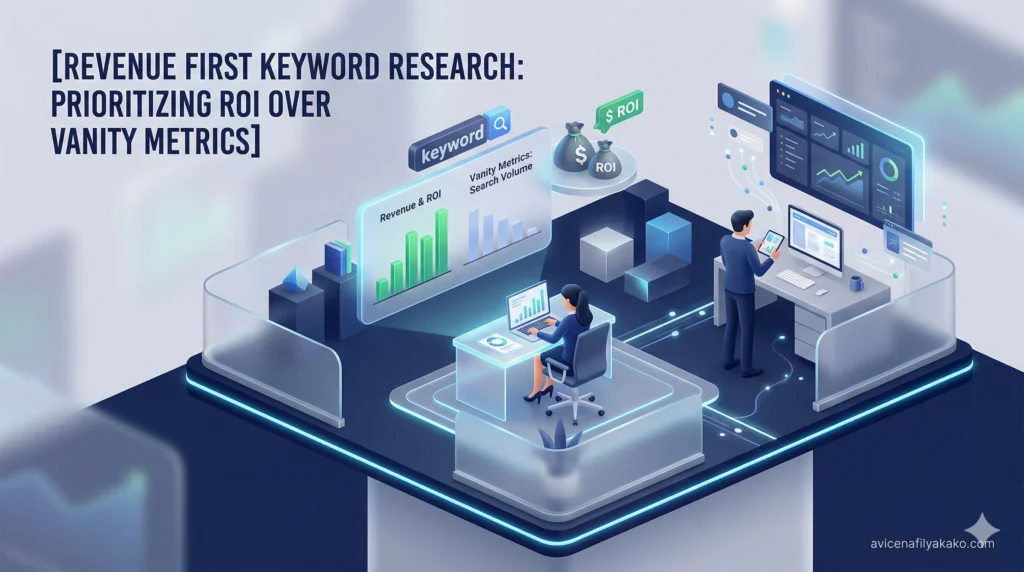
Traffic is a vanity metric; revenue is a sanity metric. If you are tired of seeing your Google Search Console graphs climb while your bank account stays stagnant, you are likely focusing on the wrong data points. Most SEO strategies cast a wide net, hoping to catch anyone with a passing interest in a topic.
Revenue First keyword research flips the script. Instead of chasing high-volume “top-of-funnel” terms, we prioritize keywords that signal a clear intent to buy. It is about finding the shortest path between a search query and a conversion.
Why Most SEO Strategies Fail the Bottom Line
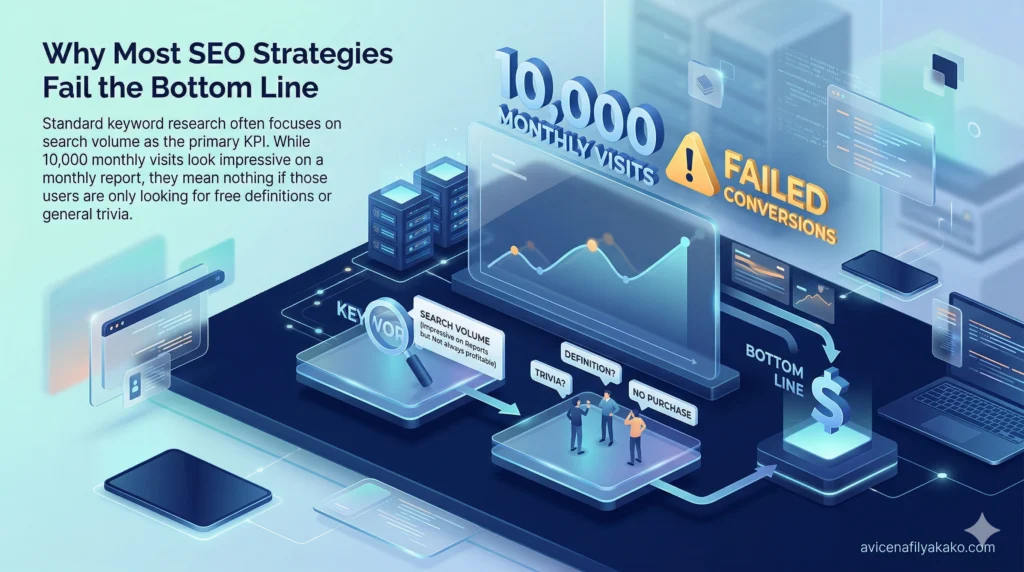
Standard keyword research often focuses on search volume as the primary KPI. While 10,000 monthly visits look impressive on a monthly report, they mean nothing if those users are only looking for free definitions or general trivia.
By adopting a Revenue First mindset, you shift your focus toward Commercial Intent. These are the searches performed by users who have already done their research and are now looking for a solution, a tool, or a service provider.
Focusing on these high-intent users is the cornerstone of a robust B2B funnel lead generation strategy, allowing you to capture prospects who are ready to transition from research to a formal inquiry.
The Logic of CPC in Keyword Research
One of the best indicators of a profitable keyword is its CPC (Cost Per Click). If competitors are willing to pay $15.00 per click in Google Ads, it is because that keyword converts.
“The goal is not to be ‘found’ by everyone; the goal is to be found by the person with their credit card already in their hand.” — Marketing Maxim
Identifying Bottom-Funnel Opportunities

To implement a Revenue First strategy, you must categorize your keywords by their proximity to the “Buy” button. We call this targeting the bottom-funnel.
1. High-Intent Modifiers
Look for keywords that include “transactional” modifiers. These are words that indicate a user is comparing options or ready to commit.
- Comparison: “Competitor A vs Competitor B”
- Specifics: “Best [Service] for [Niche]”
- Action: “Buy,” “Pricing,” “Software,” or “Service.”
2. Solving Specific Pain Points
Users searching for a solution to a specific problem are much more likely to convert than those searching for broad industry terms. For example, “how to fix leaky pipes” has higher Commercial Intent for a plumber than “plumbing basics.”
| Metric | Traditional SEO | Revenue First SEO |
|---|---|---|
| Primary Goal | Total Traffic Volume | High ROI-based SEO |
| Keyword Focus | Informational/Broad | Bottom-funnel/Specific |
| Success Metric | Ranking Positions | Conversion Rate & Sales |
How to Execute a Revenue First Keyword Strategy
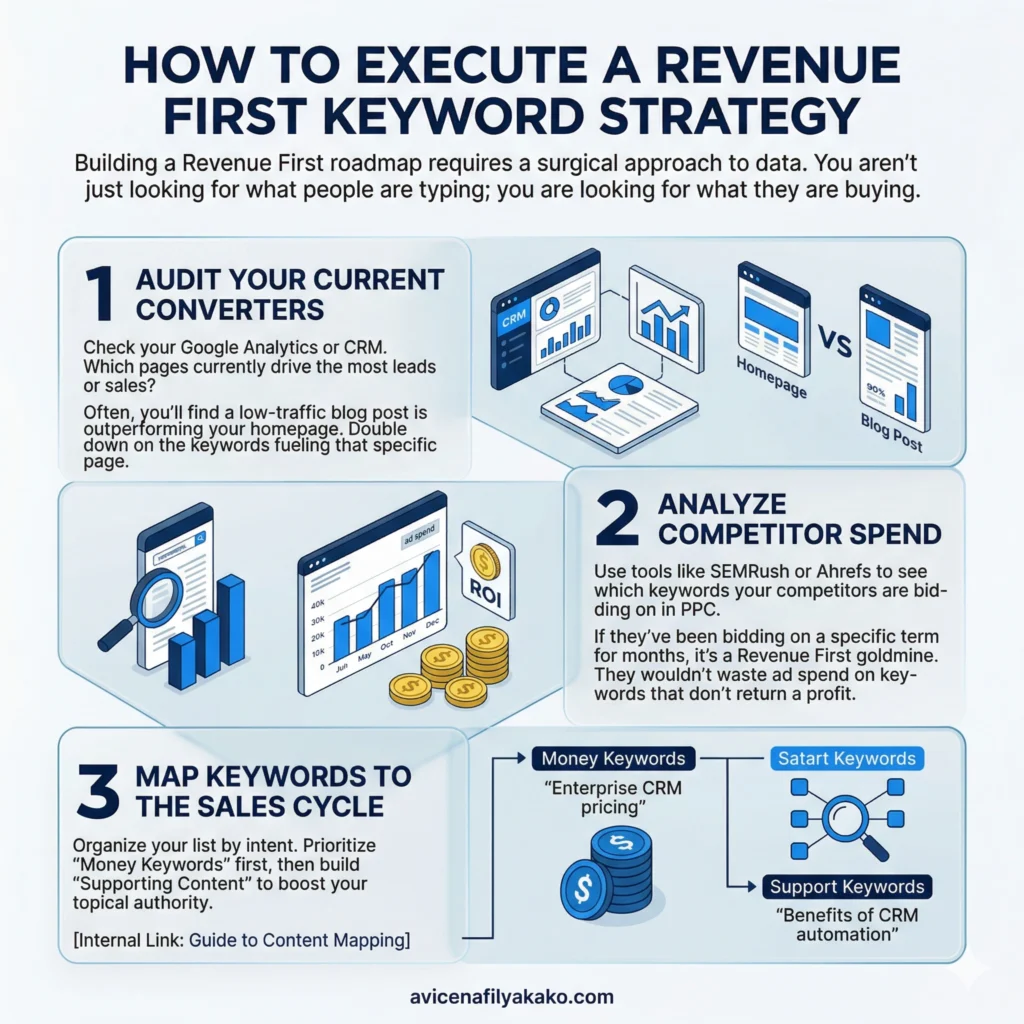
Building a Revenue First roadmap requires a surgical approach to data. You aren’t just looking for what people are typing; you are looking for what they are buying.
Step 1: Audit Your Current Converters
Check your Google Analytics or CRM. Which pages currently drive the most leads or sales? Often, you’ll find a low-traffic blog post is outperforming your homepage. Double down on the keywords fueling that specific page.
Step 2: Analyze Competitor Spend
Use tools like SEMRush or Ahrefs to see which keywords your competitors are bidding on in PPC. If they’ve been bidding on a specific term for months, it’s a Revenue First goldmine. They wouldn’t waste ad spend on keywords that don’t return a profit.
Step 3: Map Keywords to the Sales Cycle
By aligning your search terms with the buyer’s journey, you can implement an MVP content mapping framework to ensure every piece of content serves a specific conversion goal.
- Money Keywords: “Enterprise CRM pricing”
- Support Keywords: “Benefits of CRM automation”
Strengthening Your Topical Authority

Google doesn’t just rank pages; it ranks brands it perceives as experts. To win at ROI-based SEO, you must demonstrate depth. This means covering a topic from every angle—not just the selling angle.
Think of it like a specialty coffee shop. To sell the most expensive beans (Revenue First), you also need to be able to explain the roast profiles, the origin, and the brewing methods. This builds the trust necessary for a user to choose you over a generic big-box retailer.
Frequently Asked Questions
What is Revenue First keyword research?
Revenue First keyword research is an SEO strategy that prioritizes keywords based on their likelihood to generate immediate sales or leads rather than focusing on high-volume informational traffic. It targets users at the bottom of the marketing funnel who demonstrate clear Commercial Intent.
How do I determine the ROI of a keyword?
You can determine the ROI of a keyword by looking at its CPC in advertising platforms and analyzing the conversion rates of existing pages targeting similar terms. High-cost-per-click values usually indicate that the traffic is highly valuable and leads to revenue.
Is search volume still important in 2026?
Search volume is a secondary metric that should only be considered after you have established that a keyword has the right intent. A keyword with 50 monthly searches and a 10% conversion rate is more valuable than a keyword with 5,000 searches and a 0.01% conversion rate.
Final Thoughts on Sustainable Growth
Switching to a Revenue First model requires discipline. It means saying “no” to easy traffic wins that don’t move the needle for your business. By focusing on bottom-funnel queries and ROI-based SEO, you ensure that every hour spent on content creation is an investment in your company’s actual growth.
For those scaling across multiple domains, integrating these SEO insights into your multi-site portfolio management operations ensures consistent ROI and streamlined growth across all digital assets.
To better understand how users navigate their journey toward a purchase, you can explore the HubSpot Research on Search Intent which highlights how identifying user goals leads to higher engagement and conversions.
Disclaimer: The information provided in this article is for educational and general informational purposes only and should not be construed as professional advice (such as legal, medical, or financial). While the author strives to provide accurate and up-to-date information, no representations or warranties are made regarding its completeness or reliability. Any action you take based on this information is strictly at your own risk.
This article was authored by Avicena Fily A Kako, a Digital Entrepreneur & SEO Specialist using AI to scale business and finance projects.