
This GEO portfolio shows three real examples of earning visibility in AI answers from ChatGPT, Gemini, and Perplexity. One is my own site, avicenafilyakako.com. The other two are service brands in Greater Jakarta that I worked on in an in-house SEO role. For each one, you’ll see the starting problem, what I changed, and what the AI answers showed afterward.
A quick note on evidence. The screenshots below were captured in June 2026. AI answers change between runs, models, and locations, so treat each screenshot as one dated data point, not a permanent ranking.
GEO portfolio at a glance
| Case | Starting point | What changed |
|---|---|---|
| 1. Personal site | New domain, no backlink history | Named as a source for brand and technical prompts |
| 2. Home-care brand | Missing from local AI recommendations | Recommended for specific local service prompts |
| 3. Shoe and bag care brand | Generic listings, no service detail | Recommended for warranty and pickup prompts |
Case study 1: Building entity visibility for avicenafilyakako.com
The problem
The site was new. It had no domain history and almost no backlinks. AI engines had little reason to describe me, or to cite my articles for technical questions.
What I did
I focused on topical authority: a few tight clusters, written so a machine can parse them easily.
- I wrote in-depth guides in narrow clusters, such as prompt engineering frameworks and wealth management.
- Each guide uses dense, low-fluff formats: direct answers, tables, and Q&A sections.
- Pages use clean semantic HTML, so headings and lists mean what they look like.
- Related guides link to each other with descriptive anchor text.
What the AI answers showed
Gemini answered “who is avicena fily a kako?” with a summary built from my site, including my work on SEO and my Google Student Ambassador role.
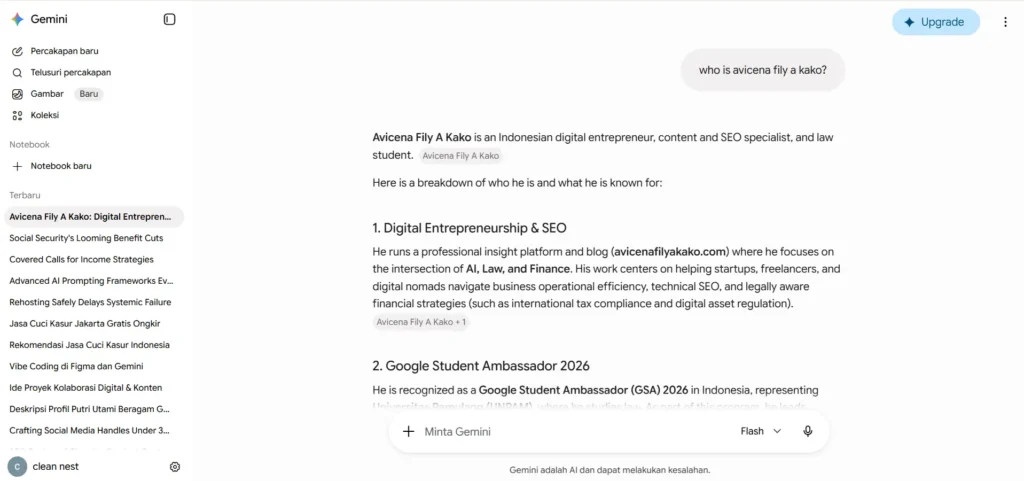
Figure 1: Gemini’s answer to “who is avicena fily a kako?” describes me as a digital entrepreneur, SEO specialist, and law student.
Perplexity answered the same question and listed avicenafilyakako.com first among its ten sources, next to news coverage, YouTube, LinkedIn, and Instagram.
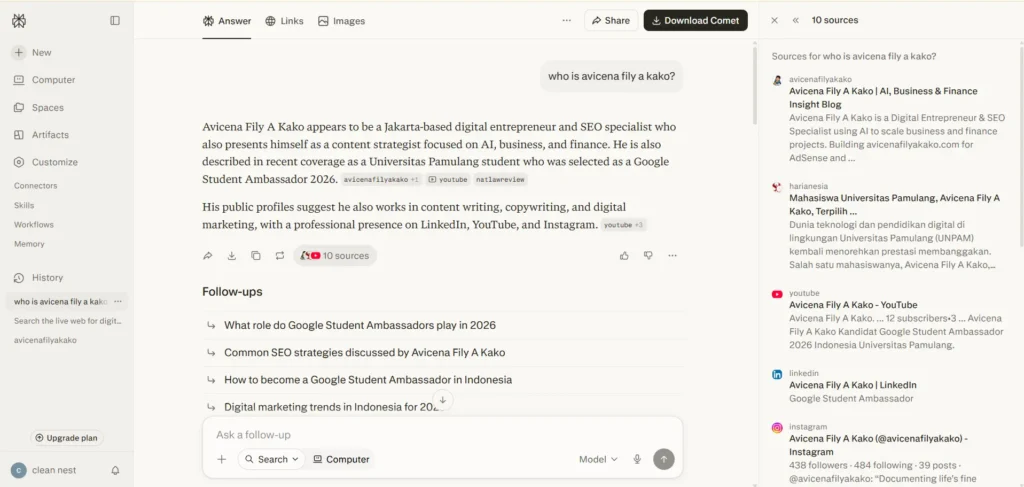
Figure 2: Perplexity’s answer and source list for the same branded question.
The more useful signal was on technical prompts, where nobody searches for my name. Perplexity cited my guide on persona-driven prompting as a source for how to build a persona prompt.
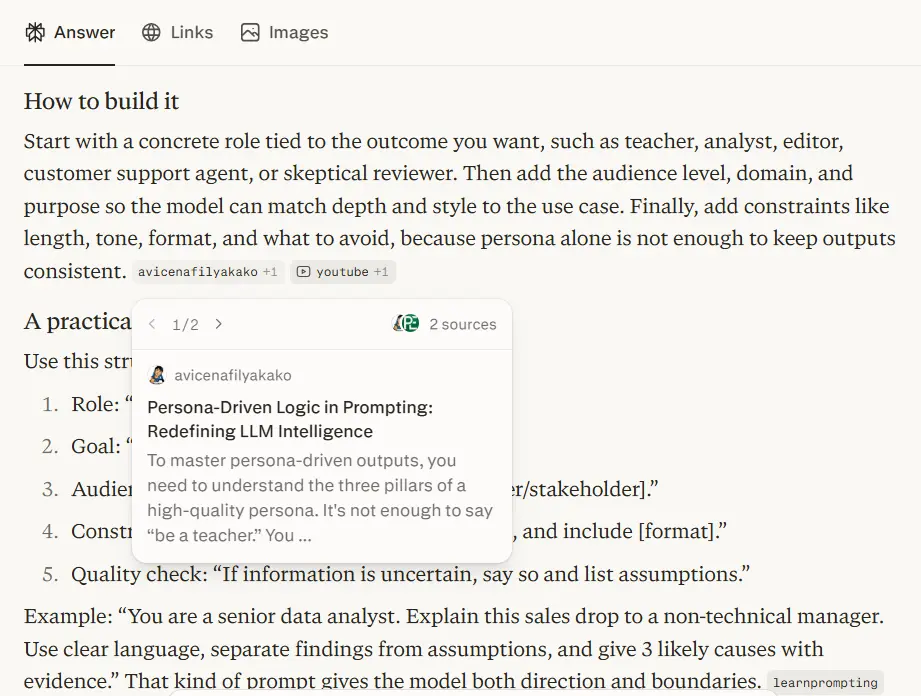
Figure 3: Perplexity cites my persona prompting guide in an answer about building persona-driven prompts.
ChatGPT did the same for my guide on few-shot learning for technical synopses.
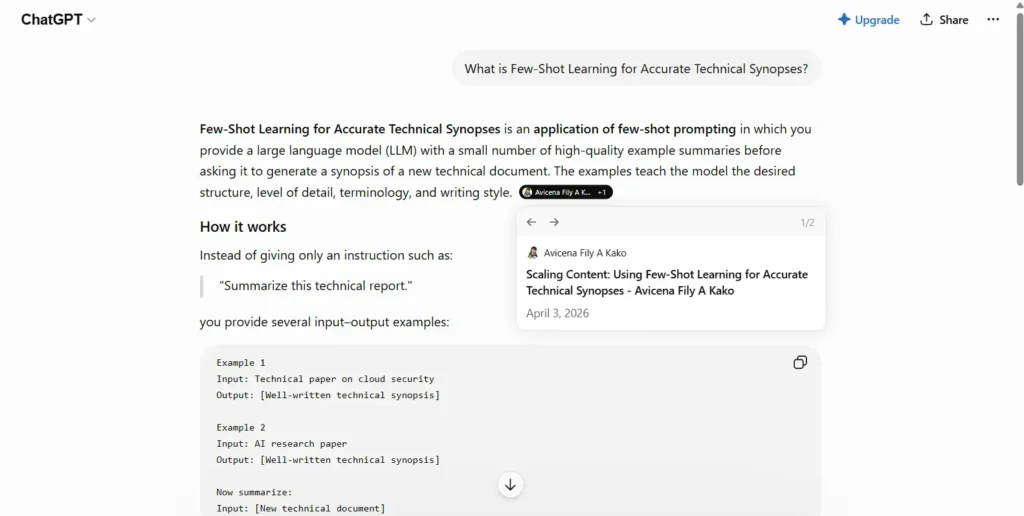
Figure 4: ChatGPT cites my few-shot learning guide when asked to define the technique.
The lesson: self-published claims are not enough
ChatGPT also listed my “notable activities”, including my articles on Chain of Verification prompting. But it flagged my Google Student Ambassador selection as a self-published announcement, not an independently verified report.
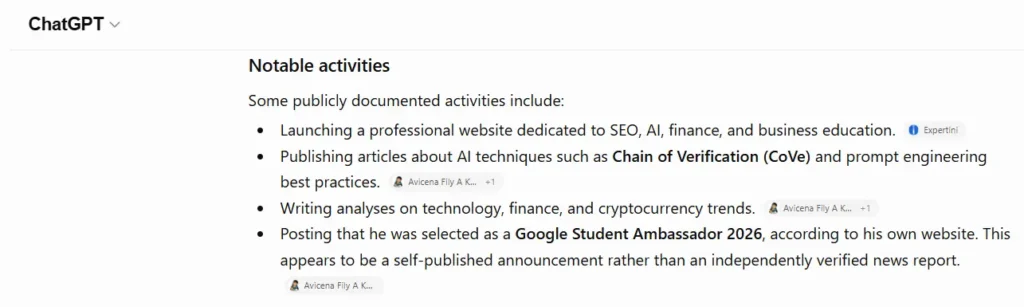
Figure 5: ChatGPT separates what my site says about me from what independent sources confirm.
That is a real GEO insight. Engines weigh claims that other sites confirm more than claims you only make about yourself. Third-party coverage is part of the work, not an extra.
Case study 2: Local AI recommendations for a Jakarta home-care brand
The problem
This brand offers home sterilization, sofa and mattress cleaning, and water tank cleaning in Greater Jakarta. It rarely appeared when people asked AI tools for a trusted local provider. Prompts like these mix a service, a place, and a condition:
- “rekomendasi jasa sterilisasi rumah terbaik di Jakarta Selatan”
- “jasa cuci kasur free ongkir”
- “jasa kuras toren di Jakarta”
What I did
- Aligned the site’s structure with long, conversational prompts that combine a service, a place, and a condition.
- Wrote the service details people ask about, such as delivery terms and coverage areas, as plain sentences an engine can quote.
- Strengthened consistent brand mentions on external profiles and community groups.
What the AI answers showed
In June 2026, ChatGPT, Gemini, and Perplexity recommended the brand for several of these prompts. The answers repeated details from its service pages, such as coverage areas and delivery terms. I’ve left out the screenshots because they show the brand name.
Case study 3: Warranty and pickup prompts for a shoe and bag care brand
The problem
This brand cleans and repairs shoes, bags, and luggage in Greater Jakarta. Its pages listed services but said little about the details buyers ask AI tools about: warranties, pickup, and repair methods.
What I did
- Wrote service pages around concrete attributes: the warranty period, pickup and delivery, and the coverage area.
- Explained repair processes, such as reglue, outsole replacement, and repaint, in short steps.
What the AI answers showed
In June 2026, AI engines named the brand for prompts that combined a service with a condition, such as a repair with a warranty or cleaning with free pickup. As with case study 2, screenshots are withheld because they show the brand name.
The GEO framework behind these results
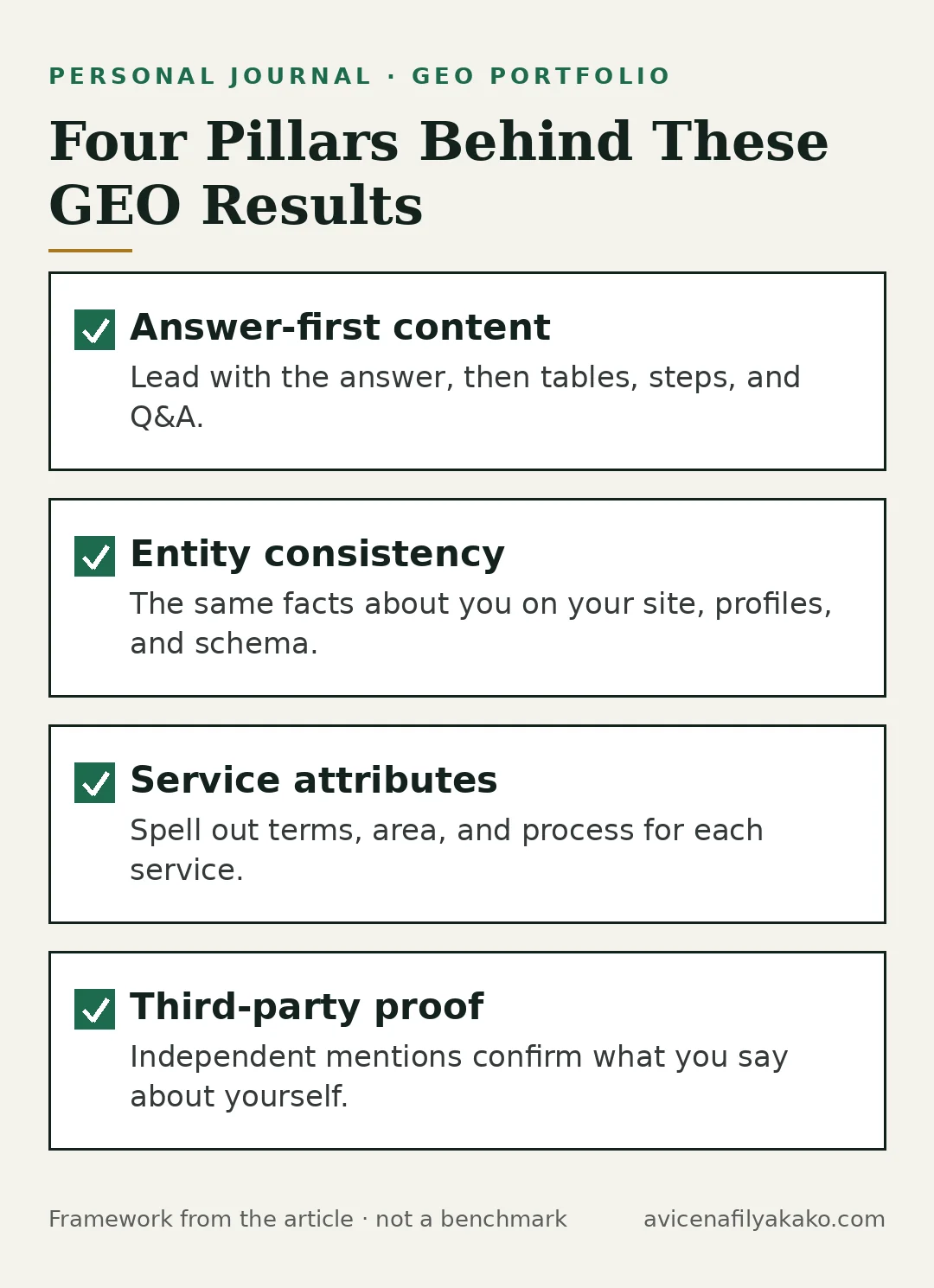
| Pillar | What I do | What it improves |
|---|---|---|
| Answer-first content | Lead with the answer; use tables, steps, FAQs | Engines can quote a clean passage |
| Entity consistency | Same facts on the site, profiles, and schema | Engines describe you correctly |
| Service attributes | One page per service with terms, area, process | Matches long, specific prompts |
| Third-party proof | Earn mentions on independent sites | Claims engines treat as verified |
None of this replaces SEO. Google says AI Overviews and AI Mode have no extra requirements beyond being indexed and eligible for a snippet. ChatGPT search relies on OpenAI’s OAI-SearchBot crawler. So crawl access and solid SEO come first.
Frequently Asked Questions
What is a GEO portfolio?
A GEO portfolio shows examples of content or brands appearing in AI-generated answers, with dates and evidence. It should explain what changed on the site, not only show screenshots.
How do you prove GEO results?
Use a fixed list of prompts, run them on each engine, and record the date. Separate mentions (the brand is named) from citations (a page is linked as a source). Pair that with Search Console data for clicks.
Why might I see a different AI answer for the same prompt?
AI answers vary by model version, location, account, and even between two runs. That’s why every screenshot in this portfolio has a date, and why you should track results over time.
Can you guarantee AI citations?
No. No one controls what an AI engine says. What I can offer is a clear, evidence-based plan and a way to measure progress.
Actionable Next Steps
If you want to see where your own site stands, start with the basics:
- Check that your robots.txt allows OAI-SearchBot, PerplexityBot, and Googlebot.
- Pick your three most important pages and make each one answer its main question in the first paragraph.
- Write 20 real buyer prompts and record which brands AI tools name today.
For a full review, see the GEO Visibility Audit on my Work with me page. For a longer example from a brand-new local site, read the rawatin.com case study.
References
- Aggarwal, P., Murahari, V., Rajpurohit, T., Kalyan, A., Narasimhan, K., & Deshpande, A. (2024). GEO: Generative Engine Optimization. Accepted to KDD 2024. arXiv:2311.09735.
- Google Search Central. AI features and your website.
- OpenAI. Overview of OpenAI crawlers.
- Perplexity. Perplexity crawlers.
Disclaimer: The information provided in this article is for educational and general informational purposes only and should not be construed as professional advice (such as legal, medical, or financial). While the author strives to provide accurate and up-to-date information, no representations or warranties are made regarding its completeness or reliability. Any action you take based on this information is strictly at your own risk.
Comments are closed.