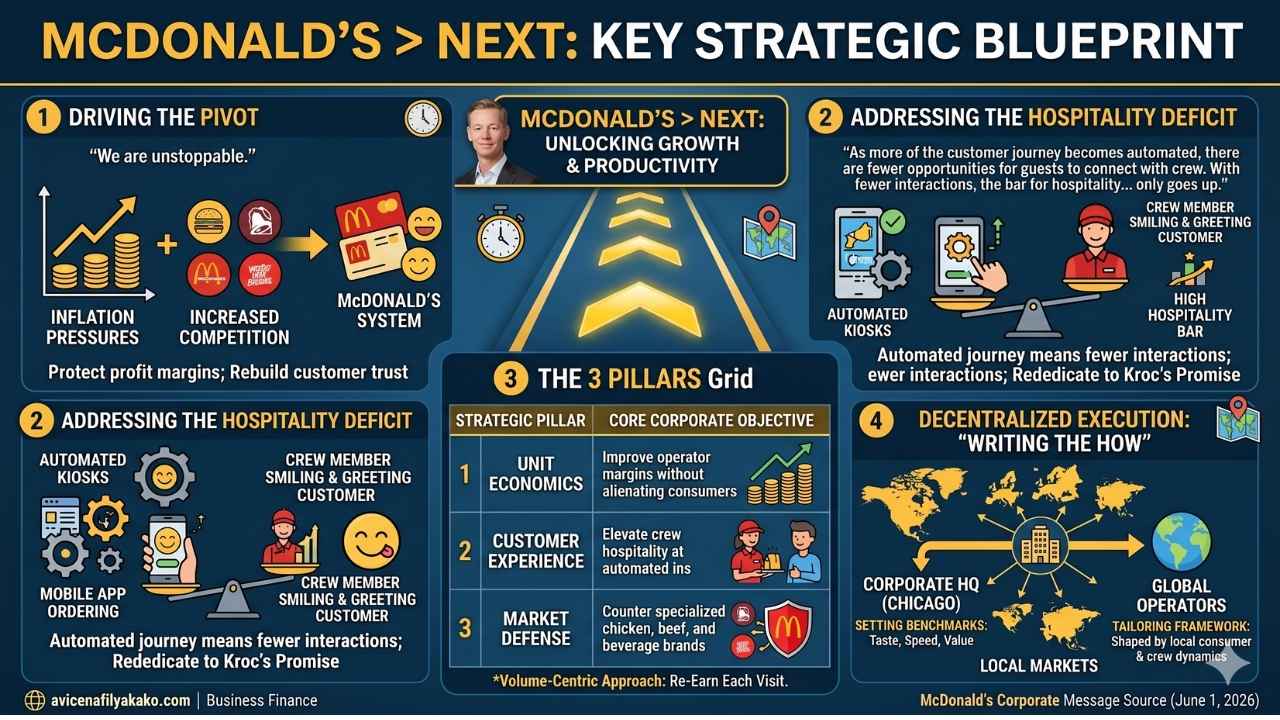
McDonald’s Chairman and CEO Chris Kempczinski has officially launched “McDonald’s > NEXT,” a brand-wide strategic framework designed to unlock the company’s next phase of growth and improve unit economics across its global network. The announcement, sent via an official system-wide message, signals an urgent operational pivot to defend market share against a rising wave of specialized fast-food competitors.
The stakes for this corporate pivot are high. As traditional and specialized competitors upgrade their menus, McDonald’s faces the dual challenge of protecting its profit margins while rebuilding consumer trust damaged by inflation.
The Automation Dilemma and the Hospitality Deficit
The cornerstone of the McDonald’s > NEXT announcement is a candid acknowledgment of a growing structural vulnerability: the alienation of the digital customer. Over the past several years, the company successfully scaled one of the largest digital loyalty programs in the world. However, my analysis of recent QSR trends shows that an aggressive shift toward mobile applications and automated self-service kiosks has systematically eliminated traditional human touchpoints.
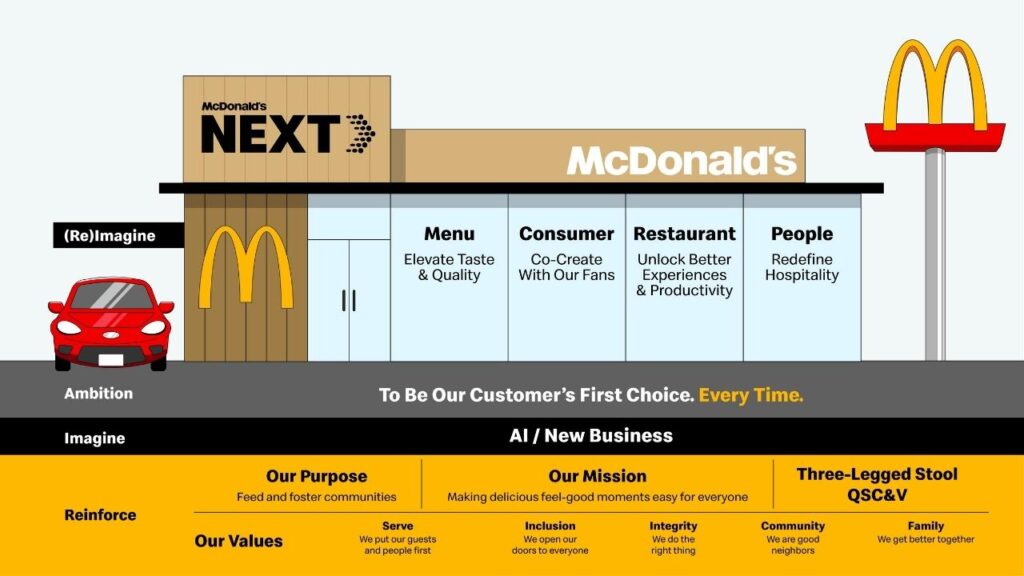
NEXT Growth Strategy (McDonald’s)
Kempczinski directly addressed this friction point in his system message:
“As more of the customer journey becomes automated, there are fewer opportunities for guests to connect with crew. With fewer interactions, the bar for hospitality that makes people feel seen, welcomed, and valued only goes up.”
In my view, this indicates that corporate leadership no longer looks at human connection as an operational luxury. Instead, it is a critical retention mechanism. When transaction automation reduces face-to-face moments, the psychological premium on the remaining human interactions increases exponentially.
Re-Earning Value in an Inflationary Landscape
Beyond the digital customer journey, the strategic framework functions as a defensive pivot against a punishing macroeconomic environment. Fast-food chains can no longer lean on aggressive menu price hikes to engineer top-line revenue growth without triggering severe consumer backlash.
According to the corporate statement, customer perceptions of McDonald’s value have rebounded in most markets, but lingering pressures remain a primary concern. “Customers also depend on us for compelling, predictable value, and even more so with unprecedented inflation,” Kempczinski stated. He reminded operators that the brand must “earn, and re-earn, each and every visit.”
The directive effectively forces a shift in how the system approaches volume. To stabilize unit economics, individual restaurants must attract more customers, more frequently, rather than relying on higher checks. This volume-centric approach is designed to insulate the brand as specialized chicken, beef, and beverage concepts aggressively chip away at McDonald’s historic market dominance.
Decentralized Execution: “Writing the How”
Unlike rigid, top-down mandates of the past, this new blueprint alters how operational strategy is deployed globally. While corporate headquarters dictates the ultimate destination—growth, frequency, and optimized economics—the tactical execution is intentionally decentralized.
- Corporate Mandate: Centralized focus on preserving Ray Kroc’s foundational promise of value, taste, and speed. PDF
- Local Execution: Global operators are explicitly tasked with tailoring the operational framework to their specific markets. PDF
“NEXT is the what,” Kempczinski noted, adding that individual markets will “write the how” based on their local consumer and crew dynamics.
The immediate rollout of the McDonald’s > NEXT strategy requires global franchisee networks to immediately audit their localized customer experience metrics. Operators must now find ways to merge speed with genuine hospitality, ensuring that convenience does not come at the expense of taste or value.
Frequently Asked Questions
What is the primary goal of the McDonald’s > NEXT strategy?
The primary goal is to unlock a new phase of system-wide corporate growth and improve unit economics. It aims to achieve this by increasing customer visit frequency and modernizing operational efficiency across local markets.
How does inflation impact this new McDonald’s initiative?
Unprecedented inflation has altered consumer spending habits, making predictable value a necessity for customer retention. The initiative recognizes that the brand must actively re-earn consumer visits rather than relying on pricing power alone.
Who is responsible for implementing the new strategic changes?
While corporate leadership sets the overarching benchmarks, individual market operators and franchisees are responsible for developing the localized tactics to achieve them. Corporate explicitly defines this approach as operators “writing the how.”
Disclaimer: This article is provided for general informational and news purposes only and should not be construed as professional advice (such as legal, medical, or financial). The author strives for accuracy and timeliness, but no representations or warranties are made regarding completeness or reliability, and details may change as a story develops. Any action you take based on this information is strictly at your own risk. Corrections or updates can be requested via the site’s contact page.