Chasing the “best-in-class” specialized SaaS stack is a trap that triggers silent margin erosion.
Many founders and digital operators build operations under the false assumption that more tools equal higher efficiency. This bias creates a sprawling web of expensive, fragmented software subscriptions that quietly chip away at financial viability.
Over the past 8 months, I have audited and restructured the digital infrastructure for bootstrapping startups and small-scale operations. I tracked overhead costs directly against net profit margins using clean financial metrics rather than vanity growth metrics.
The takeaways are uniform: hyper-automated complexity is an expensive liability. To achieve true Lean Operations, businesses must structure a Profit-Margin Tech Stack that prioritizes tool consolidation, multi-utility, and strict capital efficiency.
The Reality of SaaS Sprawl and Margin Erosion

When software expenses expand unchecked, they cease to be mere operational costs. They directly inflate your Cost of Goods Sold (COGS) or operational overhead, directly depressing your margins.
According to an industry benchmark analysis published by TechHold, software and Software-as-a-Service (SaaS) companies typically maintain gross margins between 60% and 90%. However, specialized software subsectors face highly volatile cost structures depending on distribution and server management.
Furthermore, data compiled by NYU Stern School of Business reveals that the broader System and Application Software sector carries an average Gross Margin of 71.72%, while specialized Internet Software struggles at 62.58%.
When an operation succumbs to SaaS Sprawl—the unmonitored accumulation of redundant apps—the financial runway contracts swiftly. Every unnecessary software layer reduces capital efficiency, shifting cash away from product development or customer acquisition.
Why Niche Tools Are Eroding Your Runway
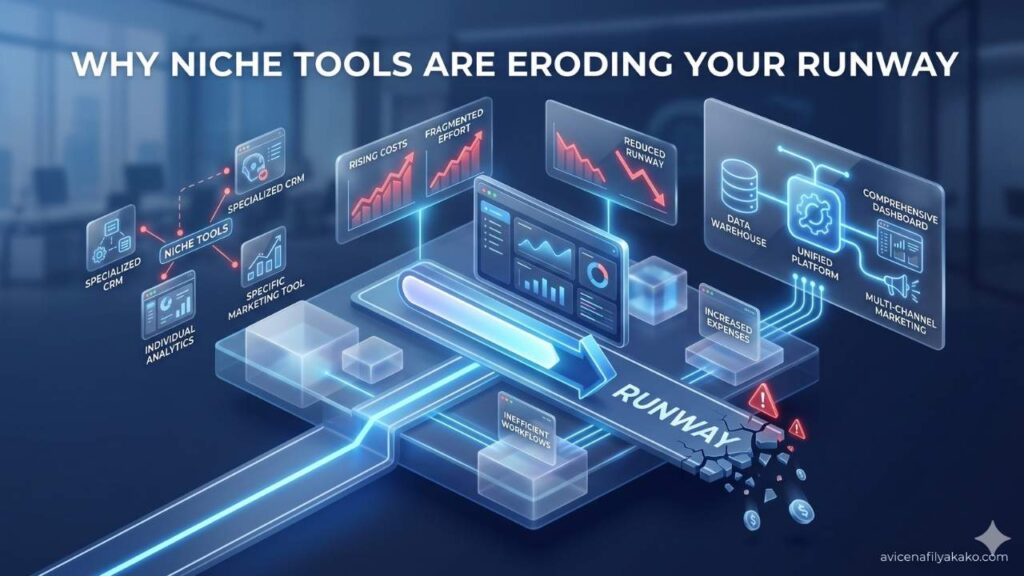
Niche software solutions present significant financial challenges. Specialized tools promise targeted automation but often create isolated pockets of data, requiring additional middleware subscriptions just to keep information synchronized.
Fragmented Architecture
Niche App A + Niche App B + Integration Middleware
VS
Consolidated Infrastructure
Single Multi-Utility Database Platform
This structural fragmentation introduces considerable operational complexity. Instead of accelerating output, teams end up managing software connections rather than executing core business tasks. Furthermore, compressing your data infrastructure into fewer nodes means you must double down on digital asset security protocols to protect your newly consolidated databases from centralized vulnerabilities.
Case Study: Cutting SaaS Expenses by 42% in 60 Days
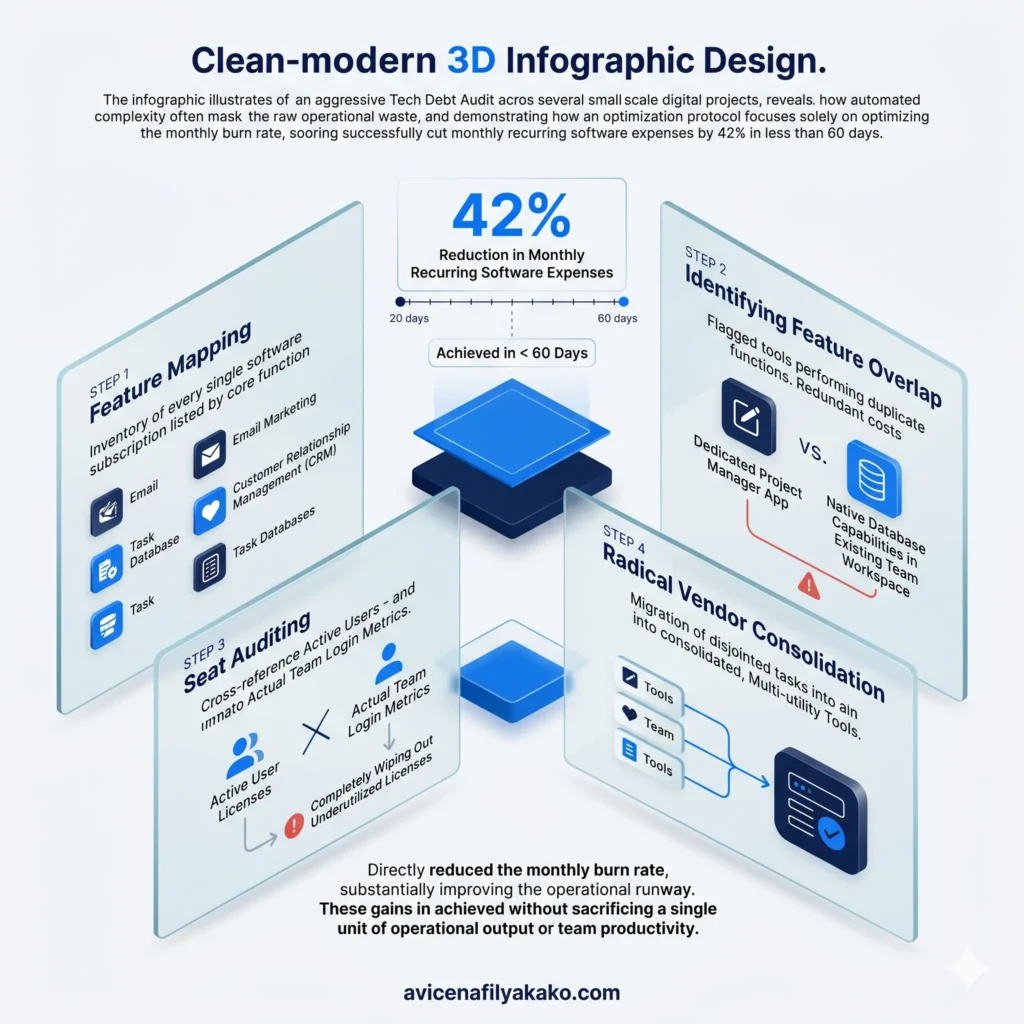
To prove that automated complexity often masks raw operational waste, I conducted an aggressive Tech Debt Audit across several small-scale digital projects. The optimization protocol ignored vanity growth indicators and focused solely on optimizing the monthly burn rate.
By identifying massive feature overlaps and auditing underutilized licenses, we successfully cut monthly recurring software expenses by 42% in less than 60 days.
Our framework followed a direct step-by-step optimization protocol:
- Step 1: Feature Mapping: We listed every single software subscription alongside its core function (e.g., email marketing, customer relationship management, task databases).
- Step 2: Identifying Feature Overlap: We flagged tools that performed duplicate functions. For instance, paying for a dedicated project manager app when an existing team workspace possessed native database capabilities.
- Step 3: Seat Auditing: We cross-referenced active user licenses against actual team login metrics, completely wiping out underutilized licenses.
- Step 4: Radical Vendor Consolidation: We migrated disjointed tasks into consolidated, Multi-utility Tools, actively eliminating three distinct niche subscriptions.
Crucially, this optimization directly reduced the monthly burn rate, substantially improving the operational runway. We achieved this without sacrificing a single unit of operational output or team productivity.
However, executing this type of consolidation without disrupting active workflows requires a structured approach; you must follow a clear blueprint for migrating business systems seamlessly to prevent operational downtime or data loss during the transition.
Engineering a Capital-Efficient Tech Stack

Building a high-margin business structure requires treating software procurement with the same discipline applied to capital allocations. A single robust platform or a well-structured native database is frequently superior for your gross margin than five interconnected, expensive niche SaaS tools.
The selection process should explicitly balance specialized utility against long-term cost profiles:
| Operational Dimension | Specialized Niche Stack | Consolidated Multi-Utility Stack |
| Financial Profile | Compounding monthly per-seat licensing costs | Stable, flat-rate or highly predictable billing |
| Data Architecture | Fragmented across webhooks and APIs | Unified within a single native schema |
| Maintenance Burden | High; frequent API updates and link breaks | Extremely low; single platform ecosystem |
| Margin Impact | Continuous, silent margin erosion | High capital efficiency and protected runway |
Before onboarding any new software platform, filter it through three strict criteria:
- Multi-Utility Yield: Can this single application natively replace at least two existing tools in our pipeline?
- Seat-Elasticity: Does scaling our team size force an aggressive, exponential jump in subscription tiers?
- Core COGS Relevance: Does this application directly improve production delivery, or is it merely automating a non-essential convenience?
- Automated Efficiency: Can you leverage AI agent resource management to maximize the output of your existing software assets before committing to new human or digital overhead?
FAQ
What is a good gross profit margin for a technology-driven business?
A healthy gross profit margin varies by specific sector, but specialized software and SaaS firms generally aim for 60% to 90%. According to industry financial datasets, the broad software sector averages around 71.72%.
How does tech stack optimization directly affect business burn rate?
Optimizing your tech stack eliminates redundant software subscriptions and underutilized seats, directly lowering fixed monthly overhead. This reduction preserves monthly cash reserves and immediately extends the business’s operational runway.
What is the fastest way to perform a tech debt audit?
The fastest approach is to pull a 90-day corporate credit card statement to isolate all automated software billing. Map each subscription’s actual usage metrics against its cost, immediately canceling applications with significant feature overlap or low seat utilization.
The Strategic Takeaway
Protecting your bottom line requires moving past the belief that every operational problem requires a new software subscription. True operational efficiency is achieved by stripping away unneeded digital layers, consolidating tools aggressively, and focusing on a high-margin framework that turns revenue directly into preserved capital. While this lean consolidation framework is critical for bootstrapping startups and small-to-midscale operations to survive and extend their runway, larger enterprises may eventually reach a scale where deeply specialized niche tools become a necessity to handle complex, volume-driven efficiencies.
Disclaimer: The information provided in this article is for educational and general informational purposes only and should not be construed as professional advice (such as legal, medical, or financial). While the author strives to provide accurate and up-to-date information, no representations or warranties are made regarding its completeness or reliability. Any action you take based on this information is strictly at your own risk.