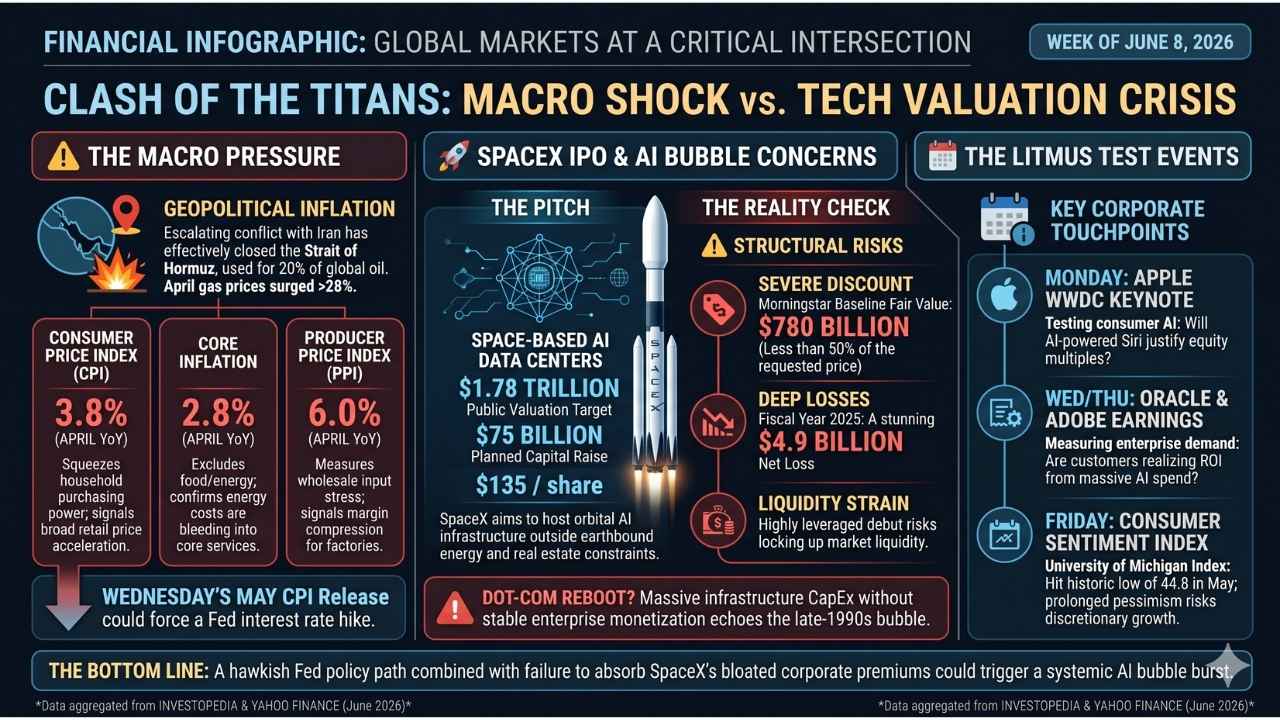
Global financial markets face severe volatility this week as a steep tech stock market crash concerns investors ahead of critical macroeconomic data and the largest public market debut in history. Following a sharp Friday sell-off driven by fears of a federal interest rate hike—which dragged the tech-heavy Nasdaq Composite down by 4.2%—Wall Street is scrambling to balance deteriorating geopolitical inflation metrics against Elon Musk’s massive $1.78 trillion public valuation target for SpaceX.
This convergence of macroeconomic strain and high-multiple tech offerings marks a decisive moment for modern capital markets. If hot inflation prints force a hawkish monetary pivot while public demand fails to absorb bloated corporate premiums, this week could register as the opening chapter of an systemic AI bubble burst.
Macro Inflation Meets Geopolitical Conflict
The immediate headwind confronting investors is Wednesday’s upcoming May Consumer Price Index (CPI) report. According to data published by Investopedia, domestic inflation has already accelerated sharply, with the April CPI jumping 3.8% year-over-year.
This inflationary surge is structurally tied to the escalating conflict with Iran. The effective closure of the Strait of Hormuz—a primary maritime chokepoint handling roughly 20% of global oil shipments—pushed April gasoline prices up by more than 28%. Because core inflation rose 2.8% year-over-year during the same period, wholesale energy costs are clearly spreading into broader components of the service and retail economies.
| Economic Indicator | April 2026 Value (YoY) | Primary Market Impact Driver |
|---|---|---|
| Consumer Price Index (CPI) | 3.8% | Squeezes household purchasing power; signals broad retail price acceleration. |
| Core Inflation | 2.8% | Excludes food/energy; confirms energy costs are bleeding into core services. |
| Producer Price Index (PPI) | 6.0% | Measures wholesale input stress; signals coming margin compression for factories. |
A hot May CPI print on Wednesday, followed by Thursday’s Producer Price Index (PPI) tracking, will likely validate market expectations that the Federal Reserve will maintain high borrowing rates or pivot toward a rate hike later this year.
SpaceX and the Space-Based AI Bubble
Against this hostile macroeconomic backdrop, SpaceX plans to open public trading on Friday, June 12. Corporate filings cited by Yahoo Finance indicate that the rocket and telecommunications firm aims to raise $75 billion by pricing shares at $135, targeting an aggregate market valuation of roughly $1.78 trillion.
While public interest focuses on Starlink and launch mechanics, the underlying institutional narrative relies heavily on artificial intelligence. SpaceX is positioning its capital strategy around orbital data centers designed to host high-compute AI architectures outside the bounds of terrestrial energy grids.
I argue that this ultra-high valuation sharpens the risk of an explosive AI bubble burst. The structural disconnect between infrastructure capital expenditure (CapEx) and realized commercial revenue is widening. Consider these structural danger signals:
- Severe Institutional Discount: Independent research firm Morningstar calculated SpaceX’s baseline fair value at $780 billion—less than half of the requested $1.78 trillion public listing price.
- Deep Structural Losses: Private financial records reveal that SpaceX absorbed a staggering $4.9 billion net loss during fiscal year 2025 due to massive capital requirements.
- Systemic Liquidity Strains: A highly leveraged public debut risks locking up market liquidity, potentially triggering an immediate reassessment of subsequent generative-AI listings like Anthropic and OpenAI.
This environment strongly echoes the structural imbalances of the late-1990s Dot-com bubble. Tech giants are deploying immense infrastructure funding based on projected usage models that have yet to show stable enterprise monetization.
Corporate Earnings as a Litmus Test
Before Friday’s public listing, institutional investors will dissect specific corporate touchpoints to evaluate the durability of the broader tech trade:
- Apple WWDC Keynote (Monday): Apple faces intense scrutiny regarding the launch of its AI-fluent Siri variant. Investors require evidence of concrete consumer monetization models to justify current equity multiples.
- Oracle & Adobe Earnings (Wednesday/Thursday): Corporate fiscal updates from these software giants will serve as a direct measure of enterprise demand. Traders will analyze if corporate customers are realizing genuine cost efficiencies from enterprise AI licensing.
- University of Michigan Consumer Sentiment (Friday): This historical index fell to an all-time low of 44.8 in May due to war-related economic anxiety. Economists project a slight rebound to 46, though prolonged pessimism risks stalling discretionary economic growth.
The structural tension between escalating geopolitical inflation and aggressive valuation expansions is unsustainable. If macro data forces the Federal Reserve into an aggressive policy stance, tech’s premium multiples will face severe downward compression. Should SpaceX’s public debut buckle under the weight of its $4.9 billion annual deficit and extreme valuation premiums, it could serve as the catalyst that pops the modern AI investment cycle.
Frequently Asked Questions
What is driving the sudden drop in tech stocks ahead of the May CPI inflation report?
The tech sell-off is primarily driven by an unexpectedly hot nonfarm payrolls report, which caused markets to price in an interest-rate hike for later this year. High interest rates systematically depress tech stocks because they increase corporate borrowing costs and reduce the present value of future earnings.
Why is SpaceX seeking a $1.78 trillion valuation despite posting financial losses?
SpaceX is leveraging its dominant position in aerospace alongside an aggressive pivot toward artificial intelligence infrastructure, specifically space-based data centers. However, independent research firms like Morningstar value the company at just $780 billion, highlighting an enormous premium built on speculative AI expansion.
How does the conflict with Iran impact inflation metrics in the United States?
The military conflict has restricted access through the Strait of Hormuz, a maritime corridor that handles roughly 20% of global oil shipments. This disruption caused domestic gasoline prices to surge over 28% in April, driving up overall shipping and production costs across the broader economy.
Disclaimer: This article is provided for general informational and news purposes only and should not be construed as professional advice (such as legal, medical, or financial). The author strives for accuracy and timeliness, but no representations or warranties are made regarding completeness or reliability, and details may change as a story develops. Any action you take based on this information is strictly at your own risk. Corrections or updates can be requested via the site’s contact page.