
Every time you paste proprietary code, unreleased content strategies, or raw financial statements into a commercial cloud-based AI model, you surrender a piece of your digital edge. The convenience of large language models comes with a hidden tax: the slow erosion of your digital autonomy. If you do not actively control where your operational data is stored, processed, and used for retraining, you lack data sovereignty.
Achieving data sovereignty means maintaining absolute ownership and legal control over your digital information throughout its entire life cycle. For digital entrepreneurs, content strategists, and independent researchers, this is no longer an abstract philosophical debate. It is a core operational risk. Protecting your competitive advantage requires a transition toward local infrastructure and deliberate ethical data governance.
The Illusion of Cloud Privacy

Most users assume that clicking a “delete history” button removes their footprint from cloud servers. It does not. Commercial AI ecosystems function by capturing massive datasets to refine future model iterations. Unless you are paying premium enterprise rates or using strict zero-retention API endpoints, your inputs are heavily processed, analyzed, and stored.
This model centralizes digital power. A comprehensive guide on digital sovereignty definitions and control layers emphasizes that true sovereignty depends on three distinct pillars: data sovereignty, operational sovereignty, and software sovereignty. If a third-party cloud provider can change its terms of service overnight and lock you out of your custom models or historical data, you have no real operational independence.
The risks amplify when handling structured business intelligence. If your workflow involves processing third-party data or sensitive project parameters, passing that data through standard consumer AI interfaces likely violates basic data protection ethics.
The Spectrum of AI Infrastructure

To establish firm data sovereignty, you must assess where your data travels. The table below outlines the core infrastructural tradeoffs between standard cloud-based models and self-hosted environments.
| Infrastructure Tier | Data Privacy Level | Operational Control | Compute Requirement | Best Use Case |
|---|---|---|---|---|
| Consumer Cloud AI | Low (Default Opt-In for Training) | Low (Dependent on Provider Uptime) | Zero (Runs on Provider Hardware) | Public brainstorming, non-sensitive research. |
| Zero-Retention API | Medium (Contractually Protected) | Medium (Subject to API Rate Limits) | Low (Client-side Scripting Only) | Scaled processing of commercial assets. |
| Local AI / Self-Hosting | Absolute (Data Never Leaves Device) | High (Full Model Customization) | High (Requires Local GPU/Hardware) | Proprietary business data, legal audits. |
Shifting to Local AI: A Practical Framework
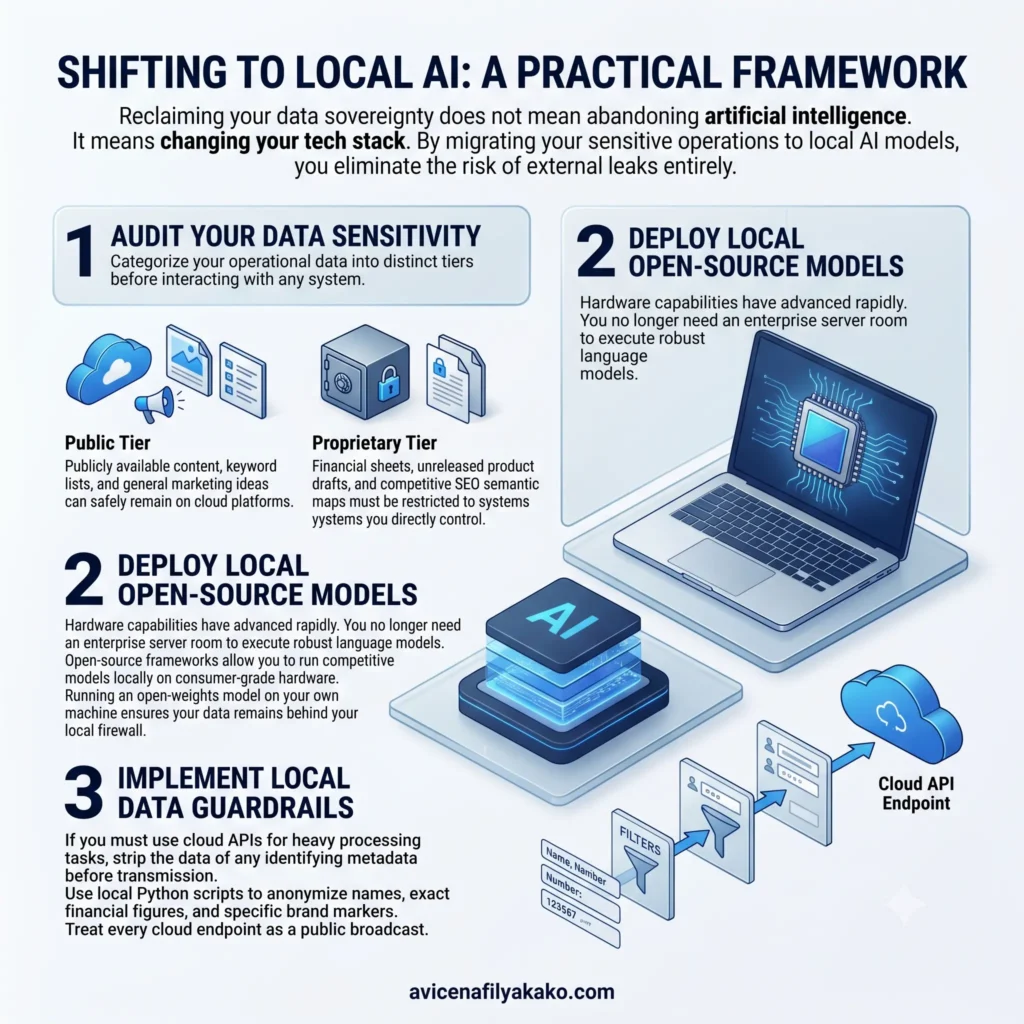
Reclaiming your data sovereignty does not mean abandoning artificial intelligence. It means changing your tech stack. By migrating your sensitive operations to local AI models, you eliminate the risk of external leaks entirely. Beyond running base models, you can safely feed sensitive communications into your system once you discover how to train a custom language model on personal email data to automate workflows securely.
1. Audit Your Data Sensitivity
Categorize your operational data into distinct tiers before interacting with any system.
- Public Tier: Publicly available content, keyword lists, and general marketing ideas can safely remain on cloud platforms.
- Proprietary Tier: Financial sheets, unreleased product drafts, and competitive SEO semantic maps must be restricted to systems you directly control.
2. Deploy Local Open-Source Models
Hardware capabilities have advanced rapidly. You no longer need an enterprise server room to execute robust language models. Open-source frameworks allow you to run competitive models locally on consumer-grade hardware. Running an open-weights model on your own machine ensures your data remains behind your local firewall. Depending on your technical background, you can decide whether to build a local AI assistant using Python or no-code platforms to match your specific development skills and infrastructure needs.
3. Implement Local Data Guardrails
If you must use cloud APIs for heavy processing tasks, strip the data of any identifying metadata before transmission. Use local Python scripts to anonymize names, exact financial figures, and specific brand markers. Treat every cloud endpoint as a public broadcast.
Ethical Implications of Decentralized AI

The discussion around data control extends past personal business security. It shapes the broader digital ecosystem. When you pull your data out of centralized silos, you actively resist the monopolization of web data.
Sovereignty also intersects directly with compliance and risk management. A 2024 analysis on ethical and legal considerations in AI systems detailed the strict liabilities associated with data handling, warning that unmonitored data pipelines create massive compliance vulnerabilities. For independent operators managing client websites or legal documents, the ethical obligation to protect that data is absolute. If a client’s proprietary strategy leaks via a shared AI history, the legal and professional fallout falls squarely on the practitioner.
Frequently Asked Questions
What does data sovereignty mean in the context of AI?
Data sovereignty in AI means that your digital inputs, prompts, and training materials remain under your direct legal and physical control. This prevents third-party providers from using your data to train public models or storing it on external servers without your explicit consent.
How can I run AI models locally to protect my privacy?
You can run AI models locally by utilizing open-source inference tools such as Ollama or LM Studio on your personal computer. These applications download open-weights models directly to your hard drive, allowing you to process highly sensitive data completely offline.
Do commercial AI APIs protect my proprietary data?
Commercial AI APIs generally offer stronger privacy guardrails than consumer web interfaces, but they still do not grant full sovereignty. While many providers contractually promise not to use API data for model training, your data is still transmitted to external servers, leaving it exposed to potential cloud-side security breaches.
Data sovereignty is an active operational choice. Continuing to feed proprietary business intelligence into unverified cloud models creates an unmanaged vulnerability for your digital assets. True data security requires establishing a strict local AI backup for every core business pipeline. By auditing your inputs, transitioning your most sensitive analytical workflows to offline local environments, and treating cloud endpoints with perpetual skepticism, you protect the long-term equity of your digital brand.
Disclaimer: The information provided in this article is for educational and general informational purposes only and should not be construed as professional advice (such as legal, medical, or financial). While the author strives to provide accurate and up-to-date information, no representations or warranties are made regarding its completeness or reliability. Any action you take based on this information is strictly at your own risk.