A biological invasion in California’s freshwater networks has escalated into an expensive infrastructure crisis as the state enters its peak summer water-use season. The rapid spread of the golden mussel (Limnoperna fortunei), a destructive freshwater bivalve native to China, has forced local emergency declarations in both Kern and San Joaquin counties. First detected in North America within the Sacramento-San Joaquin Delta in 2024, the species has demonstrated an unprecedented ability to rapidly compromise municipal and agricultural water delivery networks, prompting water managers to warn of systemic threats to the state’s multi-billion dollar water infrastructure.
The Rapid Cost of Biofouling
The fiscal impact of the golden mussel invasion has shifted from theoretical environmental projections to immediate public sector expenditures. According to data reported by People.com, a single outbreak within the Arvin-Edison Water Storage District’s distribution system required an intensive 30-day chemical eradication campaign that cost $3 million.
The primary mechanism of damage is severe biofouling—the dense accumulation of biological organisms on structural surfaces. Golden mussels utilize robust, self-secreted protein structures known as byssal threads to anchor themselves inside municipal water delivery pipes, industrial pumps, and hydroelectric facilities. When these colonies stack into what water managers describe as “dense carpets,” they restrict water volume, damage mechanical impellers, and degrade overall water quality.
“This species moves with terrifying speed,” Sam Blue, a representative with the Arvin-Edison Water Storage District, testified during a May 12 meeting with the Kern County Board of Supervisors. “A single female can produce over 1 million eggs annually.”
The threat is no longer isolated to the Central Valley. The Washington Department of Fish and Wildlife recently confirmed that the species was intercepted hitchhiking on the hull of a recreational watercraft in Oregon waters, verifying an active transit corridor heading toward the Pacific Northwest.
Structural and Biological Distinctions
For decades, the United States has monitored the economic toll of non-native organisms. According to the United States Register of Introduced and Invasive Species (US-RIIS) Fact Sheet (Fact Sheet 2024-3037), federal agencies catalog nearly 14,700 records of non-native, reproducing species nationwide. Cumulatively, these invasions cost the United States an estimated $120 billion in annual damages across agricultural, municipal, and commercial sectors.
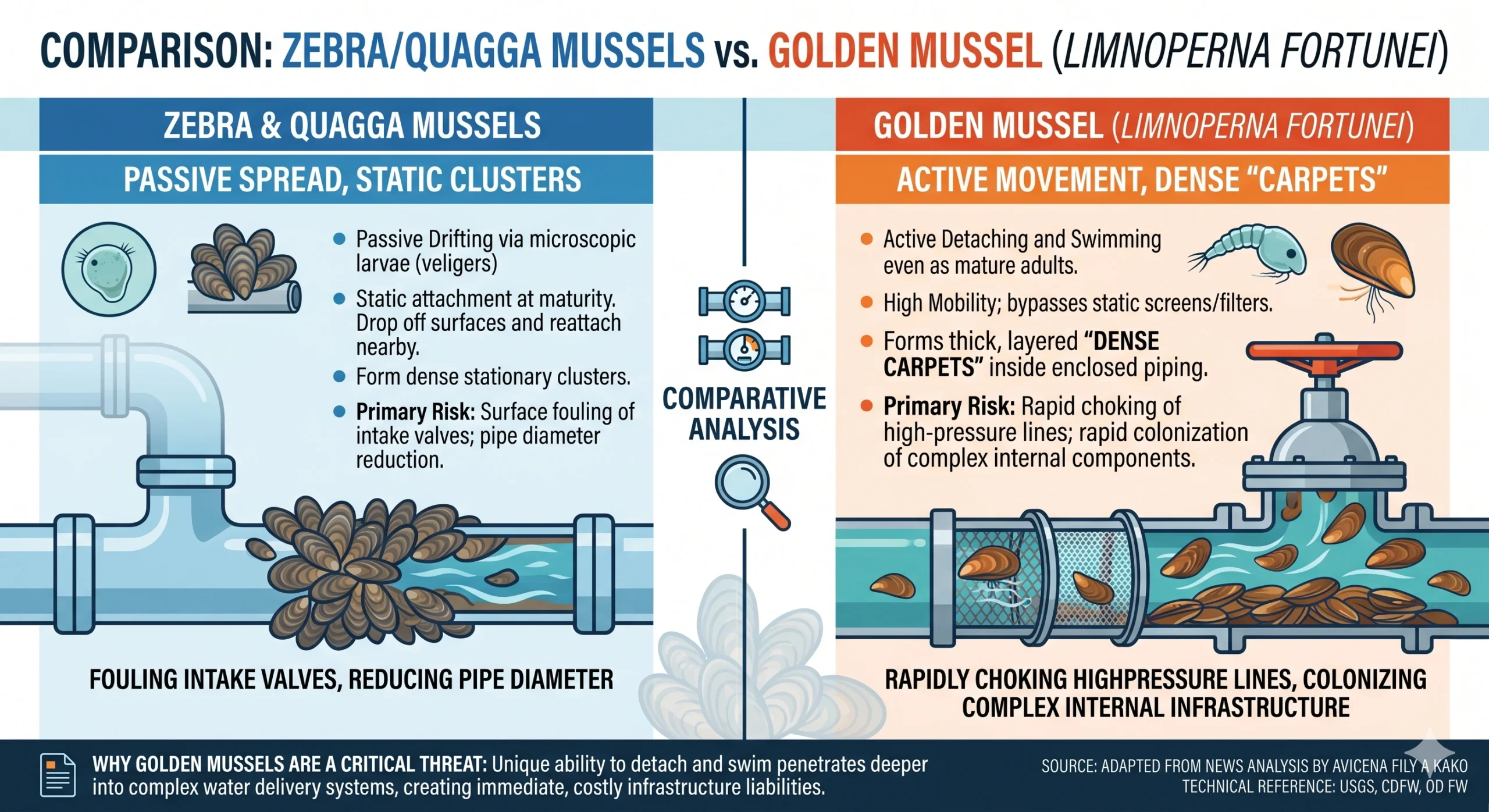
While federal agencies frequently compare the golden mussel crisis to the historical devastation caused by zebra and quagga mussels in the Great Lakes, the biological reality of Limnoperna fortunei introduces a much more complex operational challenge for engineers.
| Invasive Bivalve Species | Primary Locomotion Method | Settlement Characteristics | Key Infrastructure Risk |
|---|---|---|---|
| Zebra / Quagga Mussels | Passive drifting via microscopic larvae (veligers); static attachment upon maturity. | Drops off surfaces and reattaches nearby; forms stationary clusters. | Surface fouling of intake valves; pipe diameter reduction. |
| Golden Mussels (Limnoperna fortunei) | Active detaching and swimming behavior even during mature lifecycle stages. | High mobility; forms thick, layered “dense carpets” inside enclosed piping. | Rapid choking of high-pressure lines; rapid colonization of complex internal components (e.g., floodgates). |
As documented by aquatic invasive species technicians with Oregon’s Department of Fish and Wildlife, mature golden mussels retain the ability to detach themselves from a surface, swim through a water column, and choose new colonization sites. This active movement allows them to bypass traditional static screens and mechanical filters that successfully blocked previous invasive bivalves. Consequently, complex internal infrastructure—including a critical $100 million floodgate system within California’s delta network—is now vulnerable to unexpected, rapid biological clogging.
News Analysis: The Structural Shift in Water Economics
From an economic perspective, the emergence of the golden mussel represents a fundamental shift in how water utilities must calculate long-term operational expenditures. For decades, Western water infrastructure was engineered under the assumption that freshwater delivery systems required routine, predictable maintenance schedules. The introduction of a highly mobile, filter-feeding organism capable of producing 1 million eggs per individual completely disrupts that model.
In my view, the $3 million emergency expenditure by the Arvin-Edison Water Storage District is not a one-time mitigation cost; it is the opening baseline for a permanent, recurring capital tax on water transportation. Because these organisms consume vast quantities of microscopic organic matter, they clear water columns so intensely that they trigger harmful algal blooms. These blooms threaten native fish species and force water treatment plants to invest heavily in advanced chemical filtration just to maintain basic municipal standards.
Furthermore, this crisis highlights a critical gap in international maritime and domestic biosecurity. The US-RIIS database, maintained by the U.S. Geological Survey, serves as an essential inventory for tracking these “sleeper species” before they cause economic devastation. However, the presence of the golden mussel in California’s interior waterways indicates that ballast water regulations for international shipping containers entering inland ports—such as the Port of Stockton—remain structurally insufficient to stop microscopic veligers from breaching the state’s borders.
The response from lawmakers confirms that containment is becoming a matter of direct federal spending rather than simple local code enforcement. Congressman Vince Fong recently secured $5 million in federal funding dedicated specifically to state inspection and prevention programs throughout the Central Valley.
Summer 2026 Mandates and Public Operational Impact
As the peak summer travel season begins, the state is shifting a portion of the biosecurity burden onto commercial and recreational users of California’s waterways. The California Department of Fish and Wildlife (CDFW), alongside neighboring state agencies, has implemented mandatory inspection frameworks.
To comply with the updated Summer 2026 conservation mandates, watercraft operators must systematically execute a three-step decontamination process before transitioning between distinct bodies of water:
- Clean: Remove all visible sediment, vegetation, and biological matter from the boat hull, trailer, and recreational equipment.
- Drain: Completely empty all onboard water-containing devices, including livewells, bait buckets, bilges, and ballast tanks, which can harbor microscopic, free-floating larvae.
- Dry: Allow the entire watercraft and all related gear to dry completely in the sun for a minimum of five consecutive days before entering an uninfested waterway.
State officials emphasize that localized interventions remain the most effective method to protect uninfested, high-value ecological and economic resources, such as Lake Tahoe, where a coordinated inspection successfully intercepted an infected vessel in May 2025.
What You Need to Know (FAQ)
Why are golden mussels considered a severe threat to California’s water infrastructure?
Golden mussels form dense biological layers inside municipal and agricultural pipes, reducing water flow and damaging mechanical infrastructure. Their unique ability to detach and swim allows them to penetrate deeper into complex water delivery networks than static invasive species, creating immediate multi-million dollar maintenance liabilities.
How did the golden mussel enter United States waterways?
According to researchers, invasive aquatic species typically enter the United States through international shipping containers, unmanaged ballast water discharge, the global wildlife trade, or contaminated imported plants.
What can boaters do to prevent the spread of golden mussels this summer?
Boaters must strictly adhere to state mandates to clean all visible debris from their watercraft, drain all internal water systems, and dry all equipment for at least five days before moving between different bodies of water.
Related Technical Resources
- USGS Publication Warehouse: US-RIIS Dataset and Documentation
- California Department of Water Resources: O’Neill Forebay Outbreak Report
Disclaimer: This article is provided for general informational and news purposes only and should not be construed as professional advice (such as legal, medical, or financial). The author strives for accuracy and timeliness, but no representations or warranties are made regarding completeness or reliability, and details may change as a story develops. Any action you take based on this information is strictly at your own risk. Corrections or updates can be requested via the site’s contact page.
This article was authored by Avicena Fily A Kako, a Digital Entrepreneur & SEO Specialist using AI to scale business and finance projects.