
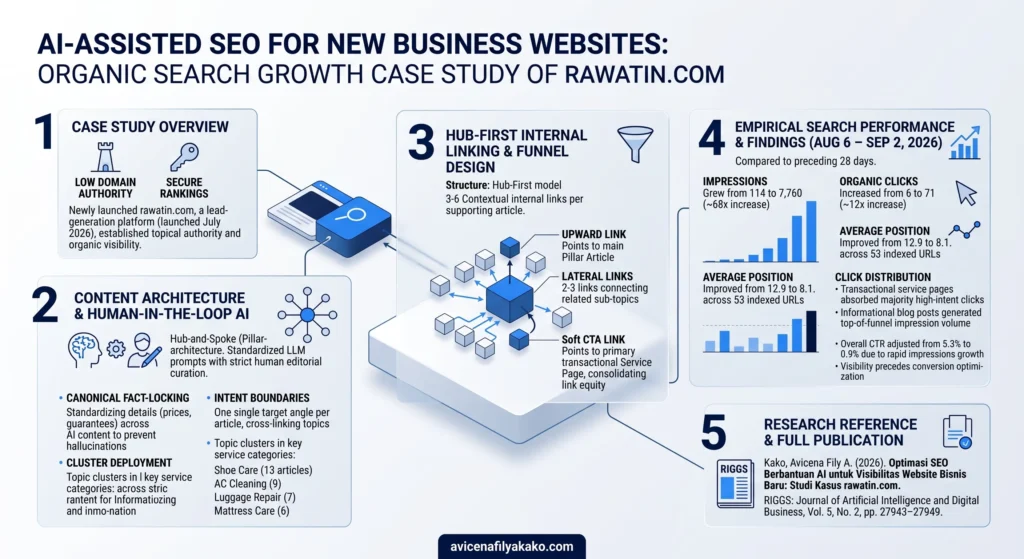
This AI-assisted SEO case study documents how I took rawatin.com — a service lead-generation platform I launched in July 2026 — from near-zero search visibility to 7,760 Google impressions and 71 organic clicks in a single 28-day window, up from 114 impressions and 6 clicks in the 28 days before. New domains start with almost no authority, so first-page rankings are hard to earn. Below is the exact workflow behind the result: what the AI drafted, where human editing took over, how the internal links were wired, and where the approach still falls short.
Key results at a glance
| Metric | Previous 28 days | Aug 6 – Sep 2, 2026 | Change |
|---|---|---|---|
| Impressions | 114 | 7,760 | ~68x |
| Organic clicks | 6 | 71 | ~12x |
| Average position | 12.9 | 8.1 | 4.8 positions higher |
| CTR | 5.3% | 0.9% | Lower (broader queries) |
Source: Google Search Console for rawatin.com, 53 URLs receiving impressions.
The first ten days
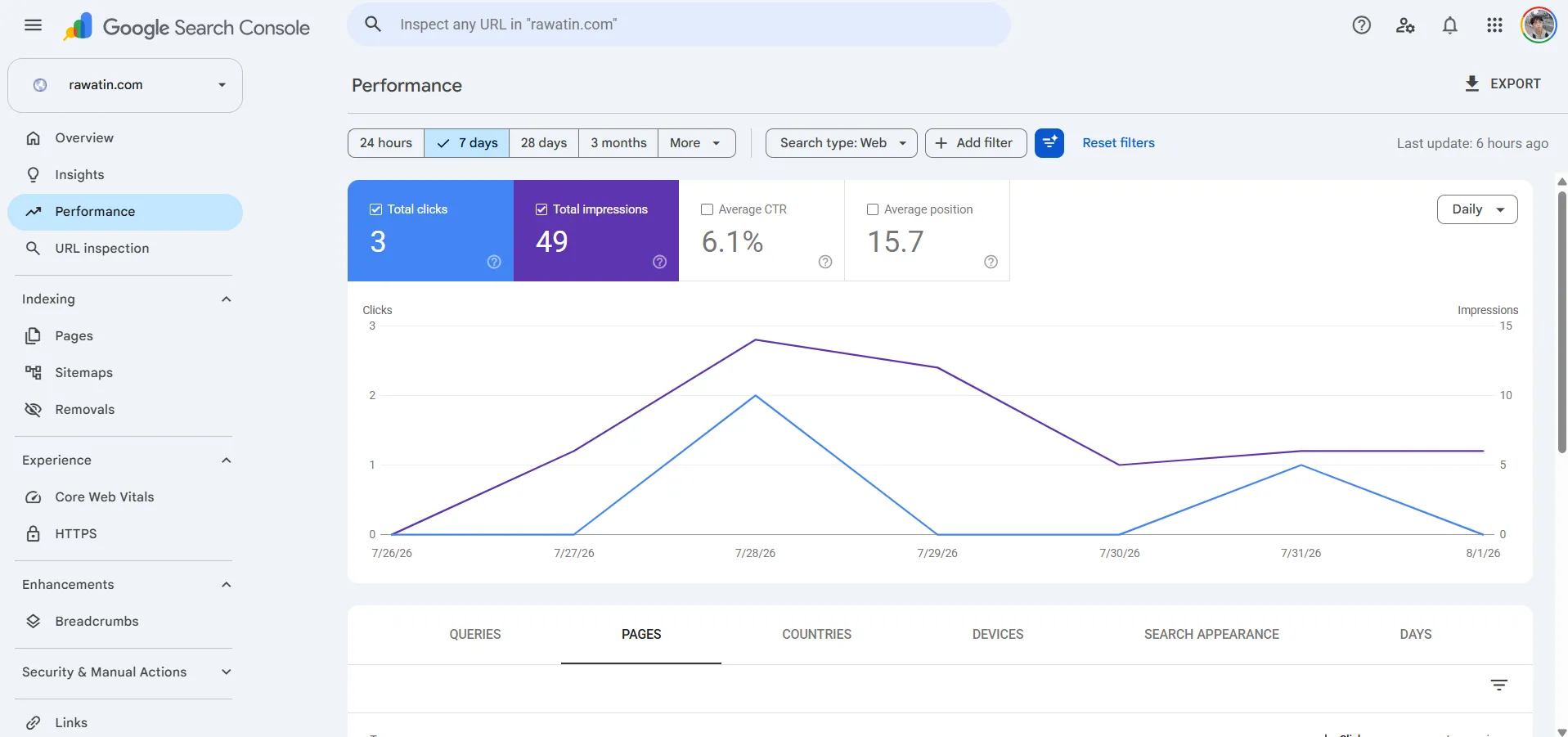
rawatin.com went live in late July 2026 with almost nothing behind it. In its first week, Google Search Console recorded 49 impressions and 3 clicks at an average position of 15.7.
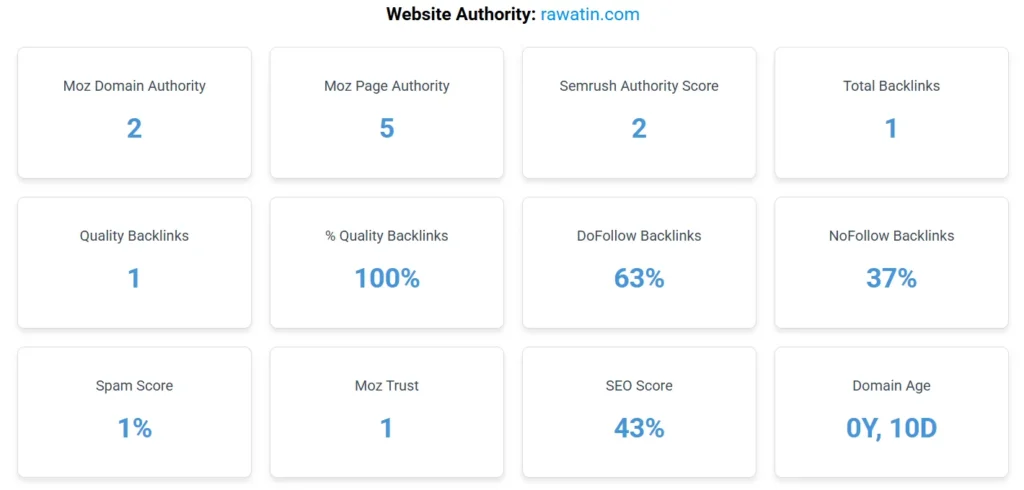
At ten days old, the domain had a Moz Domain Authority of 2, a Semrush Authority Score of 2, and a single backlink. Third-party authority scores are estimates, but they show the starting point clearly: no inherited trust to lean on.
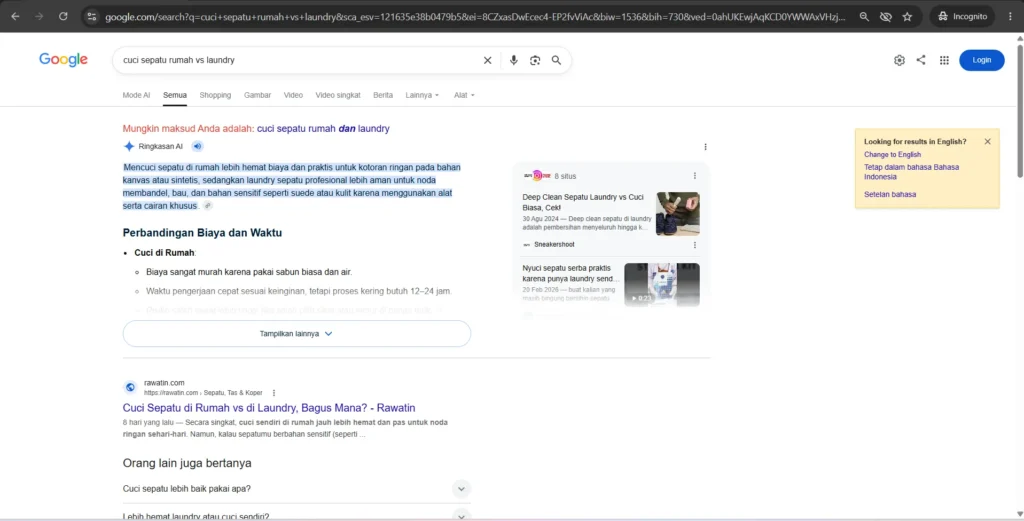
Around the same time, the article comparing home shoe cleaning with laundry services, published on July 27, reached the first organic position on Google for “cuci sepatu rumah vs laundry“. Positions for queries like this move, and this one has since shifted — but it showed that a new domain can win a specific, well-matched query fast when the page answers it directly.
Content Architecture & Human-in-the-Loop AI Workflow
To build topical depth without triggering keyword cannibalization, the site implemented a hub-and-spoke (pillar-cluster) content architecture. Standardized large language model (LLM) prompts guided initial article drafting, which was strictly followed by human editorial curation:
- Canonical Fact-Locking: Standardizing operational details—such as pricing models, turnaround times, and service guarantees—across all AI-generated content to prevent hallucinated claims.
- Intent Boundaries: Defining exact search intent limits per URL to ensure a single target angle per article while cross-linking adjacent topics.
- Cluster Deployment: Constructing topic clusters across key service categories, including shoe care (13 core articles), AC cleaning (9 articles), luggage repair (7 articles), and mattress care (6 articles).
Hub-First Internal Linking & Funnel Design
The internal linking framework was structured on a hub-first model once a cluster’s core content was published. Each supporting article incorporated three to six contextual internal links:
- One upward link pointing directly to the main pillar article.
- Two to three lateral links connecting related sub-topic articles.
- One soft call-to-action (CTA) link pointing to the primary transactional service page.
Because rawatin.com operates as an intermediary platform connecting customers with service partners, all CTAs deliberately funnel users toward dedicated service pages rather than direct partner channels. This dual-purpose design captures transactional intent while consolidating internal link equity across clusters.
Empirical Search Performance & Findings
Data collected via Google Search Console comparing a 28-day post-implementation window (August 6 – September 2, 2026) against the preceding 28 days revealed significant search visibility growth:
- Impressions: Grew from 114 to 7,760 impressions (roughly 68x).
- Organic Clicks: Increased from 6 to 71 clicks (nearly 12x).
- Average Position: Improved from 12.9 to 8.1 across 53 indexed URLs receiving impressions.
- Click Distribution: Transactional service pages absorbed the majority of high-intent clicks (e.g.,
/layanan/reparasi-koper/), whereas informational blog posts generated top-of-funnel impression volume.
While overall Click-Through Rate (CTR) adjusted from 5.3% to 0.9% due to a rapid influx of broader top-of-funnel impressions, the results demonstrate that visibility growth naturally precedes conversion optimization in newly launched domains.
Limitations of this case study
- One site, one market, one comparison window. The results describe rawatin.com between August 6 and September 2, 2026, not a guaranteed outcome for every new website.
- The starting baseline was very small, so the growth multiples look larger than they would on an established site.
- This study measures visibility (impressions, clicks, and position), not leads or revenue.
- Google’s ranking systems and search features change often, so the same workflow may perform differently over time.
How to apply this workflow to your own new website
- Lock your facts before you prompt. Write down prices, turnaround times, and guarantees once, and feed them into every AI draft so the model cannot invent them.
- Give every URL one search intent. If two pages answer the same question, merge them or change the angle of one.
- Publish a cluster first, then link it hub-first: one link up to the pillar, two or three to sibling articles.
- Point every article to one money page with a single soft call to action.
- Judge the second month by impressions and average position, not CTR. Visibility comes first; click-through improves once rankings settle.
Research Reference & Full Publication
This case study is based on peer-reviewed empirical research analyzing AI-assisted content workflows, topical cluster architectures, and early-stage organic search dynamics.
For the complete methodology, dataset breakdowns, and technical setup, read the full research paper:
- Journal Reference: Kako, Avicena Fily A. (2026). Optimasi SEO Berbantuan AI untuk Visibilitas Website Bisnis Baru: Studi Kasus rawatin.com. RIGGS: Journal of Artificial Intelligence and Digital Business, Vol. 5, No. 2, pp. 27943–27949.
FAQ
Can AI-written content rank on a brand-new website?
In this case, yes — but not raw AI output. Every draft was edited by a human, locked to verified business facts, and limited to a single search intent per URL before publishing.
How quickly did rawatin.com see results?
The first signal came within ten days of launch: one article reached #1 on Google for a long-tail query while the domain still had a Domain Authority of 2. Broader growth followed in the second month — from August 6 to September 2, 2026, impressions rose from 114 to 7,760 and clicks from 6 to 71.
Why did CTR fall while clicks grew?
The site started appearing for many broader, top-of-funnel queries. Impressions grew faster than clicks, which lowers CTR even as total clicks rise.
Want this workflow applied to your own site? The Launch Sprint adapts this exact playbook to a new website, and the GEO Visibility Audit shows what to fix first on an existing one. See how it works on the Work with me page. For how the same principles extend to AI citations, read my generative engine optimization portfolio.