
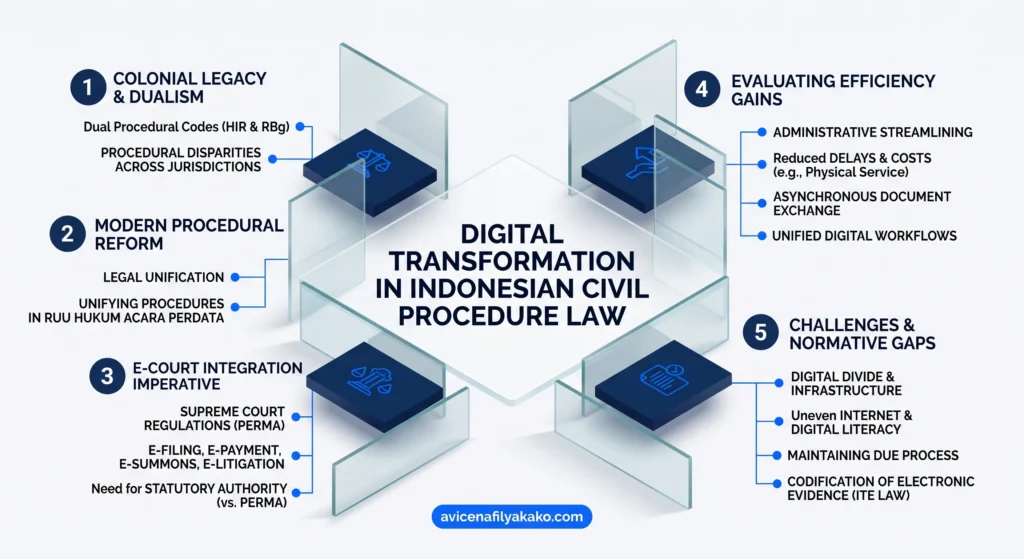
The legal landscape in Indonesia is undergoing a pivotal shift from colonial-era frameworks to a modernized, digitized judicial system. For over a century, civil litigation in Indonesia operated under dual procedural codes inherited from the Dutch colonial era: the Herziene Inlandsch Reglement (HIR) for Java and Madura, and the Rechtsreglement voor de Buitengewesten (RBg) for regions outside Java and Madura. This historical dualism created procedural disparities across jurisdictions and frequently clashed with the statutory mandate of simple, fast, and low-cost justice.
To bridge this gap, modern procedural reform seeks to establish legal unification while formalizing electronic judicial proceedings into a national statutory framework through the Draft Bill on Civil Procedural Law (RUU Hukum Acara Perdata).
The Legal Imperative for E-Court Integration
Initial strides toward judicial digitization were introduced through Supreme Court Regulations—specifically PERMA No. 3 of 2018 and PERMA No. 1 of 2019—which established mechanisms for electronic filing (e-filing), electronic payment (e-payment), digital summons (e-summons), and virtual trials (e-litigation).
However, because Supreme Court regulations sit lower than primary legislation in the statutory hierarchy, relying solely on administrative rules creates potential gaps in legal certainty. Incorporating electronic proceedings directly into the Bill on Civil Procedural Law provides the statutory authority required to fully replace legacy processes with standardized digital workflows.
Evaluating Efficiency Gains and Procedural Fairness
The transition to a digital justice platform addresses long-standing logistical and financial burdens faced by litigants:
- Administrative Streamlining: Electronic filing and notifications replace physical service by court bailiffs, significantly cutting administrative delays and geographical travel costs.
- Document Exchange: Replik, duplik, and conclusions can be submitted asynchronously through secure online platforms, minimizing overall litigation timelines.
- Legal Unification: Standardizing digital workflows across all regional courts ensures equal administrative procedures regardless of location.
Despite these efficiency gains, the digital transition presents systemic challenges. The digital divide—characterized by uneven internet infrastructure in rural areas and varying levels of digital literacy—risks creating procedural hurdles for underrepresented groups. Maintaining procedural justice requires ensuring that virtual hearings preserve due process and that all parties maintain equal opportunity to present their case.
Normative Gaps in Admitting Electronic Evidence
A key critical area in procedural reform is the treatment of electronic evidence (e-evidence). While Law No. 11 of 2008 on Information and Electronic Transactions (ITE Law) explicitly recognizes electronic documents as valid evidence, classical civil procedure codes (e.g., Article 164 HIR and Article 1866 of the Indonesian Civil Code) remain anchored to physical documentation.
In draft iterations of the Civil Procedure Code Bill, electronic evidence is often subsumed under generic residual clauses rather than being codified as an explicit, distinct category of evidence. To ensure legal certainty and consistent judicial evaluations, the statutory framework must establish explicit standards for the integrity, authenticity, and non-repudiation of digital evidence.
Research Reference & Full Publication
This article builds upon academic research exploring electronic justice systems, procedural fairness, and statutory unification in civil law.
For a detailed normative legal analysis and theoretical evaluation (covering Cappelletti’s Access to Justice, Thibaut & Walker’s Procedural Justice, Radbruch’s Three Core Values of Law, and Soerjono Soekanto’s Legal Effectiveness), read the full peer-reviewed research paper:
- Journal Reference: Handayani, Henni Rahayu & Kako, Avicena Fily A. (2026). Transformasi Digital dalam RUU Hukum Acara Perdata: Analisis Efisiensi dan Akses Keadilan melalui Sistem E-Court. Jurnal Hukum Lex Generalis, Vol. 7, No. 4.