
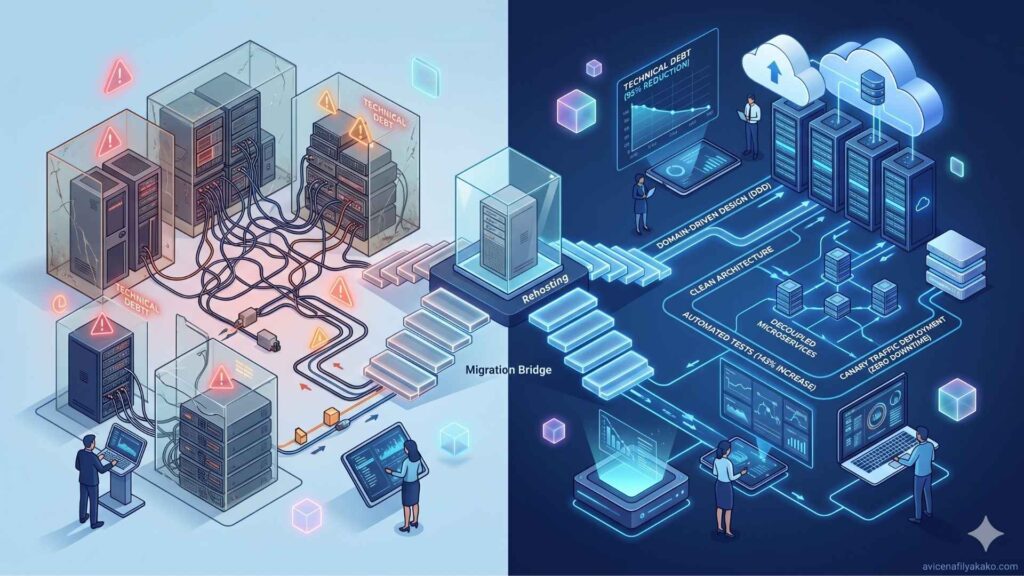
Many enterprise migration playbooks present a dangerously comfortable narrative. They suggest that moving away from your aging IT infrastructure is simply a matter of shifting computing models.
According to Foundry’s 4th Annual Digital Business Study, 93% of organizations have adopted or plan to adopt a digital-first business strategy. Yet, a vast majority of these digital initiatives stumble because engineering teams choose the path of least resistance: a simple “lift-and-shift” rehosting plan.
I recently directed the end-to-end backend system migration of a mission-critical, high-traffic cloud server handling over 327,000 daily production requests globally. The project required moving away from a brittle, monolithic architecture running Java 8 and MySQL 5 on Google App Engine 1st Generation. Our target destination was a decoupled enterprise environment built on Java 17 and Spring Boot.
My execution of this project proved that relying on backward-compatible bundled services to buy time is an engineering mistake. It merely delays systemic failure while keeping vulnerable, deprecated dependencies intact within your core runtime.
The only permanent solution to crippling tech debt is immediate, aggressive framework decoupling. You must separate your fundamental business logic entirely from third-party libraries.
The Monolithic Bottleneck: Evaluating the Real Tech Debt
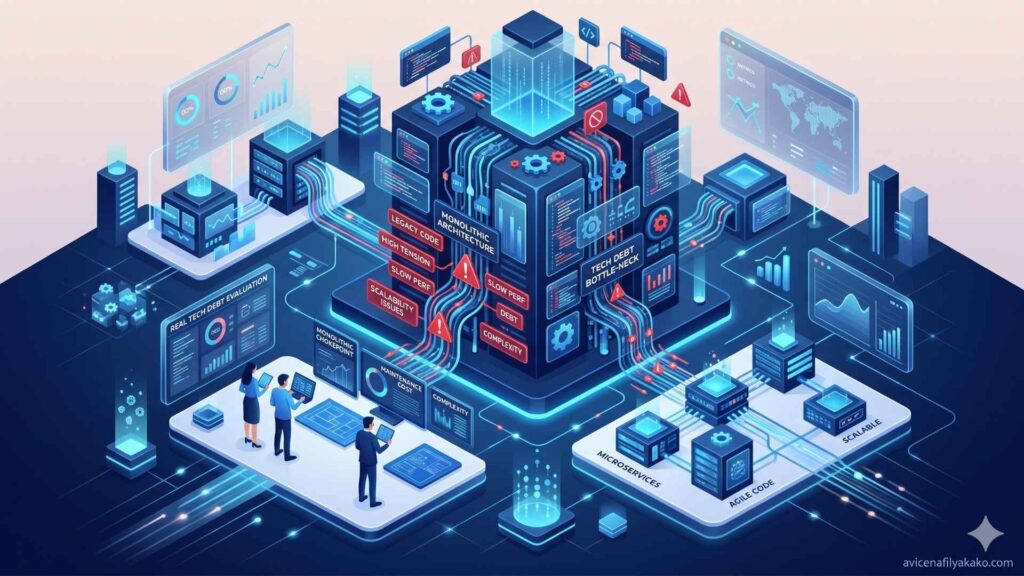
Legacy systems typically survive inside organizations because they continue to execute vital business logic. However, as custom workarounds accumulate, the effort required to implement simple, basic features increases exponentially.
In our original Java 8 stack, files within the services folder grew into massive scripts containing thousands of lines of code. The package architecture was tightly coupled with regional database layers and vendor-specific APIs.
A recent report highlighted by OpenLegacy revealed that 88% of organizations remain actively hindered by legacy technologies. This hindrance is rarely caused by the programming language itself. Instead, it is caused by the decay of software libraries that eventually lose vendor security patches, blocking automated deployment pipelines entirely.
When a cloud provider announces the hard end-of-support date for an older runtime environment, your organization faces an immediate operational risk. You can choose a fast, temporary adjustment using legacy emulation wrappers, or you can commit to structural refactoring. Beyond operational risks, delayed refactoring quietly erodes your bottom line; understanding how to optimize your tech stack for better profit margins is essential to preventing hidden infrastructure costs from draining corporate capital.
Architectural Re-Engineering: Shifting from Monolith to Decoupled Clean Architecture
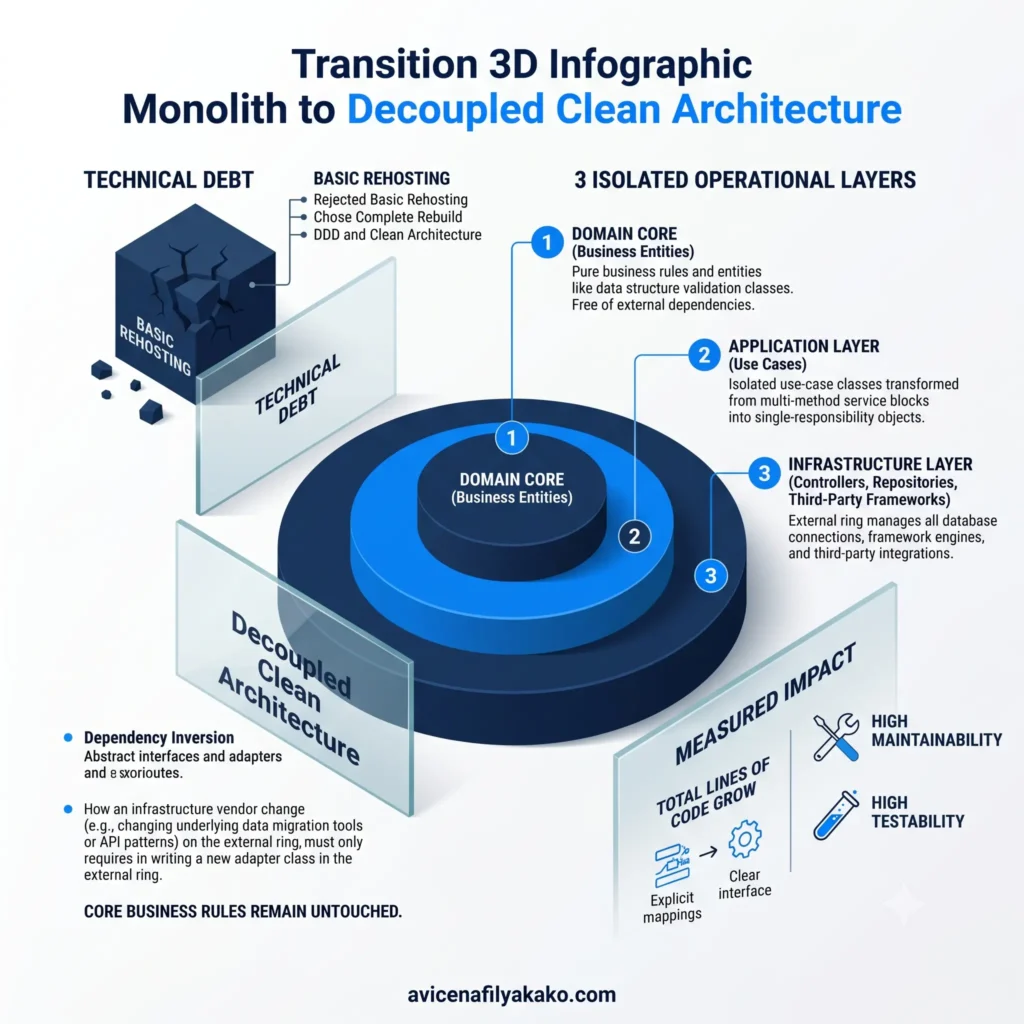
To permanently resolve our technical debt, our engineering team rejected basic rehosting. We chose to completely rebuild the application core using Domain-Driven Design (DDD) and Clean Architecture principles.
We separated the software codebase into three entirely isolated operational layers:
- The Domain Core: This contains pure business rules and entities (such as data structure validation classes). It is completely free of external library dependencies.
- The Application Layer: This layer houses isolated use-case classes transformed from multi-method service blocks into single-responsibility objects.
- The Infrastructure Layer: This external ring manages all database connections, framework engines, and third-party integrations.
Infrastructure Layer
(Controllers, Repositories, Third-Party Frameworks)
Application Layer
(Use Cases)
Domain Core
(Business Entities)
Adhering strictly to SOLID principles required us to depend entirely on abstract interfaces rather than concrete library implementations. If an infrastructure vendor changes their underlying data migration tools or API patterns tomorrow, we only need to write a new adapter class in the external ring. The core business rules remain entirely untouched. This decoupling not only safeguards the codebase but also lays the perfect technical foundation to pivot toward an API-first business model, allowing organizations to easily monetize their core assets through scalable interfaces.
This deep decoupling approach caused our total lines of code to grow due to the introduction of explicit mappings and clear interfaces. However, the gains in code maintainability and testability were immediate and significant.
The Concrete Data: Evaluating Before and After Code Metrics
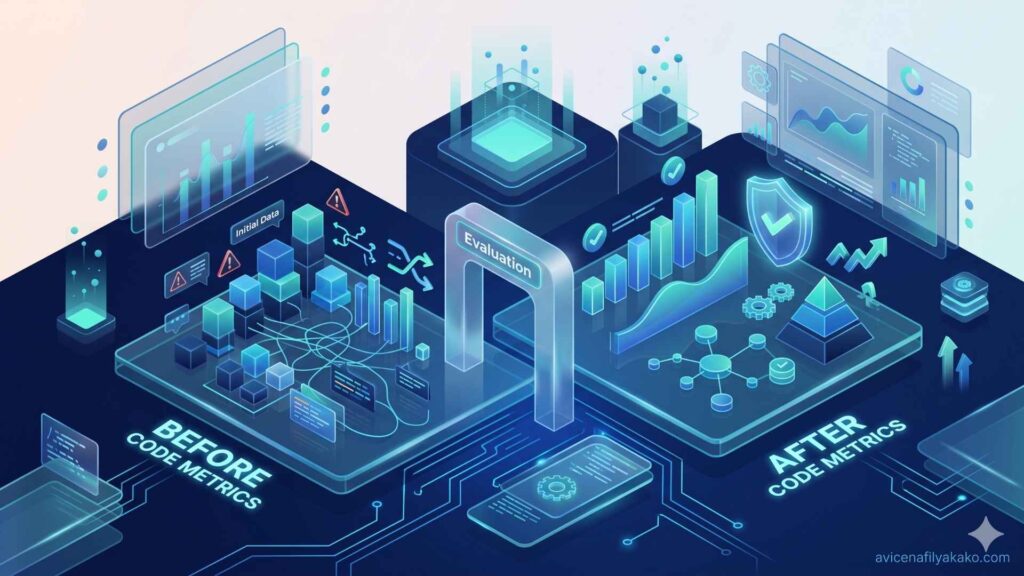
To ensure our engineering assessments were backed by clear evidence, we ran static code evaluations across both systems using SonarQube.
The empirical outcomes of this Clean Architecture refactoring strategy demonstrate clear, undeniable improvements:
| Quality Metric Assessed | Legacy Monolith Environment | Migrated Architecture Environment |
|---|---|---|
| Security Rating | Grade E (Critical Vulnerabilities) | Grade A (Fully Patched) |
| Reliability Rating | Grade E (High Failure Risk) | Grade A (Stable Operations) |
| Total Technical Debt | 4 Days, 2 Hours, 14 Minutes | 4 Hours, 40 Minutes |
| Automated Test Cases | 463 Test Coverage Units | 1,127 Test Coverage Units |
By breaking down large, complex functions into single-purpose components, we expanded our automated test suites by 143%. In the old monolithic framework, isolating components for software verification was nearly impossible due to tightly bound database dependencies.
With our new decoupled setup, developers can instantly run comprehensive unit and integration testing workflows. This structural change dropped our total technical debt score on SonarQube by 95%.
Phased Canary Traffic Shifting: Zero System Downtime Mitigation
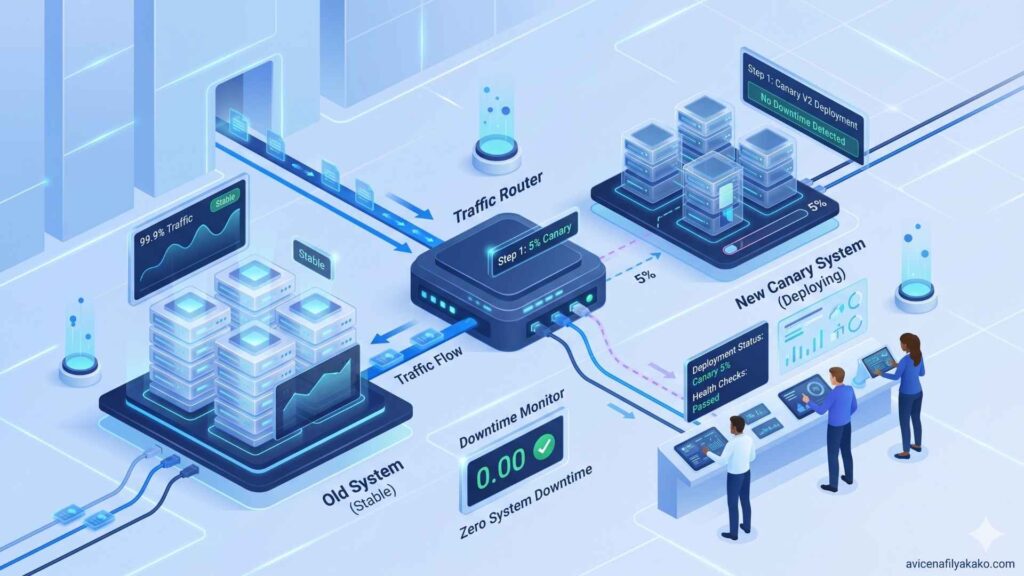
Migrating backend architecture for active global operations requires a careful, highly strategic release methodology. A sudden, single-cutover deployment approach introduces far too much operational risk for high-traffic environments.
We managed this risk by spinning up an identical green production infrastructure, allowing us to run comprehensive data verification loops in parallel. Once validated, we initiated our system downtime mitigation strategy using a strict, phased canary traffic shifting framework.
Legacy Stack
(Java 8 / App Engine 1st Gen)
95% TrafficNew System
(Java 17 / Spring Boot)
5% Canary ShiftWe began by routing a conservative 5% of live production traffic to the new system, monitoring infrastructure logs closely for unexpected edge cases. Most hidden problems—including minor payload incompatibilities within background automation scripts—surfaced during this initial 5% phase, protecting the vast majority of our active users from errors.
We gradually increased the allocation in increments. By the time traffic routing reached 40%, we had verified system performance, eliminated the need for complex rollbacks, and safely cleared all application error logs.
Frequently Asked Questions
How do you modernize a legacy system without breaking business continuity?
You modernize a legacy system by building an independent environment alongside your active platform and slowly transitioning live workloads using phased canary traffic allocation. This allows your team to test system performance under real production conditions, identify bugs early, and isolate errors without triggering widespread service disruptions.
What are the main limitations of legacy systems in high-traffic enterprise applications?
The core limitations include an inherent lack of architectural flexibility, rising maintenance costs, and severe security risks tied to deprecated framework dependencies. Over time, these rigid, tightly coupled codebases prevent your engineering teams from adding modern automated features or scaling data workloads efficiently.
Is a lift-and-shift migration strategy suitable for long-term tech debt reduction?
No, a lift-and-shift migration strategy merely moves your existing software complications to new infrastructure without addressing structural code decay. While rehosting offers a fast way to escape immediate hardware limitations, it leaves your core framework dependencies tightly bound and fails to reduce systemic technical debt.
Substantive Engineering Takeaways
A successful system migration is fundamentally an architectural engineering challenge, not an infrastructure hosting task. Choosing to simply wrap or rehost an aging monolith leaves your business vulnerable to architectural stagnation and future runtime deprecations.
True operational resilience requires immediate, systematic framework decoupling. By investing the upfront engineering effort to isolate your core business logic using Domain-Driven Design and Clean Architecture, you transform your codebase into a flexible business asset. The long-term reward is clear: a highly testable, secure platform built to easily adapt to future technological shifts.
Disclaimer: The information provided in this article is for educational and general informational purposes only and should not be construed as professional advice (such as legal, medical, or financial). While the author strives to provide accurate and up-to-date information, no representations or warranties are made regarding its completeness or reliability. Any action you take based on this information is strictly at your own risk.