

Navigating the world of passive investing often feels like choosing between a perfect replica and a smart shortcut. When you invest in index funds, you expect your portfolio to mirror the performance of a specific benchmark, like the S&P 500. However, buying every single stock in an index isn’t always the most efficient path.
I’ve found that many investors overlook the “how” behind their favorite funds. This is where index fund sampling comes into play. It is a strategic approach where a fund manager buys a representative slice of the index rather than every individual security. Let’s dive into how this optimization works and why it matters for your wallet.
What is Index Fund Sampling?

Think of index funds like a complex soup recipe. Full replication means buying every single ingredient in the exact milligram requested. Sampling, on the other hand, is like a chef who knows they can achieve the same flavor profile by using the most dominant spices and high-quality base ingredients, skipping the microscopic garnishes that don’t change the taste.
In technical terms, sampling involves selecting a subset of securities that match the primary risk factors and characteristics of the broader index. This includes matching industry weights, market capitalization, and dividend yields.
While index managers use sampling to match the yield of a benchmark, investors who prefer a more targeted approach can use a dividend growth investing framework to select specific companies with a proven track record of increasing their payouts over time.
Why Not Just Buy Everything?
- Liquidity Constraints: Some smaller stocks in an index are hard to buy or sell without moving the price.
- Transaction Costs: Every time a fund buys a stock, it pays a small fee. Multiplying that by 500 or 1,000 stocks eats into your returns.
- Efficiency: For massive benchmarks, the smallest companies often have a negligible impact on the overall performance.
Balancing the Expense Ratio and Tracking Error

When you evaluate index funds, two metrics should stay at the front of your mind: the expense ratio and the tracking error. These two forces are often in a tug-of-war.
The expense ratio is the annual fee you pay to the fund manager. Sampling helps keep this low because the fund performs fewer trades. However, if the “sample” doesn’t perfectly mimic the index, you get a tracking error—the difference between the fund’s return and the actual index’s return.
| Strategy | Cost Efficiency | Accuracy | Best For |
|---|---|---|---|
| Full Replication | Lower (Higher Trading Fees) | Highest | Small, Liquid Indices |
| Sampling | Higher (Lower Trading Fees) | Moderate | Large, Fragmented Indices |
| Optimization | Balanced | High | Professional Portfolios |
Maximizing these small percentage gains is the hallmark of a savvy investor; just as you minimize fund fees to keep more of your returns, you can also apply credit card rewards optimization to extract maximum value from your daily overhead and administrative expenses.
As Jack Bogle, the founder of Vanguard, famously said:
“The irony of institutional investing is that a relatively small group of people can achieve better results by doing less.”
Vanguard VOO: A Case Study in Efficiency
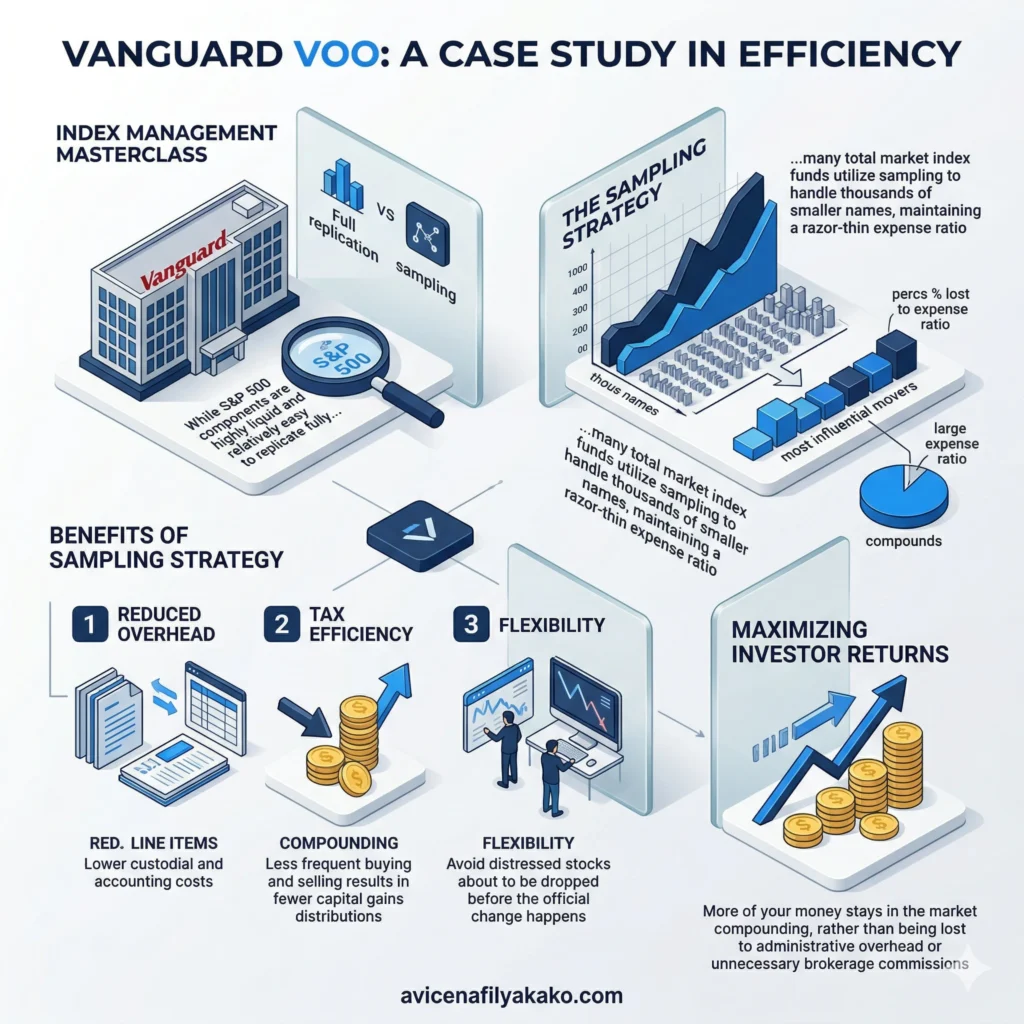
If you look at the Vanguard VOO, you see a masterclass in index management. While the S&P 500 is relatively easy to replicate fully because its components are highly liquid, many total market index funds utilize sampling to handle thousands of smaller names.
By focusing on the most influential movers, these funds maintain a razor-thin expense ratio. For you, the investor, this means more of your money stays in the market compounding, rather than being lost to administrative overhead or unnecessary brokerage commissions.
Benefits of the Sampling Strategy
- Reduced Overhead: Fewer line items mean lower custodial and accounting costs.
- Tax Efficiency: Less frequent buying and selling results in fewer capital gains distributions.
- Flexibility: Managers can avoid “distressed” stocks that are about to be dropped from an index before the official change happens.
How Sampling Impacts Your Portfolio
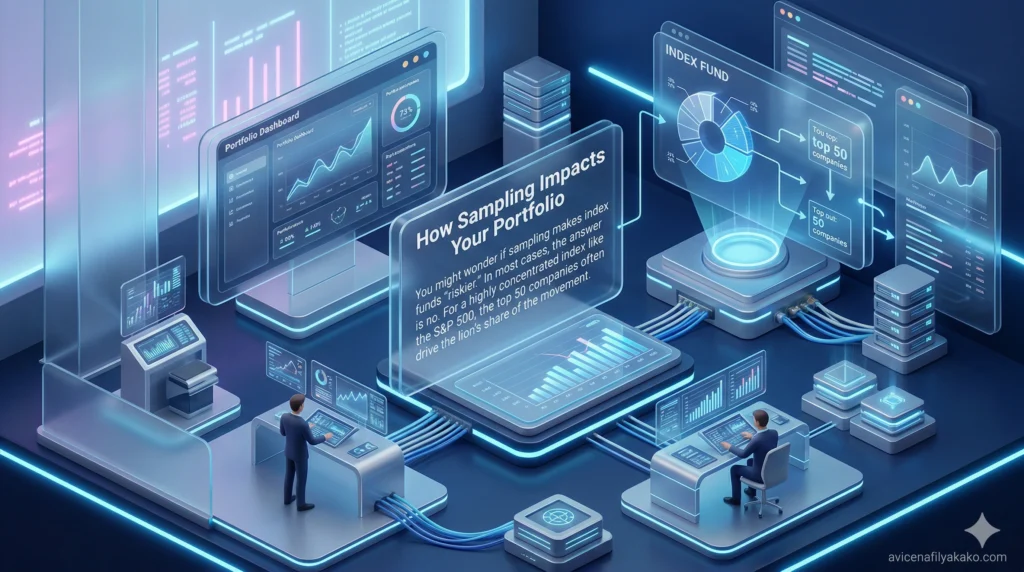
You might wonder if sampling makes index funds “riskier.” In most cases, the answer is no. For a highly concentrated index like the S&P 500, the top 50 companies often drive the lion’s share of the movement.
However, if you are investing in niche sectors or emerging markets, sampling becomes more aggressive. In those cases, I recommend checking the “holdings” count against the “index constituents” count. For a deeper dive into how these fund structures work and the risks involved, you can consult the SEC Guide to Mutual Funds and ETFs.
Frequently Asked Questions
Does index fund sampling increase my investment risk?
No, sampling typically does not significantly increase market risk, provided the fund manager effectively matches the index’s core characteristics. While it introduces a small amount of “manager risk” via the tracking error, the reduction in transaction costs often offsets this, leading to better net returns for you.
How do I know if my fund uses sampling or full replication?
You can find this information in the fund’s prospectus or on the “Product Summary” page of the provider’s website. Look for terms like “Representative Sampling” or “Passive Management Style.” Most large-cap funds like Vanguard VOO lean toward replication, while total market or international funds often utilize sampling.
Is a higher tracking error always a bad thing?
A higher tracking error is generally undesirable for an index investor because it means you aren’t getting the exact performance you “bought.” However, in rare instances, a sampled fund might actually outperform its benchmark slightly due to avoided costs, though you should never count on this as a consistent strategy.
Final Thoughts on Optimizing Your Strategy
Choosing the right index funds requires looking under the hood. Sampling is a sophisticated tool that allows us to access broad markets at a fraction of the cost of traditional active management. By understanding the balance between the expense ratio and the accuracy of the fund, you can build a more resilient, cost-effective portfolio.
Keep your eyes on the data, but don’t sweat the small stuff. In the long run, the time your money spends in the market is far more important than whether your fund holds 495 or 500 of the S&P components.
Disclaimer: The information provided in this article is for educational and general informational purposes only and should not be construed as professional advice (such as legal, medical, or financial). While the author strives to provide accurate and up-to-date information, no representations or warranties are made regarding its completeness or reliability. Any action you take based on this information is strictly at your own risk.
This article was authored by Avicena Fily A Kako, a Digital Entrepreneur & SEO Specialist using AI to scale business and finance projects.