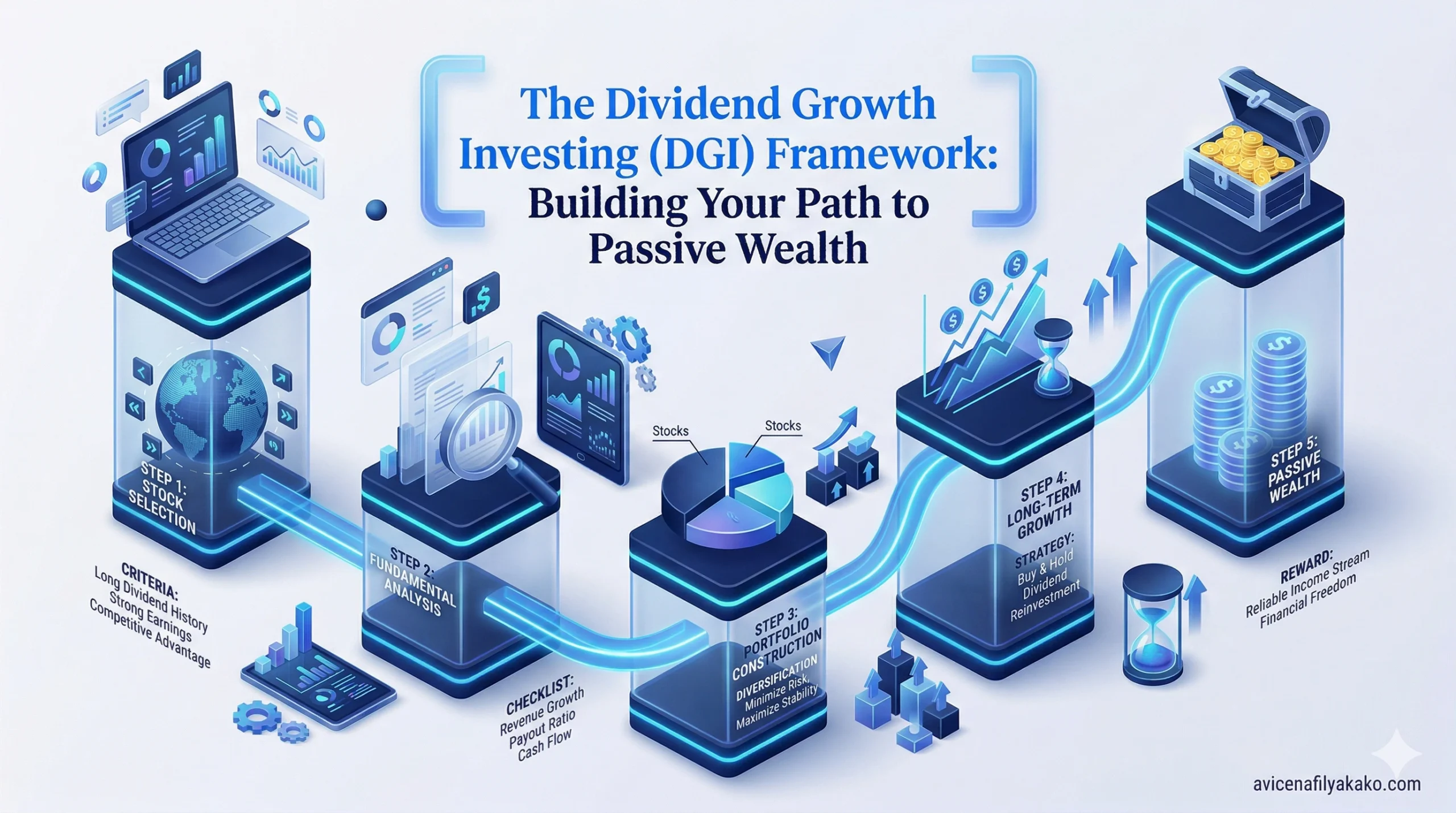
Imagine planting a fruit tree. In the first few years, you nurture it, watering the soil and pruning the branches. Eventually, it starts bearing fruit. But here is the magic of a Dividend Growth strategy: every year, that tree doesn’t just produce fruit; it produces more fruit than the year before, regardless of whether the orchard’s land value goes up or down.
I believe that for most long-term investors, the Dividend Growth framework is the most reliable bridge between a 9-to-5 grind and true financial independence. Unlike speculative trading, DGI focuses on high-quality companies that share their rising profits directly with you.
Why Dividend Growth Beats Chasing High Yields
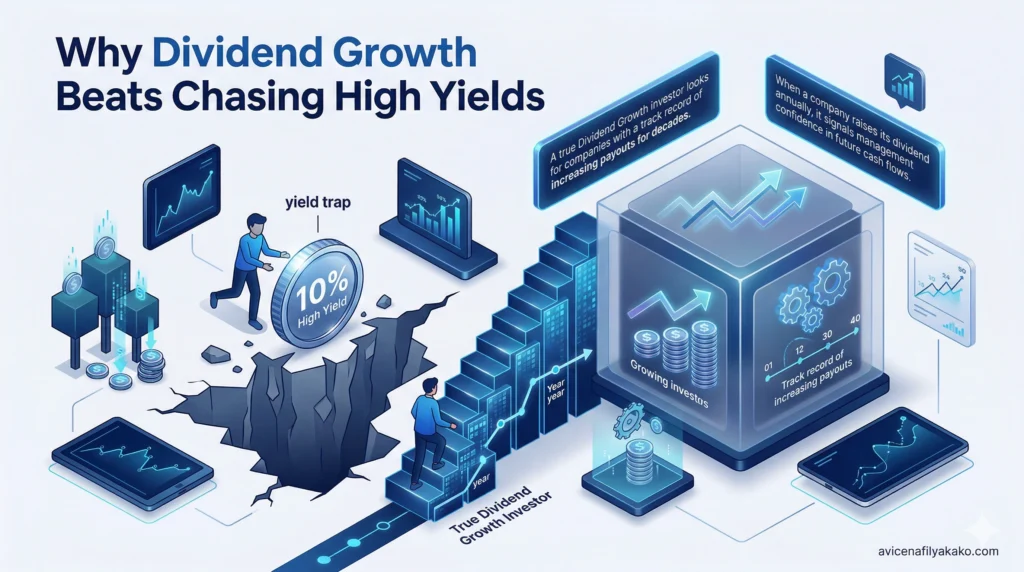
Many beginners fall into the “yield trap.” They see a stock offering a 10% dividend and jump in, only to watch the stock price crumble and the dividend get cut months later. I prefer a more sustainable approach.
A true Dividend Growth investor looks for companies with a track record of increasing payouts for decades. These aren’t just “stable” companies; they are elite compounding machines. When a company raises its dividend annually, it signals to the market that its management is confident in future cash flows.
Instead of chasing immediate payouts, seasoned investors focus on Dividend Growth. Here is why this strategy is a superior engine for long-term wealth.
The “Quality Signal” of Dividend Growth
A true Dividend Growth investor looks for companies with a proven track record of increasing payouts for decades. These aren’t just “stable” businesses; they are elite compounding machines. When a company raises its dividend annually, it sends a powerful signal to the market:
- Cash Flow Confidence: Management is certain that future earnings will be higher than today’s.
- Financial Discipline: The company must remain efficient to fund both its operations and its growing commitment to shareholders.
- Inflation Protection: Growing dividends help protect your purchasing power over time, unlike fixed-income investments.
The Power of the Payout Ratio
To distinguish a sustainable dividend from a “yield trap,” you must analyze the Payout Ratio. This metric represents the percentage of a company’s earnings paid out as dividends. It acts as a safety buffer.
- Low (Under 50%): This is the “Sweet Spot.” It indicates the company retains half its earnings to reinvest in growth while leaving plenty of room for future dividend raises.
- Moderate (50% – 75%): Common for mature companies. It’s stable but offers less room for aggressive dividend hikes.
- High (Over 80%): A “Red Flag” zone. If earnings dip even slightly, the company may be forced to cut the dividend to stay afloat.
Seeking the Dividend Aristocrats
If you want to minimize your “homework” while maximizing quality, start with the Dividend Aristocrats. To earn this title, a company must:
- Be a member of the S&P 500.
- Have increased its dividend for at least 25 consecutive years.
These companies are the “Navy SEALs” of the stock market. They have survived recessions, tech bubbles, and global shifts without missing a single raise. By investing in them, you aren’t just buying a stock; you are buying into a culture of consistent shareholder returns.
The Core Mechanics: Yield on Cost and Compounding

One of the most misunderstood concepts in the Dividend Growth framework is Yield on Cost (YOC). This is where the “get rich slowly” magic actually happens.
Your YOC is the dividend rate you receive based on your original purchase price, not the current market price. If you bought a stock at $100 with a $3 dividend, your yield is 3%. But if ten years later that company is paying a $10 dividend, your Yield on Cost is now 10%, even if the stock price has tripled.
“The direct path to wealth is to invest in businesses that have a wide ‘moat’ and a management team that loves to reward shareholders.” — Inspired by Charlie Munger
Comparing Strategy Outcomes
Below is a comparison of how Dividend Growth performs against traditional high-yield or growth-only strategies over a long horizon.
| Feature | Dividend Growth (DGI) | High Yield Only |
| Primary Goal | Compounding Income | Immediate Cash Flow |
| Risk Level | Moderate / Low | High (Value Traps) |
| Inflation Hedge | Excellent (Rising Payouts) | Poor (Fixed or Flat) |
| Key Metric | Dividend Growth Rate | Current Yield |
3 Steps to Implementing the Dividend Growth Framework
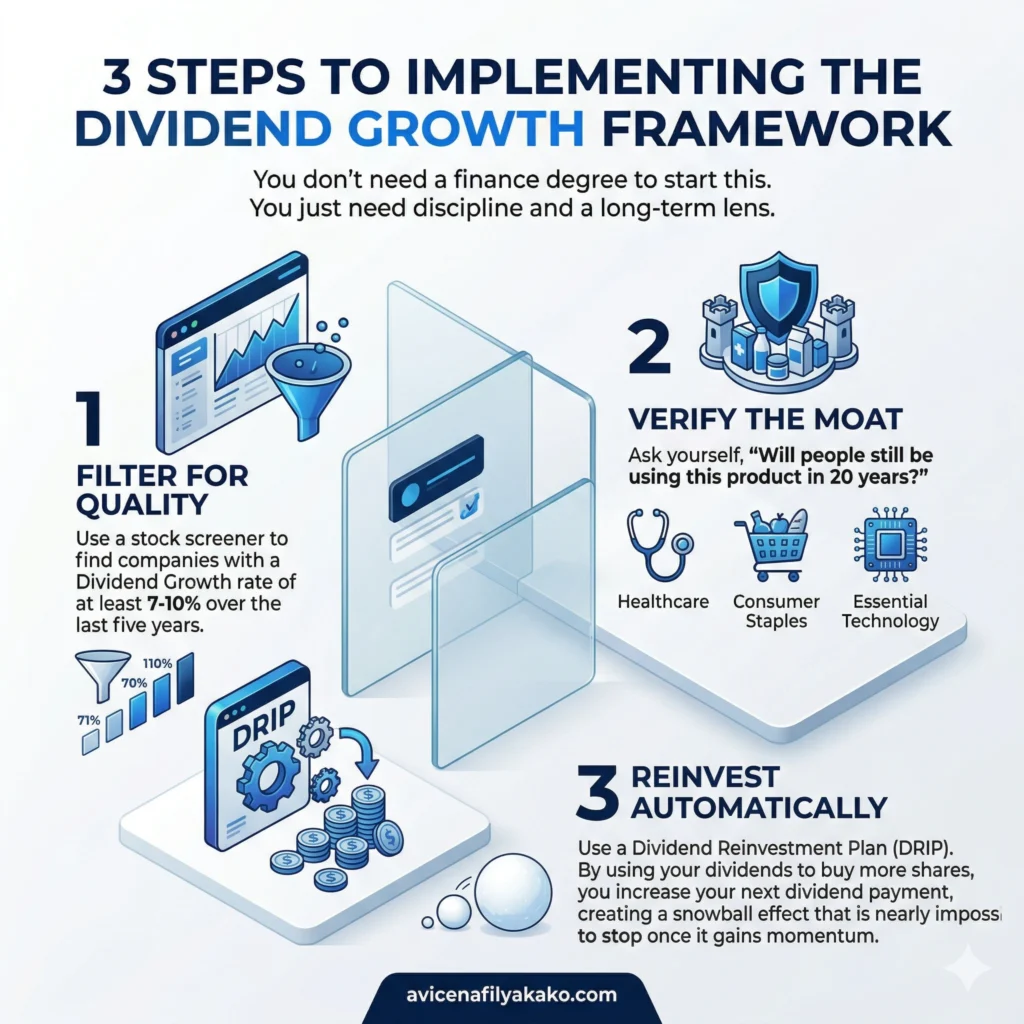
You don’t need a finance degree to start this. You just need discipline and a long-term lens.
- Filter for Quality: Use a stock screener to find companies with a Dividend Growth rate of at least 7-10% over the last five years.
- Verify the Moat: Ask yourself, “Will people still be using this product in 20 years?” Think of healthcare, consumer staples, or essential technology.
- Reinvest Automatically: Use a Dividend Reinvestment Plan (DRIP). By using your dividends to buy more shares, you increase your next dividend payment, creating a snowball effect that is nearly impossible to stop once it gains momentum.
Check the current list of Dividend Aristocrats on S&P Global
Common Pitfalls to Avoid
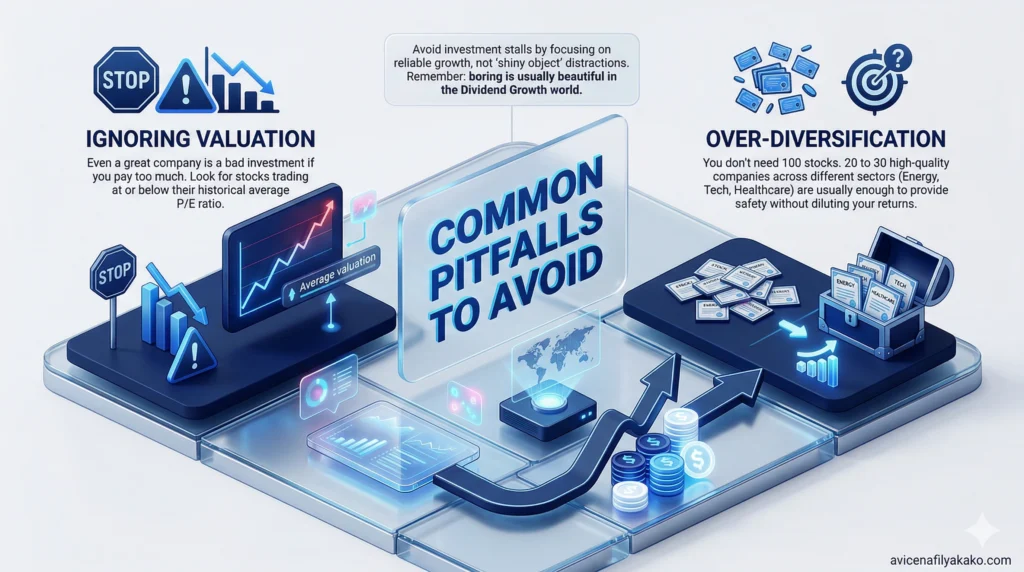
I’ve seen many portfolios stall because investors get distracted by “shiny object” stocks. In the Dividend Growth world, boring is usually beautiful.
- Ignoring Valuation: Even a great company is a bad investment if you pay too much. Look for stocks trading at or below their historical average P/E ratio.
- Over-Diversification: You don’t need 100 stocks. 20 to 30 high-quality companies across different sectors (Energy, Tech, Healthcare) are usually enough to provide safety without diluting your returns.
FAQ: Mastering the Dividend Growth Strategy
What is a good dividend growth rate?
A sustainable and attractive Dividend Growth rate is typically between 7% and 12% annually. While higher rates exist, they are often difficult for a company to maintain over several decades without straining their balance sheet.
Can I retire using only Dividend Growth investing?
Yes, you can retire on dividends by building a portfolio where the annual payout exceeds your yearly living expenses. This “living on the fruit, not the tree” method allows you to preserve your principal capital indefinitely while your income keeps pace with inflation.
Is Dividend Growth investing better than index funds?
Dividend Growth investing offers more control and potentially higher income than a broad index fund, though it requires more active research. While an S&P 500 index fund is great for hands-off investors, a DGI framework focuses specifically on cash-generating companies that often outperform during volatile market cycles.
Disclaimer: The information provided in this article is for educational and general informational purposes only and should not be construed as professional advice (such as legal, medical, or financial). While the author strives to provide accurate and up-to-date information, no representations or warranties are made regarding its completeness or reliability. Any action you take based on this information is strictly at your own risk.
The Dividend Growth framework isn’t about getting rich overnight; it’s about ensuring you never run out of money. By focusing on Yield on Cost, monitoring the Payout Ratio, and sticking to Dividend Aristocrats, you build a financial fortress that pays you to own it. Start small, stay consistent, and let time do the heavy lifting.
This article was authored by Avicena Fily A Kako, a Digital Entrepreneur & SEO Specialist using AI to scale business and finance projects.