

Building a product is expensive; building the wrong product is a catastrophe. If you are familiar with the Lean Startup methodology, you know that the goal is to learn what users actually want as quickly as possible. However, many founders forget that your content needs to be just as lean as your software.
An Minimum Viable Product (MVP) Content strategy isn’t about cutting corners. It is about identifying the minimum amount of information your audience needs to take action. Think of it like a scout team in a football game—it goes out ahead of the main force to see where the openings are before you commit your full resources.
Why You Need an MVP Content Framework
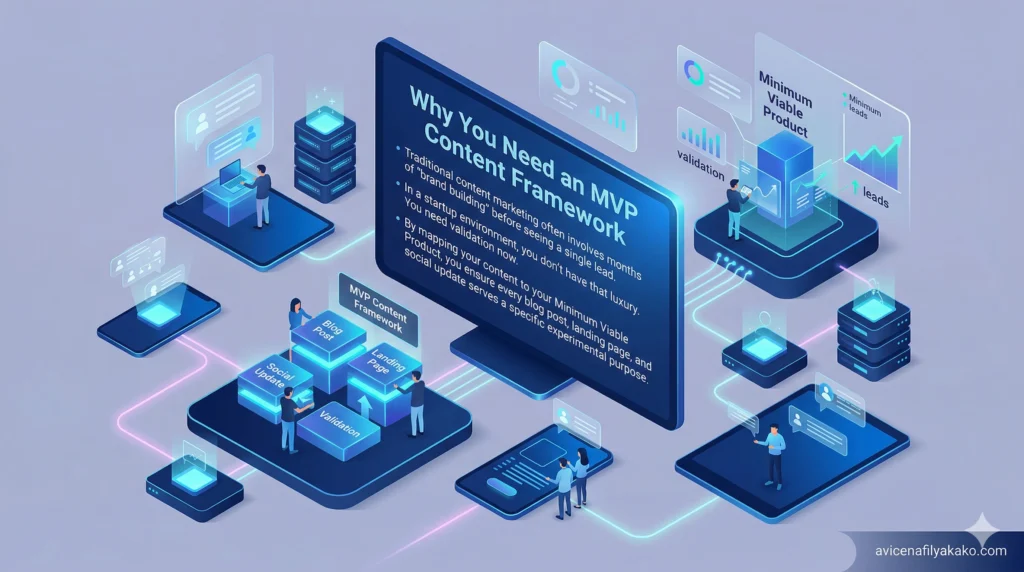
Traditional content marketing often involves months of “brand building” before seeing a single lead. In a startup environment, you don’t have that luxury. You need validation now. By mapping your content to your Minimum Viable Product, you ensure every blog post, landing page, and social update serves a specific experimental purpose.
As Eric Ries, author of The Lean Startup, famously said:
“The only way to win is to learn faster than anyone else.”
Defining Your MVP Content Strategy

To build a map that actually leads to conversion, you must strip away the fluff. Your MVP Content should focus on solving one specific problem for one specific persona. If you try to speak to everyone, you end up speaking to no one—and your data will be too noisy to use.
In a saturated market, your map must offer unique insights; learn how to leverage information gain for a competitive advantage to make your lean content stand out from AI-generated noise.
The Three Pillars of Content Validation
- The Hook: Does the problem you are solving actually resonate?
- The Solution: Is your proposed feature set the right “medicine” for that pain?
- The Transaction: Are users willing to give up an email address or a credit card?
Focusing on these pillars ensures you are targeting revenue-first keywords that prioritize conversion potential over vanity metrics like high search volume.
Comparison: Traditional vs. MVP Content
| Feature | Traditional Content | MVP Content |
|---|---|---|
| Primary Goal | Brand Awareness | Market Validation |
| Production Time | Weeks/Months | Hours/Days |
| Success Metric | Page Views/Shares | Conversion/Feedback |
How to Build Your MVP Content Map
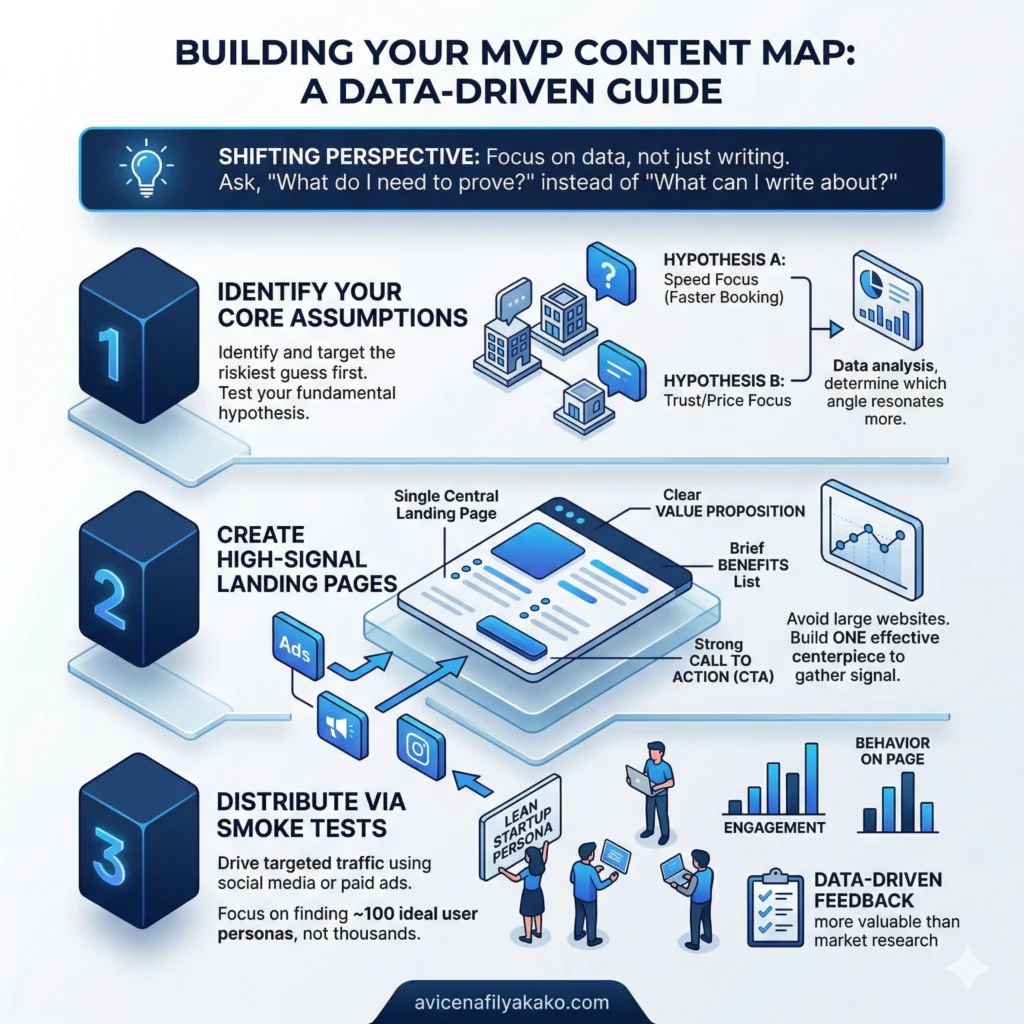
Mapping your content requires a shift in perspective. Instead of asking, “What can I write about?” you should ask, “What do I need to prove?” Here is a step-by-step guide to laying the groundwork.
In a saturated market, your map must offer unique insights; learn how to leverage information gain for a competitive advantage to make your lean content stand out from AI-generated noise.
Step 1: Identify Your Core Assumptions
Every business is built on a pile of guesses. Your MVP Content should target the riskiest guess first. If you assume people want a faster way to book dog walkers, your content should test the “speed” angle versus the “trust” or “price” angle.
Step 2: Create High-Signal Landing Pages
Don’t build a 20-page website. Build one high-converting landing page. This page acts as the centerpiece of your MVP Content map. It should feature a clear value proposition, a brief list of benefits, and a strong call to action (CTA).
Step 3: Distribute via “Smoke Tests”
Use social media or paid ads to drive targeted traffic to your content. You aren’t looking for thousands of hits; you’re looking for 100 people who fit your exact Lean Startup persona. Their behavior on the page will tell you more than a year of market research. For a deeper look at why this initial feedback is critical, check out this guide on the importance of market validation from Harvard Business School.
Optimizing for Conversion and Growth

Once your MVP Content is live, the real work begins. You are now a scientist, not just a writer. You need to look at the “bounce rate” and “time on page” as indicators of whether your message is sticking.
Refining the Narrative
If your MVP Content is getting clicks but no sign-ups, the friction is in your solution. If you aren’t getting clicks at all, the friction is in your hook. Adjust your headlines and core messaging based on this data. This iterative process is the heart of building a Minimum Viable Product that people actually want to buy.
“The goal of an MVP is not to see if a product can be built. It is to see if a product should be built.” — Unknown Industry Expert.
Tools for Mapping Your Content
- Analytics: Use simple heatmaps to see where users stop reading.
- Feedback Loops: Include a “Was this helpful?” button or a simple one-question survey.
- A/B Testing: Test two different versions of your MVP Content headlines to see which drives more validation.
Frequently Asked Questions
What is MVP Content?
MVP Content is the minimum amount of published material—such as landing pages, ads, or articles—required to validate a business hypothesis and trigger user engagement. It focuses on testing market demand before investing heavily in high-production marketing assets.
How does MVP Content help a Lean Startup?
It helps a Lean Startup by reducing the “waste” of time and capital spent on content that doesn’t drive conversion. By testing ideas through short-form content first, founders can pivot their strategy based on real-world data rather than gut feelings.
When should I scale beyond MVP Content?
You should scale your content efforts only after you have achieved “Product-Market Fit” or have seen consistent validation metrics from your initial tests. Once your core message is proven to convert, you can invest in long-form SEO, video production, and broader brand campaigns.
As your validated projects grow into a larger ecosystem, you will eventually need a robust framework for multi-site portfolio management operations to maintain efficiency across different domains.
Disclaimer: The information provided in this article is for educational and general informational purposes only and should not be construed as professional advice (such as legal, medical, or financial). While the author strives to provide accurate and up-to-date information, no representations or warranties are made regarding its completeness or reliability. Any action you take based on this information is strictly at your own risk.
This article was authored by Avicena Fily A Kako, a Digital Entrepreneur & SEO Specialist using AI to scale business and finance projects.