
Chain of verification prompting (CoVe) is a four-step technique that makes a large language model fact-check its own draft: it writes an answer, plans verification questions about each factual claim, answers those questions independently, and then rewrites the answer using only what held up. The method comes from a 2023 Meta AI research paper, where it cut hallucinated facts across list questions, closed-book QA, and long-form biographies, though it never eliminated them.
I look at Chain of Verification as the “double-check” phase of digital thinking. Instead of letting an AI provide a one-and-done answer, we implement a multi-step process that forces the model to audit its own claims. This approach is essential for anyone using AI for research, technical writing, or data analysis where accuracy is non-negotiable.
Why LLMs Hallucinate (and Why Re-Reading the Draft Doesn’t Help)
LLMs are essentially sophisticated word predictors. They don’t look facts up; they calculate the probability of the next token. When a fact is rare in the training data, the most probable continuation is often a plausible substitute: a similar name, a nearby date, a case that sounds real. And once an error is on the page, the model tends to repeat it if it can still see its own draft. That second problem is exactly what CoVe is designed to break.
The CoVe paper shows the gap clearly. In its Wikidata list test, only about 17% of the entities in the model’s first answers were correct, yet roughly 70% of those same entities were answered correctly when the model was asked about each one on its own. The knowledge was often there; the long answer buried it.
By using Chain of Verification, you break the cycle of blind prediction. You are essentially asking the AI to slow down, look at its work, and find its own mistakes before it presents the final result to you.
The 4-Step Architecture of Chain of Verification
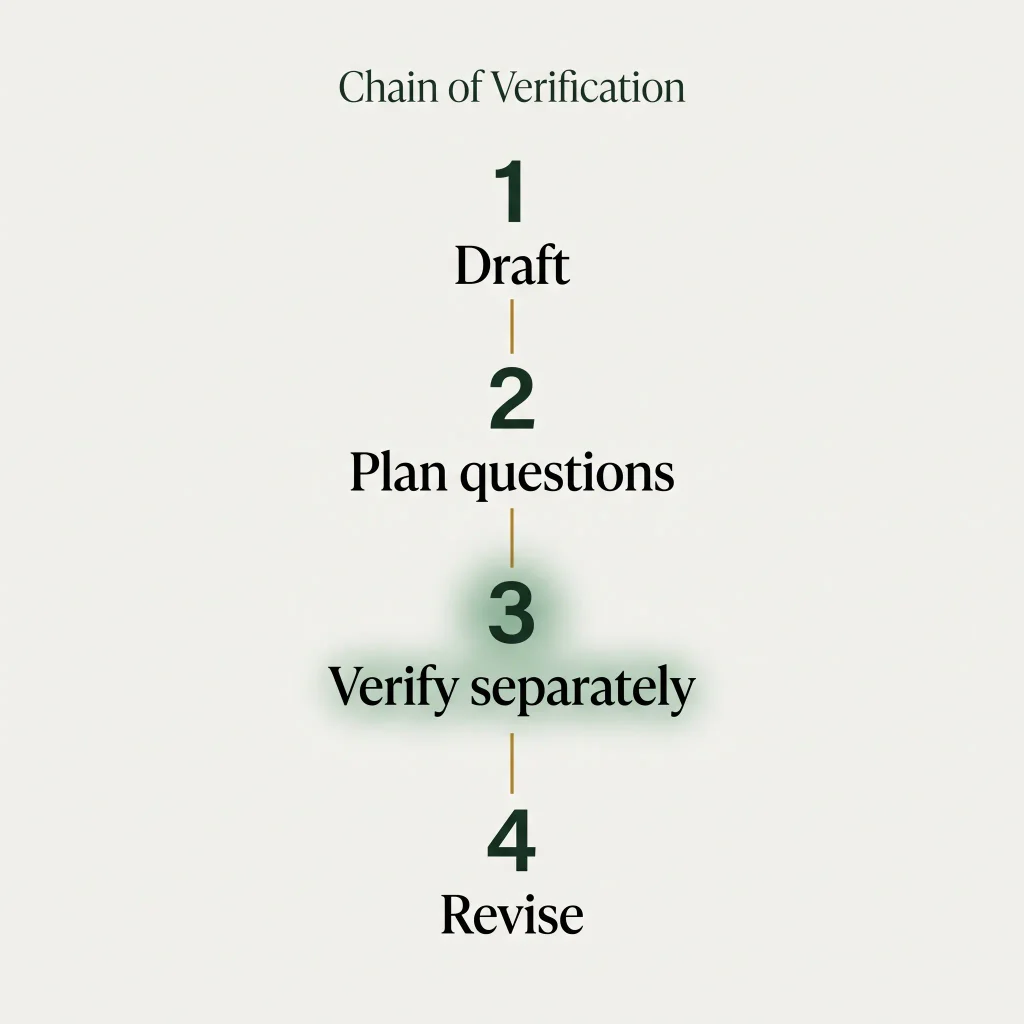
Implementing Chain of Verification isn’t about a single prompt; it’s a workflow. Here is how I break down the architecture to ensure maximum hallucination reduction:
- Draft Initial Response: The AI generates a baseline answer to your query.
- Plan Verification Questions: The AI identifies the factual claims in its draft and generates questions to verify them.
- Execute Independent Verification: Each question is answered separately, ideally without the original draft in view, so the model cannot simply copy its own mistakes. The paper calls this the “factored” approach, and it outperformed the single-prompt version on every task tested.
- Final Verified Output: The AI compares the initial draft against the verified facts and produces a corrected response.
Before diving into the multi-step workflow, it is helpful to understand how to categorize different AI behaviors by learning the taxonomy of deliberate prompting to better structure your AI interactions.
Comparison: Standard Prompting vs. Chain of Verification
| Feature | Standard Prompting | Chain of Verification |
|---|---|---|
| Accuracy | Variable (prone to hallucinations) | Higher on fact-heavy tasks (fewer hallucinations, not zero) |
| Process | Single-shot generation | Draft, verify, revise |
| How errors are caught | They aren’t, unless you spot them | Each claim is re-asked as a separate question |
| Cost | One prompt | Several prompts (more tokens and time) |
While CoVe focuses on post-generation auditing, you can further enhance accuracy by using the step-back prompting method to help the model identify high-level concepts before answering complex questions.
How to Implement Chain of Verification in Your Workflow
You don’t need to be a developer to use Chain of Verification. You can implement it manually through a structured “meta-prompting” technique. Here is a practical guide on how you can apply this today.
Step 1: The Fact-Extraction Phase
Start by asking the AI to list the core claims in its previous response. For example: “Identify every specific date, name, and statistic you just provided.” This forces the model to acknowledge its own “knowledge anchors.”
This extraction process is more effective when you utilize semantic discovery prompts to uncover the underlying relationships between the data points the AI has generated.
Step 2: The “Devil’s Advocate” Prompt
Once the facts are listed, use a prompt like this: “For each claim, write one open question that would expose it if it were wrong. Ask for the fact itself, not a yes/no confirmation.” So instead of “Was the law passed in 2019?”, the question becomes “When was the law passed?” This matters more than it looks: in the CoVe paper, open questions beat yes/no versions, because models tend to agree with whatever a yes/no question already asserts.
Step 3: Answer Each Question in a Fresh Chat
Copy the verification questions, open a new chat, and paste only the questions, not the draft. Ask the model to answer each one briefly and on its own. This separation is the core of the method: a model that cannot see its draft has no reason to defend it.
Step 4: Rewrite Using Only What Held Up
Go back to the original chat, paste the independent answers, and use a prompt like this: “Here are independent answers to your verification questions. Rewrite your original response so it keeps only the claims consistent with these answers. Remove or flag anything that conflicted or could not be confirmed, and list what you changed.” That list of changes is your audit trail for the final human check.
The Benefits of Chain of Verification for AI-Assisted Content
If you publish AI-assisted content, CoVe is a cheap first filter before human review. Readers and search engines both reward accuracy over time, and every wrong claim you catch before publishing is one you never have to retract.
- Hallucination Reduction: By isolating facts from the narrative, you reduce the “confabulation” effect where the AI fills in gaps with fiction.
- Fewer Repeated Mistakes: Because each fact is re-asked on its own, the model is less likely to carry an early error through the whole answer.
- Audit Trails: The verification questions and answers stay visible, so you can see which claims were checked and which ones changed, a useful map for your final human review. They are not citations, though: CoVe does not tell you where a fact came from.
Limitations: Where Chain of Verification Stops
CoVe is a filter, not a fact source. The paper’s own authors are clear about where it falls short:
- It reduces hallucinations; it does not remove them. The final answer can still contain errors.
- It targets factual errors only. Flawed reasoning steps and slanted opinions are outside what the method was tested on.
- It costs more. Every extra verification prompt adds tokens and waiting time.
- It can’t know what the model doesn’t know. Verification uses the same model, so the ceiling is that model’s own knowledge. On very rare facts, a retrieval-based tool still did better in the paper’s tests. If you work with your own documents, pairing CoVe with a personal RAG setup that searches your PDF library covers much of that gap.
A Legal Case Study: Mata v. Avianca
The clearest warning comes from a courtroom. In Mata v. Avianca, Inc., 678 F. Supp. 3d 443 (S.D.N.Y. 2023), lawyers filed a brief citing six court decisions that ChatGPT had invented, and the court imposed a $5,000 sanction. One detail matters for anyone using CoVe: when the citations were questioned, the attorney went back to ChatGPT to confirm the cases were real. That is self-verification with no outside source, and it failed exactly where it needed to work.
My takeaway, coming from legal studies: use Chain of Verification to decide what to check, then check it against a primary source, whether that is a court database, an official statute, or the original dataset.
Source: Dhuliawala et al., “Chain-of-Verification Reduces Hallucination in Large Language Models”, Meta AI, Findings of ACL 2024 (arXiv:2309.11495).
FAQs on Chain of Verification
Does Chain of Verification eliminate all AI errors?
No. Chain of Verification reduces hallucinated facts, but it does not remove them, and it does not check flawed reasoning. Because the same model answers its own verification questions, it cannot catch errors it confidently believes. Treat it as a filter, then confirm critical claims against a primary source.
Is CoVe the same as Chain of Thought (CoT) prompting?
No. Chain of Thought asks a model to reason step by step before it answers; Chain of Verification checks the facts in an answer after it is written. They target different problems. In the original CoVe paper, adding “Let’s think step by step” did not reduce hallucinations on fact-heavy tasks, while CoVe did.
Can I use CoVe for creative writing?
Yes, you can use Chain of Verification in creative contexts to maintain internal consistency in world-building or character history. It helps prevent “plot holes” by verifying that a new scene doesn’t contradict facts established earlier in your story or script.
How many prompts does Chain of Verification need?
At minimum three: one to draft, one to plan verification questions, and one to rewrite. The stronger “factored” version adds a separate prompt for each verification question, run without the draft in view. It costs more tokens and time, but in the original paper it consistently beat doing everything in a single prompt.
Can Chain of Verification check legal citations or statistics?
Only partly. CoVe relies on the model’s own knowledge, so it can flag a suspicious citation or number but cannot prove that a case, statute, or statistic exists. For anything you will file, publish, or rely on financially, the verification step has to end at a primary source, such as a court database, official gazette, or original dataset.
Summary of Best Practices
To get the most out of Chain of Verification, keep these tips in mind:
- Be Granular: The more specific the verification questions, the better the result.
- Ask, Don’t Confirm: Phrase verification questions as open questions, not yes/no prompts the model can simply agree with.
- Isolate Tasks: If possible, perform the verification in a new chat window to avoid the model trying to “agree” with its previous mistakes.
- Human-in-the-Loop: Use CoVe to do the heavy lifting, but always verify the final statistics yourself.
By integrating these habits, you turn AI from a confident guesser into a draft you can actually audit.
If you publish AI-assisted content and want verification built into the workflow rather than bolted on at the end, here is how I work with clients on SEO and GEO. For more prompting frameworks, browse the AI Insight hub.
Disclaimer: The information provided in this article is for educational and general informational purposes only and should not be construed as professional advice (such as legal, medical, or financial). While the author strives to provide accurate and up-to-date information, no representations or warranties are made regarding its completeness or reliability. Any action you take based on this information is strictly at your own risk.
This article was authored by Avicena Fily A Kako, a Digital Entrepreneur & SEO Specialist using AI to scale business and finance projects.