
Investing in real estate has long been the “gold standard” for building generational wealth. However, the path you choose—buying a physical property or investing in REITs—fundamentally changes how your cash flow looks at the end of the month.
Think of physical real estate like owning a car you drive yourself; you control the route, but you’re also responsible for the repairs. REITs, or Real Estate Investment Trusts, are more like a ride-sharing service. You get to the same destination (real estate exposure), but someone else handles the maintenance and navigation while you sit back and collect the dividends.
Understanding the Cash Flow Mechanics of REITs

When you invest in REITs, you are essentially buying shares of a company that owns, operates, or finances income-producing real estate. To maintain their tax-advantaged status, REITs are legally required to distribute at least 90% of their taxable income to shareholders in the form of dividends.
The Power of FFO (Funds From Operations)
In the world of REITs, traditional “Net Income” is often a misleading metric because it includes non-cash depreciation. Instead, you should look at FFO (Funds From Operations).
FFO adds depreciation back into the earnings and subtracts gains on sales, providing a much clearer picture of the actual cash generated. As billionaire investor Sam Zell once noted:
“In the world of real estate, cash flow is the only thing that matters. Everything else is just conversation.”
Diversification Through Mortgage REITs
While equity REITs own buildings, Mortgage REITs (mREITs) provide financing for real estate by purchasing or originating mortgages and mortgage-backed securities. This allows you to earn interest income rather than rental income, often resulting in higher dividend yields, though they come with increased sensitivity to interest rate fluctuations.
Physical Real Estate: The Hands-On Approach

Owning a physical rental property offers a level of control that REITs simply cannot match. You decide who the tenants are, what the rent should be, and how to improve the property’s value.
Calculating Your Return: The Cap Rate
To analyze the efficiency of a physical property, you must master the Cap Rate (Capitalization Rate). This is calculated by dividing the Net Operating Income (NOI) by the current market value of the property.
Cap Rate=Property ValueNet Operating Income
A high Cap Rate suggests a better potential return on investment, but it often correlates with higher risk or lower-quality neighborhoods.
The Hidden Costs of Tangibility
Physical real estate provides “passive” income that often feels quite active. You must account for:
- Property Management: Typically 8-12% of gross rent.
- Maintenance Reserves: The “leaky toilet” factor.
- Vacancy Risk: A single empty unit means 0% cash flow for that month.
Head-to-Head: Which Is Better for Your Wallet?

Deciding between these two paths depends on your liquidity needs and your appetite for “sweat equity.”
Comparing Key Metrics
| Feature | REITs | Physical Real Estate |
|---|---|---|
| Liquidity | High (Sell shares instantly) | Low (Months to close a sale) |
| Management | Professional (Hands-off) | Self or Third-party (Hands-on) |
| Minimum Entry | Low ($10 – $1,000) | High (Down payments/Closing costs) |
Why You Might Choose REITs
REITs are the ultimate tool for investors who value their time. You can gain exposure to data centers, hospitals, and cell towers—sectors that are nearly impossible for individual investors to enter physically. Furthermore, the REITs structure allows for instant diversification across hundreds of properties.
Why You Might Choose Physical Property
Physical real estate is a “leverage play.” You can use a bank’s money (a mortgage) to control a much larger asset. If you put 20% down on a $500,000 home and it appreciates by 5%, your actual return on cash is 25%. You can’t get that same margin of safety and leverage with REITs easily.
Tactical Tips for the Modern Investor
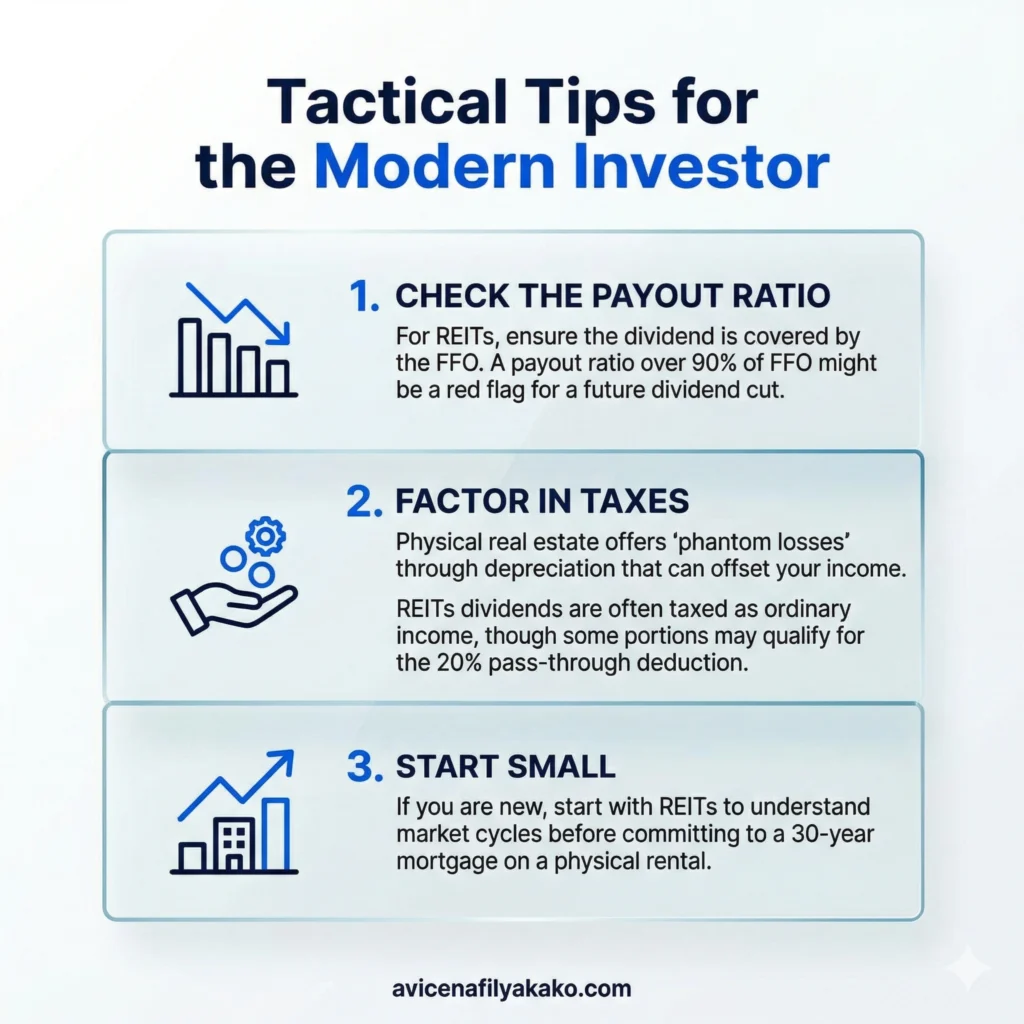
- Check the Payout Ratio: For REITs, ensure the dividend is covered by the FFO. A payout ratio over 90% of FFO might be a red flag for a future dividend cut.
- Factor in Taxes: Physical real estate offers “phantom losses” through depreciation that can offset your income. REITs dividends are often taxed as ordinary income, though some portions may qualify for the 20% pass-through deduction.
- Start Small: If you are new, start with REITs to understand market cycles before committing to a 30-year mortgage on a physical rental.
SEC Investor Bulletin on Real Estate Investment Trusts
Frequently Asked Questions
Are REITs safer than physical real estate?
REITs are generally considered less risky in terms of diversification and liquidity, but they are more volatile because their prices fluctuate daily with the stock market. Physical real estate is less volatile on paper because you don’t see a “price ticker” every day, but it carries high “concentration risk” if something happens to that specific property or neighborhood.
How does inflation affect these investments?
Both assets act as strong inflation hedges because rents typically rise as consumer prices increase. REITs with short-term leases (like hotels or apartments) can adjust prices quickly, while physical landlords with long-term leases might lag behind until the lease expires.
Can I use a 1031 exchange with REITs?
No, you generally cannot use a 1031 exchange to defer capital gains when selling REITs shares. This tax-saving strategy is reserved for “like-kind” physical property exchanges, making physical real estate a more powerful tool for long-term tax deferral.
Disclaimer: The information provided in this article is for educational and general informational purposes only and should not be construed as professional advice (such as legal, medical, or financial). While the author strives to provide accurate and up-to-date information, no representations or warranties are made regarding its completeness or reliability. Any action you take based on this information is strictly at your own risk.
This article was authored by Avicena Fily A Kako, a Digital Entrepreneur & SEO Specialist using AI to scale business and finance projects.